Reviewed for accuracy and claims compliance: Claims and compliance review
Here is a problem you cannot solve by reading a label more carefully.
Two botanically unrelated plants are both routinely sold in India under the name “brahmi”.
They belong to different families. They contain entirely different active compounds. They have different bodies of evidence. And one of them has liver injury case reports in the international literature while the other does not.
And a label that says only “Brahmi 500 mg” has not told you which one you are swallowing.
This is not a rare technicality. It is one of the most consequential naming collisions in Ayurvedic materials, and it survives because both plants have a classical reputation for the mind, which makes the substitution feel harmless to everyone in the chain.
General information, not medical advice. The liver case reports concern gotu kola and they are the single most important reason to know which plant is in your capsule.
The two plants
Bacopa monnieri
Family Plantaginaceae. A small creeping marsh plant with succulent leaves and small white or pale blue flowers, growing in wet ground and shallow water across India.
Hindi and common names: brahmi, jalnim, jal-brahmi, neerbrahmi.
And this is the plant that the Ayurvedic Pharmacopoeia of India identifies as Brahmi. In formal pharmacopoeial terms, brahmi means Bacopa monnieri. That is the authoritative position and it is worth knowing.
Active compounds: bacosides, a group of triterpenoid saponins. Bacoside A is itself a mixture (including bacoside A3, bacopaside II and bacopasaponin C), which matters for standardisation. Extracts are typically standardised to 20–55% bacosides.
Taste: distinctly bitter.
Centella asiatica
Family Apiaceae, the carrot and coriander family. A completely different plant. Small, round to kidney-shaped scalloped leaves on creeping runners, growing in damp shady ground.
Names: gotu kola, mandukaparni, and, this is the collision, “brahmi” or “brahmi manduki” across Bengal, parts of eastern and northern India, and in common usage well beyond.
And the Ayurvedic Pharmacopoeia identifies this plant as Mandukaparni. So in formal terms the names are distinct; in the market they are not.
Active compounds: triterpenes, asiaticoside, madecassoside, asiatic acid, madecassic acid. Chemically unrelated to bacosides.
Taste: mild, slightly bitter, grassy. Eaten as a leafy vegetable and in chutneys in several regions.
Why the confusion persists
Four reasons, and understanding them tells you how to protect yourself.
1. Both have a classical medhya reputation. Medhya means promoting intellect and memory. Brahmi and mandukaparni both appear in that category in classical literature, so to a traditional practitioner, substituting one for the other is not obviously wrong. The classical system itself treats them as related in function, which is exactly why the names blurred.
2. Regional naming is genuinely different. In Bengal, “brahmi” commonly means Centella. This is not an error on anyone’s part; it is a different regional tradition, and traders in a national market inherit both usages.
3. Both grow in damp ground and are collected wild, sometimes from the same sites, sometimes by the same collectors.
4. And Centella is often cheaper and more abundant, which supplies the commercial incentive when the names already overlap.
None of those reasons makes it acceptable in a modern labelled product. A supplement is sold with a quantity and an implied specification. It should name the plant.
What the evidence says, and here they genuinely differ
This is where the substitution stops being a semantic issue.
Bacopa monnieri, for memory, the better-evidenced of the two
And in fairness, among nootropic botanicals generally, bacopa has one of the more respectable evidence bases.
There are multiple randomised controlled trials, and meta-analyses have found modest improvements in memory measures, particularly delayed word recall, which is a measure of memory acquisition and retention rather than attention or processing speed.
The dosing in those trials is consistent: typically around 300 mg a day of a standardised extract, for 12 weeks.
And the single most important finding, which almost no marketing mentions: the effect is not acute. Trials that dosed bacopa once and tested shortly after found nothing. The benefit appears over weeks, commonly described as emerging by around 8 to 12 weeks. We have written a separate article on that time-course, because it determines whether taking it is worth your money.
Honest limits: effect sizes are modest, trials are mostly small, populations vary (healthy older adults, healthy young adults, children in a few studies), and the measures that improve are specific rather than general. “Improves memory” overstates what “improved delayed word recall on a list-learning task” means in daily life.
Centella asiatica, better evidence elsewhere
Its strongest evidence is not cognitive at all.
Wound healing and skin, asiaticoside and madecassoside have genuine supporting work, and Centella extracts are widely used in dermatology and cosmetics. This is where the plant earns its reputation.
Venous insufficiency, there is a body of work, some of it reasonably old, on Centella extracts for symptoms of chronic venous insufficiency, with modest findings.
Cognition, some studies exist, and they are fewer, smaller and weaker than bacopa’s.
So substituting Centella for Bacopa in a memory product is not a neutral swap. You are replacing the better-evidenced ingredient for that purpose with a less-evidenced one, while keeping the price and the claim.
And the safety profiles are not the same
This is the section that matters most, and it is the reason we think this article needs to exist.
Bacopa monnieri
Gastrointestinal effects are common and are the main practical issue: nausea, abdominal cramping, bloating, loose stools, dry mouth. Taking it with food reduces this substantially and is the standard advice.
Fatigue or sedation in some people.
Thyroid, animal studies have reported increases in thyroid hormone (T4). So in thyroid disease, or on levothyroxine, this is worth mentioning to your doctor. It is a caution based on animal data, not established human harm, and it is a real enough signal to raise.
Cholinergic activity, bacopa has acetylcholinesterase-inhibiting activity reported, which is relevant if you take a cholinesterase inhibitor such as donepezil (additive effect) or an anticholinergic medicine (opposing effect).
Possible heart rate and calcium channel effects have been reported, so mention it if you take a calcium channel blocker such as amlodipine.
Pregnancy and breastfeeding, insufficient data, so no.
Centella asiatica
And here is the finding that makes the confusion genuinely unsafe:
There are published case reports of hepatotoxicity, liver injury, associated with oral gotu kola use.
They are case reports, not a large signal, and they are real enough that regulatory and pharmacovigilance sources list liver injury among the concerns for oral Centella.
So:
If you have liver disease, or take a medicine with liver concerns, oral Centella is a question for your doctor.
And if you are taking a product labelled only “brahmi”, you do not know whether you are taking the plant with that concern. That is the whole argument of this article in two sentences.
Other Centella cautions: sedation, and additive effects with sedatives; contact dermatitis with topical use in some people; pregnancy, avoid.
How to protect yourself
Demand the botanical name on the label. “Brahmi (Bacopa monnieri)” or “Mandukaparni (Centella asiatica)”. A product that prints only a common name has told you nothing identifiable.
And this is not a courtesy, it is basic pharmacopoeial practice, because the entire point of a botanical name is that it is unambiguous.
Check the part used. Bacopa: whole plant or aerial parts. Centella: leaves or whole plant.
Look for the standardisation marker, which is itself a tell:
Bacosides named on the label → the product is Bacopa. Asiaticosides or madecassoside named → it is Centella. Neither named → nobody has committed to anything.
And in bulk purchasing or private-labelling, this is a specification question with a specification answer: botanical identity confirmation on incoming raw material, macroscopic and microscopic identification, and TLC or HPLC against a reference. Not a supplier’s word, and not the name on the invoice. We have written about what else belongs in that conversation separately.
Leaf shape is also genuinely diagnostic if you ever see the raw herb: Bacopa has small, thick, smooth, oblong succulent leaves. Centella has round to kidney-shaped leaves with scalloped edges. They do not look remotely alike. The confusion lives entirely in powder and capsule form.
Which one do you actually want
For memory and cognition: Bacopa monnieri, standardised to bacosides, around 300 mg a day, for at least 8 to 12 weeks, and with realistic expectations about what “modest improvement in delayed recall” means.
For skin, wound healing or venous symptoms: Centella asiatica has the better case, and topically its evidence is stronger than orally.
For a child: we would say neither, without a paediatrician, and we have written separately about why the children’s memory product category is one we decline to serve.
And in pregnancy: neither.
What we will and will not say
Sayable: the botanical name and part used; a traditional-use statement framed as traditional use, including the classical medhya designation described as a classical designation; the standardisation marker and quantity; and authorised claims for any vitamins or minerals present.
And the governing fact: there is no authorised health claim for either plant. Not for memory, not for concentration, not for brain health.
Not sayable: improves memory, increases IQ, treats Alzheimer’s or dementia, improves academic performance, cures anxiety, “brain tonic” in a medicinal sense.
And a specific refusal: we will not supply a product labelled only “brahmi” without the botanical name. For a client who wants that, the answer is no, and the reason is this article. It costs us work occasionally. The alternative is participating in a substitution that has a liver signal attached to one side of it.
And the most honest summary:
“Brahmi” in India can mean either Bacopa monnieri or Centella asiatica. They are unrelated plants with unrelated chemistry.
Bacopa has the better memory evidence and a mostly gastrointestinal side-effect profile. Centella has better skin and venous evidence and liver injury case reports.
The pharmacopoeia distinguishes them. The market does not. And a label printing only the common name is asking you to accept whichever one arrived.
When to see a doctor
Before starting either, if you:
- are pregnant or breastfeeding, neither
- have liver disease, particularly relevant for Centella, and relevant to not knowing which you have
- have thyroid disease or take levothyroxine, bacopa’s animal thyroid data
- take donepezil or another cholinesterase inhibitor, or an anticholinergic medicine
- take a calcium channel blocker such as amlodipine
- take sedatives, Centella sedation
- have a slow heart rate
- want to give it to a child, see a paediatrician first
Stop and get checked urgently: yellowing of the eyes or skin, dark urine, persistent nausea, right-upper-abdominal pain or unusual fatigue, possible liver injury. Tell the doctor exactly what you were taking, and bring the pack, because “brahmi” alone will not tell them which plant to consider.
Get a diagnosis rather than a supplement if you have: memory loss that is worsening, or that others have noticed; getting lost in familiar places; difficulty with words; personality change, these need assessment, and reversible causes including thyroid disease, vitamin B12 deficiency, depression, sleep apnoea and medication effects are found often enough to make the check worth it. Delay is the harm here, not the herb.
The short version
- Two unrelated plants are both sold in India as “brahmi”
- They differ in family, chemistry, evidence and safety profile
- A label saying only “Brahmi 500 mg” has not told you which one
- The Ayurvedic Pharmacopoeia identifies brahmi as Bacopa monnieri
- And identifies Centella asiatica as mandukaparni
- In Bengal and elsewhere, “brahmi” commonly means Centella, a different regional tradition, not an error
- Bacopa is in Plantaginaceae; Centella is in Apiaceae, the carrot family
- Bacopa’s actives are bacosides, triterpenoid saponins
- Bacoside A is itself a mixture, which complicates standardisation
- Extracts are standardised to 20–55% bacosides
- Centella’s actives are asiaticoside and madecassoside, chemically unrelated
- Both are classically medhya, which is why the names blurred
- Centella is often cheaper and more abundant, that is the commercial incentive
- Bacopa has the better memory evidence: multiple RCTs and meta-analyses
- Improvements are mainly in delayed word recall, not general brainpower
- Trial dosing is typically 300 mg/day of standardised extract for 12 weeks
- The effect is not acute, single doses showed nothing
- Benefit emerges over roughly 8 to 12 weeks
- Centella’s strongest evidence is skin and wound healing, not cognition
- It also has work on chronic venous insufficiency
- So substituting it in a memory product swaps the better ingredient for a weaker one
- Bacopa’s common side effects are gastrointestinal, take it with food
- Animal studies report bacopa raising thyroid T4, mention it on levothyroxine
- Bacopa has cholinergic activity, relevant with donepezil or anticholinergics
- Reported heart-rate and calcium channel effects, mention amlodipine
- There are published case reports of liver injury with oral gotu kola
- So an unlabelled “brahmi” may be the plant with a liver signal
- Demand the botanical name, that is what botanical names are for
- Bacosides on the label means Bacopa; asiaticosides means Centella
- Neither named means nobody committed to anything
- Bacopa has small thick oblong leaves; Centella round scalloped ones
- The confusion exists only in powder and capsule form
- In bulk, require macroscopic, microscopic and TLC/HPLC identity confirmation
- Neither plant in pregnancy; neither for a child without a paediatrician
- There is no authorised health claim for either
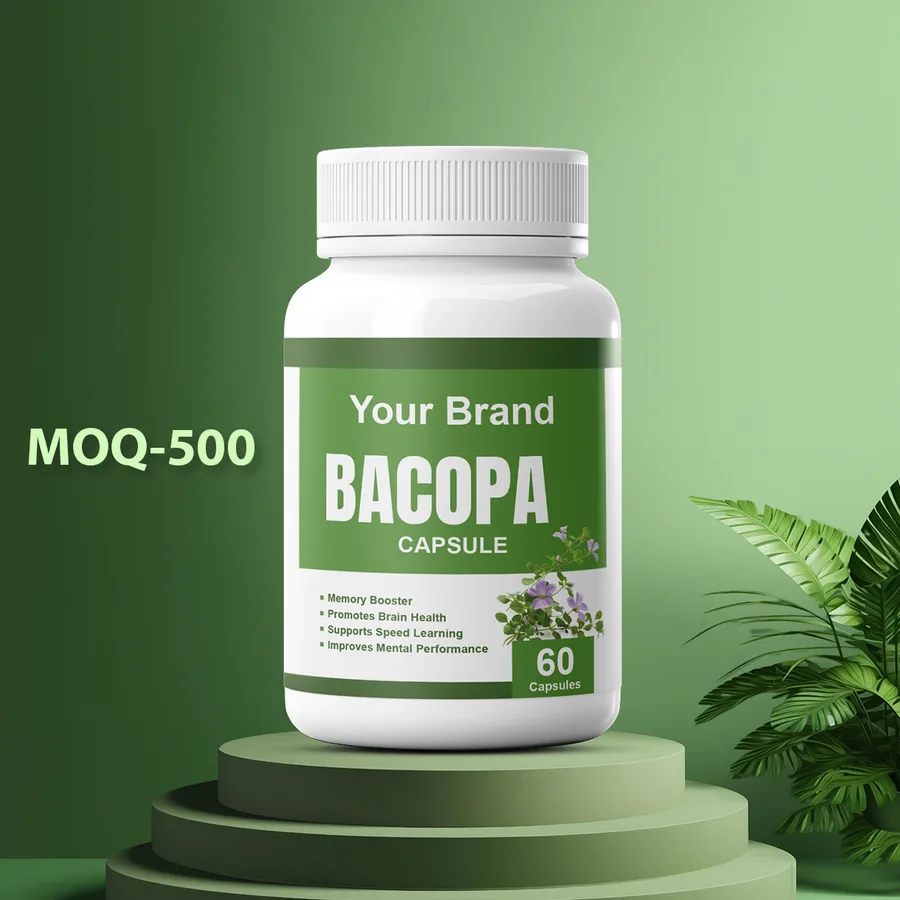
Ingredient details: brahmi and gotu kola. Our formulation: Brahmi Capsule. Related reading: how long before memory effects appear, ब्राह्मी के फ़ायदे, brahmi, shankhpushpi and ginkgo compared, and choosing a contract manufacturer.
Get our product list and minimum orders
Leave your email and we will send the formats we make, the minimum order for each and typical lead times. We use it only to reply to you.
Manufacturing in this category?
We make products in this category for other people's brands. Tell us the format and volume and we will send a specification and a per-unit cost.
Request a quotation ↗NutraHerbal manufactures food supplements, Ayurvedic proprietary medicines and cosmetics for business customers. Product information on this site describes composition, format and commercial positioning for brand owners. It is not medical advice, does not claim to diagnose, treat, cure or prevent any disease, and is not a substitute for consulting a qualified practitioner. Final label claims are the brand owner's responsibility and must be approved for the destination market.
How we write and review content: editorial policy.