Reviewed for accuracy and claims compliance: Claims and compliance review
Most writing about Ayurvedic herbs cites the classical texts as an authority without quoting what they actually contain. With shatavari that is worth correcting, because the texts and the marketing say noticeably different things, and the difference teaches you something about how herbs get repositioned.
The modern Indian market sells shatavari as “the women’s herb”, frequently narrowed further to lactation and hormones.
The classical texts place it in groups concerned with strength, tissue-building, cooling and the sustaining of vitality with age. It appears in men’s contexts as often as women’s.
And it is not that the texts are being misquoted. It is that one application has been amplified and the rest dropped, because “women’s wellness” is a category you can build a product line in, and “generally strengthening and cooling” is not.
General information, not medical advice. And a modern caution the texts could not have known: shatavari has reported oestrogen-like activity in laboratory and animal work, which makes hormone-sensitive conditions a doctor’s question. That is at the end.
The plant
Asparagus racemosus, a climbing, thorny plant with needle-like leaves, found across much of India. The part used is the tuberous root, which grows in a dense cluster.
And the name is literal. Shata = hundred, vari = root. “The one with a hundred roots”, a plain botanical description of what you see when you dig it up.
The popular gloss “she who possesses a hundred husbands” is a later folk etymology, attached to its reputation rather than its name. It is the kind of story that accretes around a plant, and it is not what the word means.
Where the texts place it
Charaka Samhita
The Charaka Samhita organises many drugs into mahakashayas, groups of ten drugs sharing a therapeutic action. Shatavari appears in several, and which ones matters:
Vayasthapana, age-sustaining. A group of drugs held to delay the effects of ageing. This is a general vitality classification, not a reproductive one.
Balya, strength-giving. Again general.
Jivaniya context, the life-promoting or vitalising direction, where its sweet, cooling, nourishing character places it.
And in the stanyajanana context, promoting breast milk, which is the designation the modern market has built on, and which is genuinely there.
And vrishya, relating to reproductive vitality, a category that in classical usage applies to men as much as to women. Shatavari appears in formulations aimed at male reproductive health, which surprises people who know it only as a women’s product.
Sushruta Samhita and later texts
Shatavari appears in contexts including pitta disorders, burning sensations, emaciation and debility, and in oil and ghee preparations for both internal and external use.
And its rasa panchaka, the classical pharmacological description, is consistent across sources:
Madhura rasa, sweet taste. Madhura vipaka, sweet post-digestive effect. Sheeta virya, cooling potency. Guru, snigdha, heavy and unctuous in quality. And therefore vata-pitta shamaka, reducing vata and pitta, and potentially increasing kapha.
That last clause is the practically useful part, and it is the thing modern products never mention.
The classical formulations
Shatavari ghrita and Shatavari gulam, the straightforward preparations.
Phala ghrita, used in the context of fertility and pregnancy, where shatavari is one component among several.
Narayana taila, an oil preparation used externally for musculoskeletal complaints, which has nothing to do with women’s health at all.
Vishnu taila, Shatavari mandur in some traditions.
Look at that list. One is a women’s-health formulation, one is a general-purpose massage oil, and the rest are nourishing preparations. That spread is the classical position, and the modern market represents about a fifth of it.
What the classical description actually tells you
And this is where the texts are more useful than they are usually given credit for, because the rasa panchaka is a set of practical indications.
Sheeta (cooling) and madhura (sweet) means: shatavari is classically indicated where there is heat, burning, dryness and depletion.
And classically contraindicated, or at least unsuitable, where there is kapha excess, heaviness, congestion, sluggish digestion, mucus, or a tendency to gain weight easily.
Guru (heavy) and snigdha (unctuous) means: it can sit heavily on a weak digestion. The classical framework would say to give it with something that aids digestion, and would not give it to someone with agnimandya, poor digestive fire, without addressing that first.
So the classical system has a selection rule, and it is: shatavari suits the hot, dry, depleted person, not the heavy, congested one.
No modern shatavari pack tells you this. And it is a genuinely useful filter, if shatavari gives you heaviness, bloating, a coated tongue or loose stools, the classical reading is that it is the wrong drug for your constitution, not that you need more of it.
We think that is worth printing, and it is the kind of thing we take from the texts rather than the claims.
What the texts do not say
Being precise here matters, because these absences are filled in by marketing.
They do not say “hormone balance”. The concept does not exist in the classical framework. Hormones were identified in the twentieth century. So “Ayurveda says shatavari balances your hormones” is not a possible sentence.
They do not say “oestrogen”, “prolactin” or “PCOS”. PCOS is a modern diagnostic entity defined by specific criteria. Classical texts describe menstrual and reproductive disorders in their own categories, which do not map one-to-one onto it.
They do not say “women’s herb”. The groups shatavari belongs to are about strength, ageing and tissue nourishment.
They do not say it increases breast size. That claim is purely modern.
And they do not describe a dose in milligrams, a standardised extract, or a twelve-week course. Classical use is long-term, dietary in character, taken with specific anupana, a carrier such as milk or ghee, and adjusted to the person.
The anupana point, which is genuinely interesting
One classical detail that modern products discard entirely: shatavari is traditionally given with milk.
And there is a coherent internal logic to it. Milk is itself madhura and sheeta, sweet and cooling, so it reinforces the drug’s direction. It also carries fat-soluble constituents, and it softens the heaviness on digestion.
Whether that logic is pharmacologically correct is a separate question. The point is that the classical system specified a carrier, and modern capsules deliver the drug with water, having dropped half the instruction.
Anupana , the carrier, recurs across Ayurvedic materials and is one of the most consistently ignored classical details, and it deserves its own treatment.
And where modern evidence sits
Briefly, since we have covered it elsewhere:
Lactation, the most-studied use. Some small trials report increased prolactin; others found no clear difference; systematic reviews of galactagogues generally conclude the evidence is insufficient. And the dominant determinant of milk supply is the frequency and effectiveness of milk removal, not any herb.
Menopause, small studies, weak evidence. The pitta-reducing, cooling classification is interesting against hot flushes, and interesting is not demonstrated.
Gastric protection, animal antiulcer work, consistent with the demulcent mucilage and the pitta-reducing classification. Little human data.
Immunomodulation and antioxidant activity, laboratory and animal.
And nothing of quality for PCOS, infertility, or weight gain.
And the governing regulatory fact: there is no authorised health claim for shatavari.
The honest reading
What the classical texts give you, fairly summarised:
A sweet, cooling, nourishing root, classified as strength-giving and age-sustaining, used in depletion, heat and dryness, with a recognised application in promoting breast milk, given long-term with milk as a carrier, and unsuitable where congestion and weak digestion dominate.
That is a reasonable, coherent, internally consistent description. It is also much less exciting than “the women’s herb for hormone balance”.
And the distance between those two sentences is the whole subject of this article.
Our position as a manufacturer: cite the classical designation as a classical designation, state the part and the botanical name, and do not convert a traditional category into a modern physiological mechanism. The texts can be quoted honestly. They are just quoted selectively.
Quality, the practical problem the texts cannot help with
Shatavari root is expensive, and adulteration is common.
Substituted with: other Asparagus species, and, the significant one, Chlorophytum borivilianum, safed musli, which is a different plant with a different classical position, sometimes sold as shatavari.
And because both are dried, pale, fibrous roots, powdered material cannot be distinguished by eye.
So what to require:
The botanical name, Asparagus racemosus, on the label. Botanical identity confirmation on incoming raw material: macroscopic, microscopic, and TLC or HPLC against a reference. Not the supplier’s invoice. Batch-wise heavy metals, it is a root, and roots take up lead and cadmium from soil. Pesticide residues. Microbiology, especially for juices. And cultivated rather than wild-collected material, since over-collection has made wild Asparagus racemosus a conservation concern in parts of India.
What we will and will not say
Sayable: the botanical name and part used; a traditional-use statement framed as traditional use, including the classical balya, vayasthapana and stanyajanana designations described as classical designations; the quantity; and authorised claims for any vitamins or minerals present.
And the fact that governs it: there is no authorised health claim for shatavari.
Not sayable: balances hormones, increases breast milk, treats PCOS, treats infertility, treats menopause, increases breast size.
And two specific refusals:
Infertility claims, separately restricted in India under the Drugs and Magic Remedies (Objectionable Advertisements) Act, and in any case the point in the market where the most frightened people are charged the most.
And “Ayurveda says it balances your hormones”, because the texts cannot say that, and attributing a modern mechanism to a classical source is a misrepresentation of both.
And the most honest summary:
Charaka places shatavari among the strength-giving and age-sustaining drugs, not among women’s medicines. It appears in a massage oil and in male reproductive formulations as well as in women’s preparations.
Its classical description, sweet, cooling, heavy, unctuous, is a selection rule: it suits the hot, dry, depleted person and not the congested one, and no pack says so.
It was given with milk, and modern capsules dropped the carrier.
And “hormone balance” is not in the texts, because hormones were not known when they were written.
When to see a doctor
Ask before taking shatavari if you:
- have a history of, or are being treated for, breast, uterine or ovarian cancer, the most important one, because of reported oestrogen-like activity
- have endometriosis or uterine fibroids
- take hormonal medication, tamoxifen, hormone therapy, oral contraceptives
- are pregnant, classical use exists; modern safety data for concentrated supplements does not. Decide with your doctor, and show them the pack
- are breastfeeding, and speak to a lactation consultant first
- are allergic to asparagus
- take a diuretic, or lithium, shatavari has a reported diuretic effect and lithium is renally cleared
- have kidney disease or oedema
- take diabetes medication, monitoring
Get a diagnosis rather than a supplement if you have:
- very irregular, very heavy, or absent periods, thyroid, prolactin and PCOS assessment, and haemoglobin
- bleeding between periods or after intercourse, this needs investigating, not waiting
- any bleeding after menopause, this is urgent
- a breast lump or nipple discharge, see someone promptly
- difficulty conceiving, both partners need assessment
And in breastfeeding: a baby not gaining weight, fewer wet nappies, or persistent distress at the breast is a lactation consultant and paediatrician question, early, not a herb question.
The short version
- The market sells shatavari as “the women’s herb”; the texts classify it differently
- Shata = hundred, vari = root, the name is a plain botanical description
- “She of a hundred husbands” is a later folk etymology, not the meaning
- Charaka places it in vayasthapana, age-sustaining
- And in balya, strength-giving
- Both are general vitality groups, not reproductive ones
- The stanyajanana (milk-promoting) designation is genuinely there
- And vrishya, which classically applies to men as much as women
- It appears in male reproductive formulations too
- Narayana taila is an external musculoskeletal oil containing it
- So the classical spread is wider than the modern market by a factor of several
- Its rasa panchaka: sweet taste, sweet vipaka, cooling potency, heavy and unctuous
- Therefore vata-pitta reducing and potentially kapha increasing
- Which makes it a selection rule: for the hot, dry, depleted person
- And unsuitable where heaviness, congestion and weak digestion dominate
- If it causes bloating and a coated tongue, the classical reading is wrong drug, not low dose
- No modern pack prints this, and it is the most useful thing in the texts
- The texts cannot say “hormone balance”, hormones are a twentieth-century concept
- They do not say oestrogen, prolactin or PCOS
- They do not say it increases breast size, that claim is purely modern
- They specify no milligram dose or standardised extract
- They do specify an anupana, traditionally milk
- Milk is itself sweet and cooling, reinforcing the drug’s direction
- Modern capsules dropped the carrier entirely
- Lactation evidence is mixed; systematic reviews find it insufficient
- Milk supply depends mainly on how often and how well milk is removed
- Menopause evidence is weak; the cooling classification is interesting, not demonstrated
- Animal antiulcer work fits the mucilage and the pitta-reducing classification
- Nothing of quality for PCOS, infertility or weight gain
- Safed musli is sold as shatavari, and powders cannot be told apart by eye
- Require the botanical name, identity confirmation, and batch heavy-metal testing
- Wild Asparagus racemosus is a conservation concern in parts of India
- There is no authorised health claim for shatavari
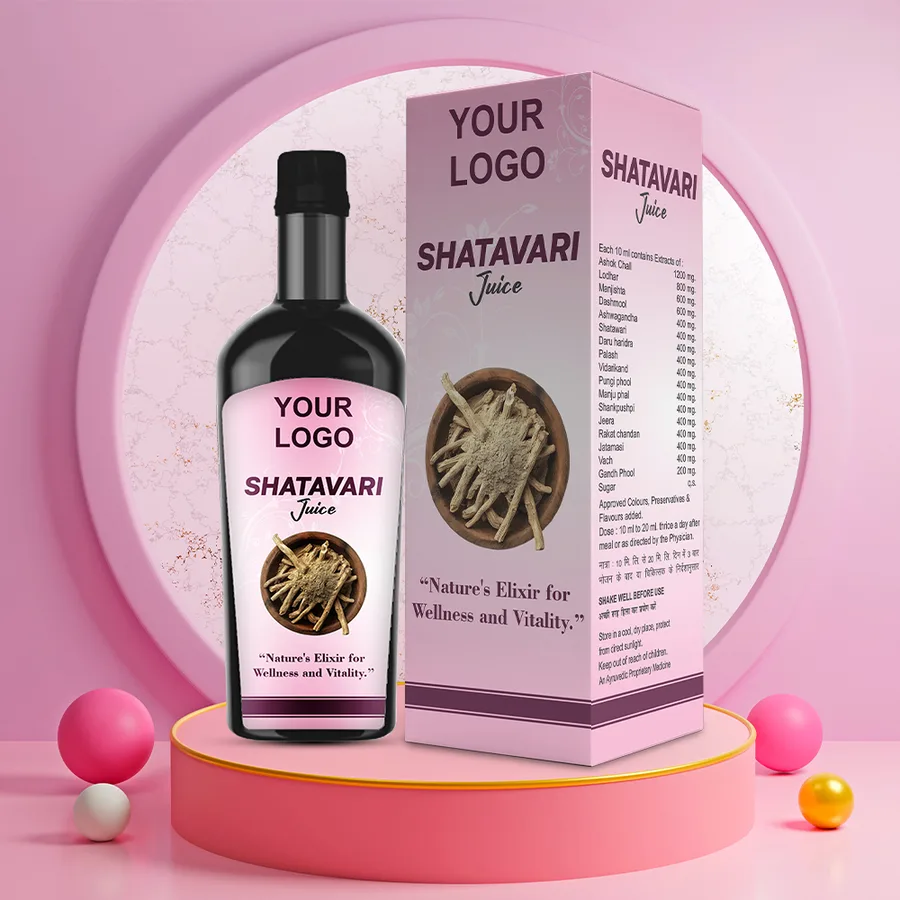
Ingredient details: shatavari, ashoka, lodhra. Our formulations: Shatavari Juice, Femino 360. Related reading: शतावरी के फ़ायदे महिलाओं के लिए, shatavari for lactation, शतावरी कैसे और कब लें, and the glossary for the classical terms used here.
Get our product list and minimum orders
Leave your email and we will send the formats we make, the minimum order for each and typical lead times. We use it only to reply to you.
Manufacturing in this category?
We make products in this category for other people's brands. Tell us the format and volume and we will send a specification and a per-unit cost.
Request a quotation ↗NutraHerbal manufactures food supplements, Ayurvedic proprietary medicines and cosmetics for business customers. Product information on this site describes composition, format and commercial positioning for brand owners. It is not medical advice, does not claim to diagnose, treat, cure or prevent any disease, and is not a substitute for consulting a qualified practitioner. Final label claims are the brand owner's responsibility and must be approved for the destination market.
How we write and review content: editorial policy.