Reviewed for accuracy and claims compliance: Claims and compliance review
Spirulina’s headline claim is one of the few in this industry that is factually accurate.
It really is about 60 to 70% protein by dry weight. That is genuinely remarkable, higher than meat, higher than soy, higher than almost any whole food.
And then the arithmetic:
A serving is 3 to 5 grams.
Which delivers about 2 to 3.5 grams of protein.
An egg gives 6 grams.
So the percentage is true and nearly useless, and the gap between those two facts is the whole story of this ingredient, the same arithmetic problem we have written about with moringa.
And there is a second issue that matters much more, because it concerns a nutrient vegans genuinely depend on: spirulina’s vitamin B12 is largely the wrong kind, and it can make a blood test look reassuring while providing nothing.
We sell spirulina powder. This article is the honest accounting.
General information, not medical advice. And there is a contamination issue specific to this organism, microcystins, which has its own article and is more important than anything here.
What spirulina actually is
And the first correction is taxonomic, because it changes how you think about it.
*Spirulina is not an algae. It is a cyanobacterium, Arthrospira platensis and Arthrospira maxima.
Cyanobacteria are bacteria. They photosynthesise, which is why they are green and why they get called “blue-green algae”, but they are prokaryotes, no nucleus, bacterial cell structure.
Which has three practical consequences:
No cellulose cell wall. Unlike true algae such as chlorella, spirulina’s cell wall is made of mucopolysaccharides, which humans digest. So no “cracked cell wall” processing is needed, and digestibility is genuinely good.
High nucleic acid content, because single-celled organisms are mostly machinery. This matters for uric acid, below.
And it can produce cyanobacterial toxins, or be contaminated by other cyanobacteria that do. That is the microcystin issue.
The protein, properly
Protein content: roughly 60–70% of dry weight. Genuinely high, and not a marketing exaggeration.
Amino acid profile: contains all nine essential amino acids. Relatively lower in methionine and cysteine, which is typical of non-animal proteins.
Digestibility: good, helped by the absence of a cellulose wall.
And now the serving:
| Protein | |
|---|---|
| Spirulina, 5 g serving | ~3 g |
| One egg | 6 g |
| One cup of milk | ~7 g |
| 100 g paneer | ~18 g |
| 30 g whey protein | ~24 g |
| One katori of dal | ~6 g |
So a spirulina serving is half an egg.
And at a typical Indian price, it is one of the most expensive ways to buy protein that exists.
Which means: spirulina is not a protein supplement, and should not be sold as one. If your goal is protein, the answer is dal, paneer, eggs, soya chunks or a protein powder, all of which we have written about and most of which are cheaper.
What spirulina is: a dense micronutrient and pigment concentrate, in small amounts.
The B12 problem, and this is the serious part
This deserves emphasis because it concerns the one nutrient a vegan diet genuinely cannot supply.
Spirulina labels frequently list vitamin B12, sometimes in impressive quantities.
And the B12 in spirulina is largely pseudovitamin B12, corrinoid analogues that are structurally similar to B12 but not biologically active in humans.
Reported figures suggest the great majority of the apparent B12 in spirulina is these inactive analogues.
And there are two consequences, the second worse than the first:
One: it does not meet your B12 requirement. A vegan relying on spirulina for B12 is not getting B12.
Two: the analogues can register in some B12 assays. So a blood test can come back looking adequate while the person is functionally deficient.
And B12 deficiency’s most serious consequence is neurological damage that can become permanent, and it can occur without anaemia, which we have written about separately.
So the honest statement, as plainly as we can put it:
Do not rely on spirulina for vitamin B12. If you are vegan, you need a B12 supplement, cyanocobalamin or methylcobalamin, and spirulina is not a substitute for it.
We print this on our spirulina page. It removes one of the ingredient’s selling points.
The iron question
Spirulina is often promoted for iron, and the pattern is familiar.
Iron content per 100 g is high.
Per 5 g serving it is modest.
And it is non-haem iron, absorbed in single-digit percentages, improved by vitamin C in the same meal and reduced by tea, coffee and calcium.
So: a contribution, not a treatment. Iron deficiency anaemia needs a blood test, a therapeutic iron dose, and the cause investigated, particularly in an adult man or a post-menopausal woman.
Where the evidence is real
And it is not zero, which is worth saying after all that.
Lipids. Several small trials and meta-analyses report modest reductions in total and LDL cholesterol and triglycerides with spirulina supplementation. This is probably its best-supported effect.
Blood pressure. Some small trials report modest reductions.
Allergic rhinitis. A small trial reported symptom improvement. Interesting, single, not replicated at scale.
Exercise performance and oxidative stress markers. Small studies.
Malnutrition. And this is the most legitimate use historically, spirulina has been used in nutritional rehabilitation programmes in food-insecure settings, where a dense micronutrient source in small quantity is genuinely valuable. That work is serious, and it is a different context from a wellness supplement.
Phycocyanin, the blue pigment, has antioxidant and anti-inflammatory activity in laboratory work, and is the compound most research interest attaches to.
And what there is no good evidence for: detoxification, heavy metal chelation, immunity, cancer, weight loss, or curing anything.
And the governing regulatory fact: there is no authorised health claim for spirulina.
The safety points worth knowing
Four, and the first has its own article.
Microcystins. Cyanobacteria can produce hepatotoxic microcystins, and spirulina grown in open ponds can be contaminated with other cyanobacteria that produce them. This is the real safety issue with this ingredient, it is documented, and batch testing for microcystins is not optional. We have written about it separately and it is the more important article.
Phenylketonuria. Spirulina is high in protein and therefore in phenylalanine. Anyone with PKU must avoid it. This is absolute, and it is rarely on a label.
Uric acid and gout. And this one is under-mentioned: single-celled organisms are high in nucleic acids, which are metabolised to purines and then to uric acid. So spirulina is a meaningful purine source per gram. With gout or raised uric acid, this is worth asking about, and it applies even more to chlorella, which is higher still.
Autoimmune disease. Spirulina has immunostimulant activity reported. So in autoimmune conditions, and after transplant on immunosuppressants, ask first. Which is awkward, since “boosts immunity” is a selling line.
And vitamin K, present, so tell whoever monitors your INR if you take warfarin. The rule is consistency, not avoidance.
And heavy metals, as with any cultivated biomass, batch testing matters.
So who is spirulina actually for
Our honest answer:
As a small, dense micronutrient top-up for someone whose diet is poor, a genuine, dull, modest use.
In nutritional rehabilitation contexts, where its density per gram is the point.
For the lipid effect, modestly, if you want to try it with realistic expectations and a lipid profile before and after.
And not for: protein, B12, iron deficiency, detox, immunity, or weight loss.
And a note on the price: spirulina is one of the most expensive sources of almost everything it contains. If the goal is micronutrients, vegetables and a cheap multivitamin do it for less; if the goal is protein, almost anything does it for less.
We sell it, and that paragraph is still true.
What to check when buying
The organism named, Arthrospira platensis or maxima, not just “blue-green algae”, because that phrase also covers Aphanizomenon flos-aquae, which is harvested from a natural lake and has a different and worse contamination profile.
Microcystin testing, per batch, with a figure and a limit. This is the one that matters.
Heavy metals, per batch.
Microbiology.
Cultivation method, closed photobioreactor or controlled open ponds, rather than wild-harvested.
And protein and phycocyanin content, if declared.
And what not to pay for: a B12 figure. If a spirulina label advertises B12 as a benefit, that is a reason to trust the label less, not more.
What we will and will not say
Sayable: the organism’s name and the cultivation method; protein and phycocyanin content as factual figures; microcystin and heavy metal test results; and authorised nutrient-function claims only for nutrients present in significant, quantified amounts, which at a 5 g serving is a short list.
And the governing fact: there is no authorised health claim for spirulina.
Not sayable: detoxifies, chelates heavy metals, boosts immunity, treats anaemia, aids weight loss, is a complete protein source, supplies vitamin B12.
And three refusals:
Any B12 claim. The B12 is largely inactive analogues, and a vegan acting on that claim risks neurological harm. This is the clearest case on this site of a claim we refuse on safety grounds rather than evidence grounds.
“Complete protein” as a reason to buy it. The percentage is real and the serving delivers half an egg.
And “detox” or “removes heavy metals”, particularly ironic for an ingredient whose own principal quality risk is contamination.
And the most honest summary:
Spirulina is genuinely 60 to 70% protein, and a 5 gram serving gives about 3 grams, half an egg, at a high price.
It is a cyanobacterium, not an algae, which is why it digests well and why it carries a cyanotoxin risk.
Its B12 is largely pseudovitamin B12, inactive in humans, and it can make a blood test look falsely reassuring, so a vegan must not rely on it.
Its best-supported effect is a modest improvement in blood lipids.
And its real historical value is nutritional rehabilitation, where density per gram is the point, which is a long way from a wellness shelf.
When to see a doctor
Do not take spirulina if you have: phenylketonuria (PKU), absolute.
Ask before taking it if you:
- have an autoimmune condition or take immunosuppressants, or have had a transplant, reported immunostimulant activity
- have gout or raised uric acid, high nucleic acid content means purines
- take warfarin or acenocoumarol, vitamin K content; tell whoever monitors your INR
- have liver disease, because of the microcystin question
- are pregnant or breastfeeding, contamination risk makes this a caution
- are giving it to a child, paediatrician, and for the same reason
- have kidney disease
And if you are vegan, do this specifically: get vitamin B12 tested, and take a proper B12 supplement. Do not count spirulina towards it. And know that B12 deficiency can cause neurological damage without anaemia, and that damage can be permanent if prolonged.
Get a diagnosis rather than a green powder if you have: fatigue, pallor or breathlessness on exertion (haemoglobin and ferritin, and the cause investigated); tingling or numbness in the hands or feet (B12); unexplained weight loss; or joint pain and swelling with a history of gout.
Stop and get checked: yellowing of the eyes, dark urine or persistent nausea (liver, and mention the spirulina); rash; or a gout flare.
The short version
- Spirulina really is 60 to 70% protein by dry weight
- Higher than meat, higher than soy, the claim is accurate
- And a serving is 3 to 5 grams
- Which delivers about 2 to 3.5 grams of protein
- An egg gives 6 grams
- So the percentage is true and nearly useless
- And it is one of the most expensive ways to buy protein
- Spirulina is not an algae, it is a cyanobacterium
- Arthrospira platensis and maxima are bacteria that photosynthesise
- No cellulose cell wall, so no “cracked cell wall” processing is needed
- Which makes digestibility genuinely good
- High nucleic acid content, because single cells are mostly machinery
- And it can carry cyanobacterial toxins, the microcystin issue
- It contains all nine essential amino acids, lower in methionine and cysteine
- Spirulina’s B12 is largely pseudovitamin B12, inactive analogues
- So a vegan relying on it is not getting B12
- And the analogues can register in some assays
- Making a blood test look adequate in a functionally deficient person
- B12 deficiency can cause permanent neurological damage without anaemia
- So do not rely on spirulina for B12, take a real supplement
- Iron content per 100 g is high; per serving it is modest and non-haem
- Its best-supported effect is a modest reduction in cholesterol and triglycerides
- Some small trials report modest blood pressure reductions
- A small trial reported benefit in allergic rhinitis
- Its most legitimate historical use is nutritional rehabilitation
- Where density per gram is the actual point
- Phycocyanin is the blue pigment and the main research interest
- No good evidence for detox, chelation, immunity, cancer or weight loss
- Microcystins are the real safety issue and need batch testing
- Phenylketonuria is an absolute contraindication, rarely on a label
- Nucleic acids mean purines, which matters in gout
- Immunostimulant activity makes autoimmune disease a caution
- Which is awkward, since “boosts immunity” is a selling line
- Check the organism is named, not just “blue-green algae”
- Because that phrase also covers wild-harvested Aphanizomenon
- A B12 figure on a spirulina label is a reason to trust it less
- There is no authorised health claim for spirulina
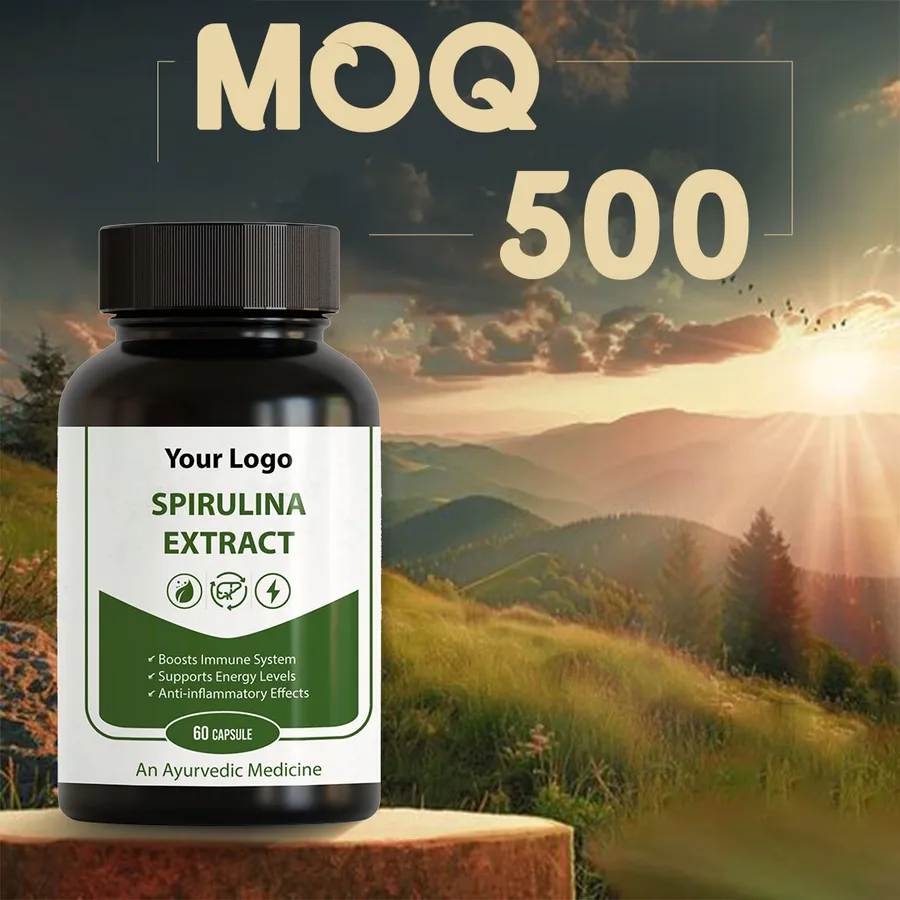
Ingredient details: spirulina, moringa, wheatgrass. Our products: Spirulina Powder, Plant Protein, Multi-Green Blend. Related reading: the microcystin problem nobody mentions, स्पिरुलिना के फ़ायदे और कैसे लें, spirulina vs chlorella vs moringa, why Indian vegetarians run short of B12, and moringa’s nutrient profile.
Get our product list and minimum orders
Leave your email and we will send the formats we make, the minimum order for each and typical lead times. We use it only to reply to you.
Manufacturing in this category?
We make products in this category for other people's brands. Tell us the format and volume and we will send a specification and a per-unit cost.
Request a quotation ↗NutraHerbal manufactures food supplements, Ayurvedic proprietary medicines and cosmetics for business customers. Product information on this site describes composition, format and commercial positioning for brand owners. It is not medical advice, does not claim to diagnose, treat, cure or prevent any disease, and is not a substitute for consulting a qualified practitioner. Final label claims are the brand owner's responsibility and must be approved for the destination market.
How we write and review content: editorial policy.