Reviewed for accuracy and claims compliance: Claims and compliance review
“Indian vegetarians are often B12 deficient” is a statement most people have heard and few can explain.
And the explanation matters, because the common responses to it are all wrong in instructive ways: “but I drink milk”, “but we have eaten this way for generations”, “but idli is fermented”, “but spirulina has B12”.
Each of those is a reasonable thought that fails for a specific, checkable reason.
So this article is the mechanism. Not that you should supplement, we have written about that elsewhere, but why the shortfall exists at all, and why the diet that caused it worked for a very long time before it stopped.
General information, not medical advice. And one thing that outranks everything here: if you have tingling or numbness in the hands or feet, that is a reason to get tested, not a reason to start a supplement. We have written separately on symptoms and treatment.
The founding fact: B12 is bacterial
No plant makes B12. No animal makes B12 either.
B12 is synthesised only by certain bacteria and archaea. It is the only vitamin with that distinction, and it is also the largest and most structurally complex vitamin, built around a cobalt atom, which is why it is called cobalamin.
So how does it get into food?
Ruminants, cows, buffaloes, goats, host B12-producing bacteria in their rumen. The bacteria make B12, the animal absorbs it, and it accumulates in the animal’s tissues and milk. The cow is, functionally, a B12 delivery system that runs on grass.
Other animals get it by eating other animals, or soil, or faecal matter, or contaminated feed.
Humans have no such internal source. Bacteria in the human colon do produce some B12, but they do it downstream of the ileum, where absorption happens. So it is produced in the wrong place and passes out. This is a genuinely unfortunate piece of anatomy and it is the root of the entire problem.
Which means: a diet with no animal products and no supplement has no B12 source. Not a small one. None.
“But I drink milk”, the arithmetic
This is the most important section, because lacto-vegetarianism is the Indian norm and the assumption is that dairy covers it.
Dairy does contain B12. The question is how much, against what requirement.
The adult requirement is in the region of 2 to 2.5 micrograms a day. It is a small number, B12 is needed in micrograms, not milligrams.
And rough values for common Indian foods:
| B12, roughly | |
|---|---|
| Milk, 1 cup (200 ml) | ~0.9 µg |
| Curd, 1 cup | ~0.8 µg |
| Paneer, 100 g | ~0.8–1 µg |
| Cheese, 1 slice | ~0.3 µg |
| Egg, 1 whole | ~0.6 µg |
| Chapati, dal, rice, vegetables | 0 |
Now look at what that implies.
Two cups of milk a day gets you to roughly the requirement. So the diet is not impossible, it is marginal.
And “marginal” is exactly the problem, because several things erode the margin:
Boiling. Indian milk is boiled, often repeatedly, and B12 is partly heat-labile. Some is lost. This is not a trivial detail in a country where milk is never drunk raw.
Actual consumption. Many adults do not drink two cups of milk a day. Tea with a splash of milk is not a cup of milk. A family’s milk goes mostly into tea, and the per-person share is small.
It is a store, not a stream. The liver stores several years’ worth of B12. So a marginal intake does not cause symptoms this month or this year, it causes them after a long, silent depletion. Which is why people are genuinely surprised by the diagnosis.
And absorption limits. The receptor-mediated absorption pathway saturates at roughly 1.5 to 2 µg per meal. So you cannot bank it by drinking four cups at breakfast. Spreading intake across meals matters, and almost nobody knows this.
So the honest conclusion: lacto-vegetarianism does not guarantee deficiency, and it provides a thin margin that many people do not actually achieve. Veganism without supplementation guarantees deficiency, given time.
“But we have eaten this way for generations”
This is the most interesting objection, because it is historically accurate and it explains the change.
Several things used to supply incidental B12 that no longer do:
Bacterial contamination of food and water. B12-producing bacteria live in soil and water. Vegetables washed in river water, drawn from a well, carrying soil, these carried bacteria, and some B12 with them. Chlorinated municipal water and thorough washing removed that.
And this is worth stating carefully: that incidental source came with cholera, typhoid and dysentery. Nobody should want it back. Clean water is one of the great public health achievements, and losing an accidental B12 source is a price worth paying, but it is a price, and it should be acknowledged rather than romanticised.
Higher dairy intake, less processed. More milk, more ghee, more curd, consumed closer to the source.
Shorter life expectancy. B12 deficiency takes years to manifest, and it worsens with age as stomach acid declines. A population that did not commonly live into its seventies had less time to express the problem.
Less metformin and fewer PPIs. Both impair B12 status, and both are now extremely widely prescribed in India. This is a genuinely new and large contributor that did not exist in any previous generation.
And nobody was measuring it. Mild deficiency presents as tiredness and vague aches. It was not diagnosed because nobody looked.
So “we have always eaten this way” is true, and the conditions around the diet changed.
The absorption cascade, and why things go wrong in the middle
B12 absorption is absurdly elaborate for a nutrient needed in micrograms, and every step is a possible failure point.
1. Stomach acid and pepsin release B12 from the food protein it is bound to. No acid, no release, hence the PPI problem.
2. Haptocorrin (R-binder), from saliva, protects it through the stomach.
3. Parietal cells in the stomach secrete intrinsic factor (IF). In pernicious anaemia, autoimmune destruction of these cells removes IF, and absorption collapses regardless of diet.
4. In the small intestine, pancreatic enzymes transfer B12 from haptocorrin to IF.
5. The B12–IF complex binds a specific receptor in the terminal ileum. This is the only site. Ileal disease or resection, Crohn’s, coeliac, all cause deficiency.
6. Transcobalamin carries it in blood to tissues.
Which produces the clinically useful insight:
A perfect diet does not protect you if step 1, 3 or 5 is broken.
And conversely, this is why very high oral doses work even in pernicious anaemia, a small fraction crosses by passive diffusion, bypassing the whole cascade. At 1000–2000 µg, that fraction is enough.
The three myths worth killing
“Fermented foods give you B12”
Idli, dosa batter, dhokla, pickles, kanji.
Some fermented foods contain small amounts, depending on which organisms happened to grow. The quantities are small, inconsistent, and unmeasurable in a home kitchen.
And the organisms used in most Indian fermentations are lactic acid bacteria and yeasts, which are not reliable B12 producers.
Verdict: not a source you can plan around.
“Spirulina has B12”
And this one is actively harmful, so it deserves emphasis.
Spirulina contains a large proportion of pseudo-B12, corrinoid analogues that are structurally similar but not biologically active in humans.
Worse: these analogues can register in some B12 assays. So spirulina can make a blood test look better while providing nothing usable, and there is a reasonable argument that inactive analogues may compete with real B12.
Verdict: do not rely on algae for B12. We sell spirulina powder and we say this on its page too.
“Curd and ghee are enough because of the bacteria”
Curd’s B12 comes from the milk, not from the culture adding meaningfully to it. Fermentation does not create B12 out of nothing.
And ghee is nearly pure fat. B12 is water-soluble, so it stays with the milk solids that ghee-making removes. Ghee has essentially no B12.
Who is at highest risk
Vegans, guaranteed deficiency without supplementation, given time.
Lacto-vegetarians with low actual dairy intake, which is a very large group.
Pregnant and breastfeeding vegetarian women. And this is the most serious case in the article: maternal deficiency affects the infant, whose stores and breast-milk supply both depend on the mother. Infant B12 deficiency can cause developmental and neurological harm, and some of it may not be fully reversible. This is not optional territory, it is a conversation to have with a doctor during pregnancy planning.
Infants of vegetarian mothers, exclusively breastfed.
Anyone on long-term metformin. Testing should be routine here and usually is not.
Anyone on long-term PPIs.
Adults over 60, declining acid production.
People with coeliac disease, Crohn’s, or ileal or bariatric surgery.
And people with recurrent H. pylori infection or atrophic gastritis.
What this means practically
Get tested if you are in any risk group above. Serum B12, with MCV; and in borderline cases homocysteine or methylmalonic acid, which are more informative.
Do not start a supplement before testing if you can avoid it, because it makes the result uninterpretable and obscures the cause.
And know that the cause determines the duration. A vegetarian diet is a permanent cause, so the supplement is permanent. A three-month course for a lifelong dietary pattern is the commonest mistake in this area.
Spread dairy across meals rather than concentrating it, given the per-meal absorption ceiling. This is free and almost never mentioned.
And if you take metformin, ask for B12 to be checked. You will usually have to ask.
What we will and will not say
Sayable, and this is the one category where real claims exist: authorised nutrient-function claims for vitamin B12, where the product contains a significant, quantified amount, contribution to normal energy-yielding metabolism, normal functioning of the nervous system, normal red blood cell formation, normal homocysteine metabolism, and reduction of tiredness and fatigue, in the permitted wording.
And the distinction worth understanding: vitamins and minerals have authorised claims. Botanicals in India generally do not. So B12 is one of the few things on which a supplement label can make a substantiated statement at all.
Not sayable: treats anaemia, treats neuropathy, improves memory, “energy booster”, treats depression, prevents dementia.
And one thing we will not do: sell B12 injections or imply that injections are superior for ordinary dietary deficiency. High-dose oral works for dietary shortfall, and the injection business in India runs substantially on people who do not need injections.
And the most honest summary:
B12 is made by bacteria. The cow collects it for you. Remove animal products and there is no source at all, not a small one, none.
Dairy makes the Indian vegetarian diet marginal rather than impossible, and boiling, real-world intake, and the per-meal absorption ceiling all erode that margin.
The diet did not change. Clean water, longer lives, metformin and PPIs did.
When to see a doctor
Get tested, rather than self-treating, if you have:
- tingling, numbness or burning in the hands or feet
- unsteadiness, or imbalance that is worse in the dark
- a red, smooth or sore tongue
- persistent fatigue with pallor or breathlessness
- a clear drop in memory or concentration
- a report showing raised MCV
Ask for testing if you:
- are vegan
- are a vegetarian who is pregnant, planning pregnancy or breastfeeding, this one matters most
- take metformin long term
- take a PPI long term
- have had ileal or bariatric surgery, or have coeliac disease or Crohn’s
- are over 60 with fatigue or tingling
And ask specifically: if you have tingling and are taking an iron-and-folic-acid tablet, has B12 been checked? Folic acid can correct the blood picture while nerve damage continues, we have written about that trap separately.
Urgent: confusion; rapidly worsening walking difficulty; severe breathlessness or chest pain with anaemia.
The short version
- No plant and no animal makes B12, only bacteria and archaea do
- It is the largest, most complex vitamin, built around a cobalt atom
- Ruminants host B12-producing bacteria and accumulate it in tissue and milk
- The cow is functionally a B12 delivery system running on grass
- Human colonic bacteria make some, but downstream of where absorption happens
- So it is produced in the wrong place and passes out
- No animal products and no supplement means no source at all
- The adult requirement is roughly 2–2.5 µg a day, micrograms, not milligrams
- A cup of milk gives roughly 0.9 µg; dal, roti and rice give zero
- So two cups of milk approaches the requirement, marginal, not impossible
- Boiling degrades some, and Indian milk is always boiled
- Tea with a splash of milk is not a cup of milk
- The liver stores years’ worth, so depletion is slow and silent
- Which is why the diagnosis surprises people
- Receptor absorption saturates at roughly 1.5–2 µg per meal
- So you cannot bank it in one sitting, spread it across meals
- Bacterial contamination of water and soil once supplied incidental B12
- That source came with cholera and typhoid; clean water was worth the trade
- Longer life expectancy gives the deficiency time to express
- Metformin and PPIs are large, genuinely new contributors
- Mild deficiency was never diagnosed because nobody looked
- Absorption needs acid, intrinsic factor, pancreatic enzymes and an intact ileum
- A perfect diet does not help if any of those steps is broken
- Very high oral doses bypass the cascade by passive diffusion
- Fermented foods are inconsistent and unplannable as a source
- Spirulina contains largely pseudo-B12, inactive in humans
- And those analogues can make a blood test look falsely reassuring
- Curd’s B12 comes from the milk, not from the culture
- Ghee has essentially none, B12 is water-soluble and stays with the solids
- Maternal deficiency harms the infant, and some harm may not be reversible
- Test before supplementing, or the result becomes uninterpretable
- A permanent dietary cause means a permanent supplement, not a three-month course
- B12 has authorised nutrient-function claims; Indian botanicals generally do not
- High-dose oral works for dietary deficiency, injections are mostly unnecessary
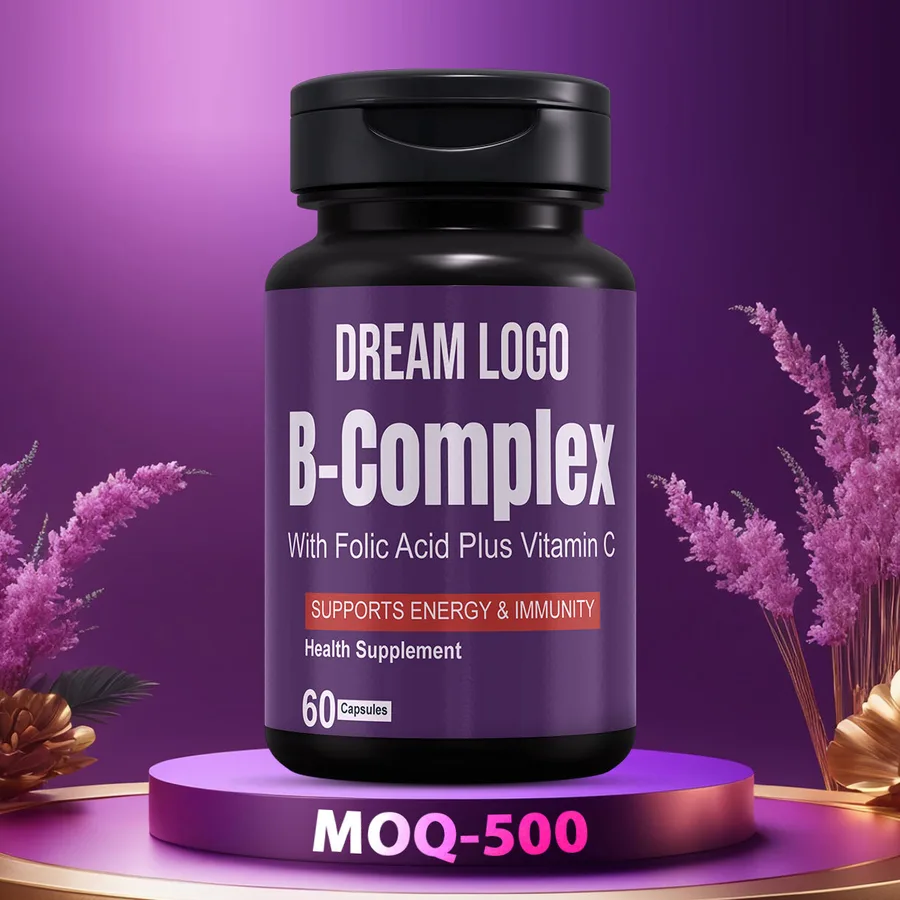
Our formulation: B-Complex Capsule. Related reading: विटामिन B12 की कमी के लक्षण और इलाज, शाकाहारी लोगों के लिए B12 के स्रोत, methylcobalamin vs cyanocobalamin, and vegan B12, non-negotiable and why.
Get our product list and minimum orders
Leave your email and we will send the formats we make, the minimum order for each and typical lead times. We use it only to reply to you.
Manufacturing in this category?
We make products in this category for other people's brands. Tell us the format and volume and we will send a specification and a per-unit cost.
Request a quotation ↗NutraHerbal manufactures food supplements, Ayurvedic proprietary medicines and cosmetics for business customers. Product information on this site describes composition, format and commercial positioning for brand owners. It is not medical advice, does not claim to diagnose, treat, cure or prevent any disease, and is not a substitute for consulting a qualified practitioner. Final label claims are the brand owner's responsibility and must be approved for the destination market.
How we write and review content: editorial policy.