Reviewed for accuracy and claims compliance: Claims and compliance review
Walk through the B12 shelf in India and you will see two words doing a lot of commercial work.
Methylcobalamin, usually described as the “active” or “natural” or “bioavailable” form, at a premium.
Cyanocobalamin, usually described by implication as the cheap synthetic one with cyanide in it.
The premium is real. The justification for it is largely marketing.
We make a B-complex capsule and we have to choose a form, so we have had to think about this properly. Here is what the evidence actually supports, where methylcobalamin genuinely has an edge, and why the cyanide argument is arithmetic nonsense.
General information, not medical advice. And the practical headline: for ordinary dietary deficiency, the form matters far less than the dose and whether you keep taking it. If you have neurological symptoms, that is a doctor’s question, not a form question.
The four forms
B12 is a family of cobalamins, a cobalt atom in a corrin ring, with different groups attached at one position. That attached group is the only difference between them.
Cyanocobalamin, a cyanide group. Does not occur meaningfully in nature; it is a product of the purification process. The most stable of the four, the cheapest, and the form used in most of the clinical trial literature and most national fortification programmes.
Methylcobalamin, a methyl group. One of the two forms your body actually uses. Less stable, light-sensitive, more expensive.
Adenosylcobalamin (cobamamide), the other active form. Used in mitochondria.
Hydroxocobalamin, a hydroxyl group. A natural form, used for injections in much of Europe because it is retained longer in the body, and, separately, used as a cyanide poisoning antidote, which is a detail that will matter in a moment.
The crucial fact about all of this:
Your body converts between them.
Whatever form you swallow, it is processed in the cell to the two active forms, methylcobalamin for methionine synthase in the cytoplasm, and adenosylcobalamin for methylmalonyl-CoA mutase in the mitochondria.
So “taking the active form” does not skip a step in any meaningful sense. Methylcobalamin that you swallow still has to be dealt with by the same intracellular processing machinery, which includes removing the methyl group. The body does not simply take your methylcobalamin molecule and drop it into the enzyme.
The cyanide argument, settled with arithmetic
This is the claim that sells methylcobalamin, and it is worth demolishing precisely because it sounds alarming.
Yes, cyanocobalamin releases a cyanide ion when the body converts it.
Now the quantity.
A 1000 µg cyanocobalamin tablet contains roughly 20 µg of cyanide.
For comparison:
A single bitter almond contains cyanogenic compounds in the milligram range. Cassava, lima beans, flaxseed and the seeds of apples, cherries and apricots all contain cyanogenic glycosides. An ordinary mixed diet delivers cyanide in amounts that dwarf a B12 tablet.
And tobacco smoke delivers substantially more, which is actually the one clinically relevant caveat, discussed below.
The body detoxifies small amounts of cyanide continuously via the rhodanese enzyme system, converting it to thiocyanate, which is excreted. 20 µg is not a challenge to that system.
So the honest statement: for a person with normal kidney function, the cyanide in a B12 tablet is nutritionally and toxicologically irrelevant.
The one genuine exception is kidney failure, where thiocyanate clearance is impaired. In advanced kidney disease and on dialysis, hydroxocobalamin or methylcobalamin is the reasonable preference, and this is a real clinical consideration, not a marketing one.
And a second, narrower one: in tobacco-related optic neuropathy and in certain inherited metabolic disorders, non-cyano forms are specifically preferred. Also real, also rare.
What is not a reason: being an ordinary healthy person worried about 20 micrograms.
Where methylcobalamin may genuinely have an edge
We should be fair. There are arguments on its side, and two of them are reasonable.
Retention. Some pharmacokinetic work suggests methylcobalamin is retained in tissues somewhat better than cyanocobalamin, with less lost in urine. This is the strongest argument for it, and it is a pharmacokinetic argument rather than a clinical-outcome one. Nobody has shown that the difference changes how patients do.
Specific genetic and metabolic situations. Rare inborn errors of cobalamin metabolism require specific forms. These are diagnosed conditions, not something to self-identify with.
And the MTHFR argument, which deserves care. MTHFR variants are common and affect folate metabolism, not B12 metabolism directly. The claim that “people with MTHFR need methylcobalamin” is extrapolation. MTHFR genotype testing is not recommended as routine clinical practice, and an entire supplement marketing category has been built on it. If you have raised homocysteine, that is worth investigating; a gene test you bought online is not the same thing.
Neuropathy. Methylcobalamin has been studied in diabetic peripheral neuropathy, with mixed and generally weak results. It is widely prescribed for this in India. The evidence does not strongly support it, and “it is prescribed a lot” is not evidence.
Where cyanocobalamin genuinely has the edge
And this side is usually left out entirely.
Stability. Cyanocobalamin is markedly more stable, to heat, light and shelf time. Methylcobalamin degrades faster, particularly with light exposure.
And this has a consequence nobody mentions: a methylcobalamin product stored badly, in a clear bottle, in an Indian summer, for eighteen months, may deliver less B12 than a cyanocobalamin product in the same conditions. A theoretically superior form that has degraded is worse than a stable form that has not.
Evidence base. Most of the clinical trial literature used cyanocobalamin. When someone says “high-dose oral B12 corrects deficiency even in pernicious anaemia”, that finding comes largely from cyanocobalamin studies.
Fortification. National food fortification programmes use cyanocobalamin, precisely because of stability and cost.
Cost. Several times cheaper. Which matters more than it sounds, because the single biggest determinant of whether a supplement works is whether the person keeps taking it, and for a lifelong requirement, price is an adherence factor.
The dose point that outweighs the form question
This is the part that makes the whole debate smaller than it looks.
B12 absorption has two routes:
The receptor-mediated route, requiring intrinsic factor and an intact ileum, which saturates at roughly 1.5–2 µg per dose.
And passive diffusion, which absorbs roughly 1% of whatever is present, with no ceiling and no requirement for intrinsic factor.
So at a 1000 µg dose, passive diffusion alone delivers around 10 µg, several times the daily requirement.
And this is why high-dose oral B12 works even when the absorption machinery is broken.
Now the implication for the form debate:
At 1000 µg, you are flooding the system through a route that does not care which form you used.
So a modest pharmacokinetic advantage for methylcobalamin is swamped by the dose. The choice of form matters most at low doses and least at the high doses actually used to correct deficiency.
Which inverts the marketing: the premium form is sold hardest in exactly the products where it matters least.
What to actually look for on a label
The quantity in micrograms. This matters far more than the form.
And the context: 2–3 µg for a maintenance multivitamin; 500–1500 µg for correcting dietary deficiency; and up to 1000–2000 µg daily for malabsorption, under medical guidance.
Protective packaging, and specifically if it is methylcobalamin. Opaque, sealed, blister or amber. A clear jar of methylcobalamin is a product whose premium is leaking out.
A sensible expiry, and storage away from heat and light.
And whether you can afford to take it indefinitely, which for a vegetarian or vegan is the actual requirement.
What not to pay extra for:
“Sublingual.” Studies have not shown sublingual to outperform swallowed tablets at equivalent doses. The mouth is not a better absorber here; the stomach and ileum were never the limiting factor at high doses.
“Liposomal”, “nano”, “activated.” No meaningful evidence of advantage for B12.
And injections, for ordinary dietary deficiency. High-dose oral is established for this. Injections are appropriate for neurological involvement, severe deficiency, or confirmed malabsorption where oral has failed, and the B12 injection business in India extends well beyond those indications.
So what should you take
For dietary deficiency, which is the common Indian situation: either form, at an adequate dose, taken consistently. If cost matters, cyanocobalamin, without apology.
For advanced kidney disease or dialysis: methylcobalamin or hydroxocobalamin. This one is genuine.
For a diagnosed inborn error of cobalamin metabolism: as specified by the treating doctor.
For neurological symptoms: see a doctor, do not choose a form off a shelf. The urgency matters more than the molecule, because prolonged deficiency can leave permanent damage.
And in pregnancy or breastfeeding on a vegetarian diet: a doctor’s conversation, because the infant depends on maternal status.
What we use: cyanocobalamin in our B-complex, at a dose that works, in protective packaging, and we would switch a client’s formulation to methylcobalamin on request while telling them the premium is not buying what the brochure says.
What we will and will not say
Sayable, and B12 is one of the few ingredients where real claims exist: the authorised nutrient-function claims for vitamin B12, where present in a significant quantified amount: contribution to normal energy-yielding metabolism, normal functioning of the nervous system, normal red blood cell formation, normal homocysteine metabolism, normal psychological function, and the reduction of tiredness and fatigue, in the permitted wording.
Not sayable: treats anaemia, treats neuropathy, improves memory, “energy booster”, treats depression.
And three specific refusals of ours:
We will not claim that methylcobalamin is “better absorbed” without qualification. At the doses used, that framing is misleading.
We will not use the cyanide scare. It is 20 micrograms against a dietary background orders of magnitude larger, and frightening people with chemistry they cannot check is the cheapest trick in this industry.
And we will not market B12 to people with the MTHFR argument, because it conflates folate metabolism with B12 metabolism and sells a test that clinical guidance does not recommend.
And the most honest summary:
All four forms converge on the same two active cofactors inside the cell, so “taking the active form” skips nothing meaningful.
The cyanide in a tablet is 20 micrograms against a diet that delivers far more, irrelevant unless your kidneys are failing.
Methylcobalamin may be retained slightly better and is markedly less stable; cyanocobalamin is cheaper, tougher, and carries most of the evidence.
And at 1000 µg, passive diffusion delivers the dose regardless, which makes the form the smallest variable in the decision.
The dose, and whether you are still taking it in two years, are the large ones.
When to see a doctor
Do not choose a supplement form, see a doctor, if you have:
- tingling, numbness or burning in the hands or feet
- unsteadiness, worse in the dark
- a red, smooth or sore tongue
- memory or concentration change
- severe anaemia symptoms, marked breathlessness, chest pain, fainting
Ask your doctor about the form specifically if you:
- have advanced kidney disease or are on dialysis, avoid cyanocobalamin
- have a diagnosed disorder of cobalamin metabolism
- have tobacco-related optic neuropathy
- smoke heavily and need long-term high-dose B12
Ask for testing if you: are vegan; are a vegetarian who is pregnant, planning pregnancy or breastfeeding; take metformin or a PPI long term; have had ileal or bariatric surgery; or are over 60 with fatigue or tingling.
And ask this: if you have tingling and are on an iron-and-folic-acid tablet, has B12 been checked? Folic acid can normalise the blood count while nerve damage continues.
The short version
- Methylcobalamin sells at a premium that the evidence does not justify for most people
- The forms differ only in one attached group on the cobalt atom
- Cyanocobalamin does not occur meaningfully in nature, it comes from purification
- It is the most stable, cheapest, and carries most of the trial evidence
- Methylcobalamin and adenosylcobalamin are the two forms the body uses
- Hydroxocobalamin is retained longest and is also a cyanide antidote
- The body converts between all of them intracellularly
- So “taking the active form” does not skip a meaningful step
- A 1000 µg cyanocobalamin tablet contains roughly 20 µg of cyanide
- One bitter almond contains cyanogenic compounds in the milligram range
- Cassava, lima beans, flaxseed and apple seeds all contain cyanogenic glycosides
- The rhodanese system detoxifies small amounts continuously
- So for normal kidney function the cyanide is irrelevant
- Advanced kidney disease and dialysis are the genuine exception
- So are tobacco optic neuropathy and inherited cobalamin disorders, both rare
- Methylcobalamin’s best argument is tissue retention, which is pharmacokinetic
- No clinical-outcome study shows that retention difference changes results
- The MTHFR argument conflates folate metabolism with B12 metabolism
- MTHFR genotyping is not recommended as routine practice
- Methylcobalamin for diabetic neuropathy has mixed, weak evidence despite wide use
- Cyanocobalamin is far more stable to heat, light and shelf time
- A degraded superior form is worse than an intact stable one
- A clear jar of methylcobalamin is a leaking premium
- Fortification programmes use cyanocobalamin for stability and cost
- Cost matters because a lifelong requirement needs adherence
- Receptor absorption saturates at roughly 1.5–2 µg per dose
- Passive diffusion takes about 1% with no ceiling and no intrinsic factor needed
- So 1000 µg delivers roughly 10 µg by diffusion alone
- Which is why high-dose oral works even in pernicious anaemia
- At that dose the form barely matters, the route does not care
- The premium form is pushed hardest where it matters least
- Sublingual has not outperformed swallowed tablets at equal doses
- “Liposomal” and “nano” B12 have no meaningful supporting evidence
- Injections are for neurological involvement, severe deficiency or failed oral
- Dose and adherence are the large variables; form is the small one
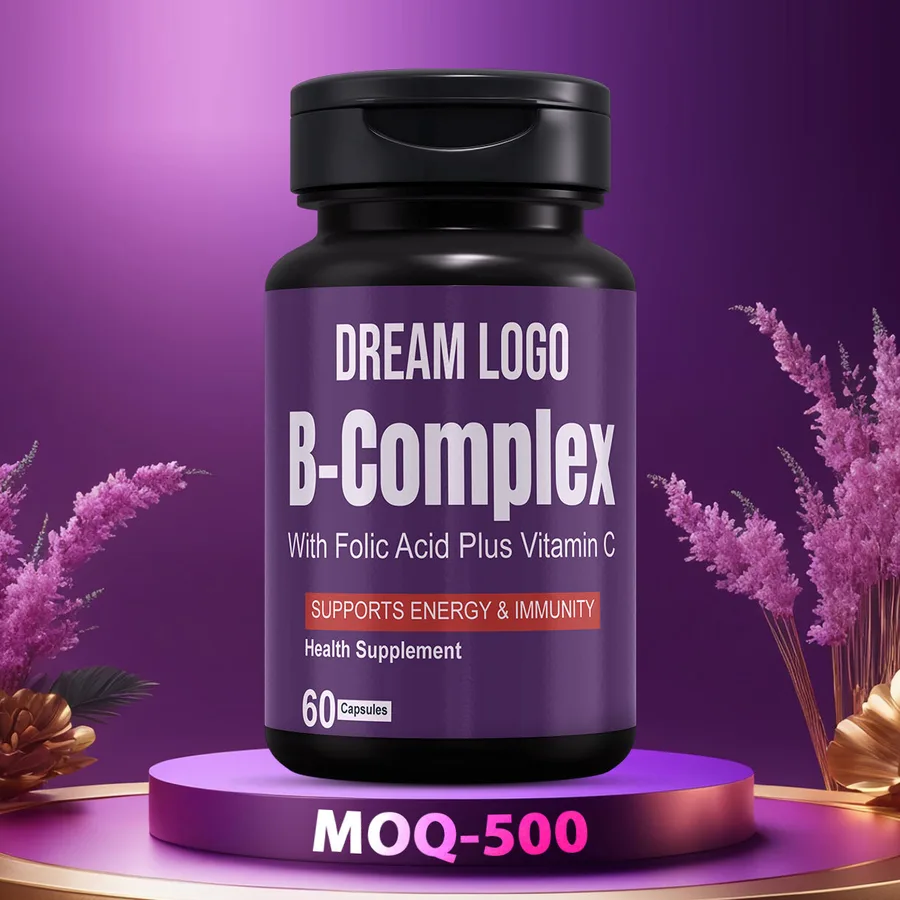
Our formulation: B-Complex Capsule. Related reading: विटामिन B12 की कमी के लक्षण और इलाज, why Indian vegetarians run short, शाकाहारी लोगों के लिए B12 के स्रोत, and private label vs custom formulation.
Get our product list and minimum orders
Leave your email and we will send the formats we make, the minimum order for each and typical lead times. We use it only to reply to you.
Manufacturing in this category?
We make products in this category for other people's brands. Tell us the format and volume and we will send a specification and a per-unit cost.
Request a quotation ↗NutraHerbal manufactures food supplements, Ayurvedic proprietary medicines and cosmetics for business customers. Product information on this site describes composition, format and commercial positioning for brand owners. It is not medical advice, does not claim to diagnose, treat, cure or prevent any disease, and is not a substitute for consulting a qualified practitioner. Final label claims are the brand owner's responsibility and must be approved for the destination market.
How we write and review content: editorial policy.