Reviewed for accuracy and claims compliance: Claims and compliance review
This is the shortest honest article in this cluster, because the answer is arithmetic.
Collagen trials that found an effect used 2.5 to 10 grams of collagen peptides a day.
A capsule holds roughly 500 milligrams of powder.
So a trial-range dose is ten to twenty capsules a day.
And almost every collagen capsule product on the market directs you to take one or two.
That is 500 to 1,000 mg against a 2,500 to 10,000 mg trial dose, between a fifth and a twentieth of what was studied.
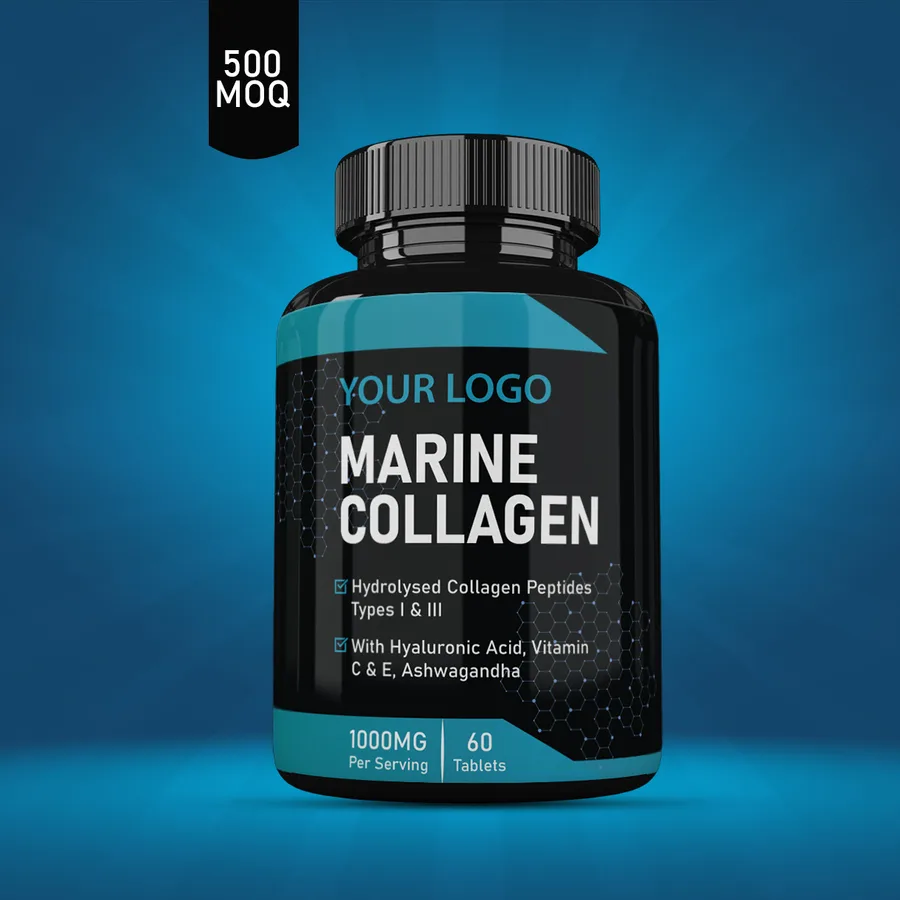
We sell a marine collagen capsule. This article explains why the powder is the only format that can deliver a real dose, and why we still make the capsule.
General information, not medical advice. And if you have a kidney stone history, there is a point about collagen and oxalate below that is worth reading first.
The dose, properly
What the research used:
Skin studies, typically 2.5 to 10 g a day of hydrolysed collagen peptides, for 8 to 12 weeks or longer. Several trials used 2.5 g, several used 5 g, and 10 g appears often.
Joint studies, often around 10 g a day for collagen hydrolysate in osteoarthritis and in athletes’ joint pain, over 12 to 24 weeks. And a separate line of research uses “undenatured type II collagen” at a much smaller dose, around 40 mg, which works by a completely different proposed mechanism and should not be confused with peptides. That 40 mg figure is sometimes borrowed to justify low-dose capsules of ordinary hydrolysate, and it does not transfer.
So the honest range to aim for: 2.5 g minimum, 5 to 10 g typical.
Now the formats:
| Per serving | To reach 5 g | To reach 10 g | |
|---|---|---|---|
| Powder (1 scoop ~10 g) | ~10 g | half a scoop | 1 scoop |
| Capsule (500 mg) | 0.5 g | 10 capsules | 20 capsules |
| Tablet (1000 mg) | 1 g | 5 tablets | 10 tablets |
| Liquid shot | varies, read it | varies | varies |
| Gummy | often 0.5–1 g | 5–10 gummies | 10–20 gummies |
Ten to twenty capsules a day is not a realistic regimen. Nobody does it, the cost would be absurd, and no label recommends it.
Which means the capsule format cannot deliver a studied dose. That is not a criticism of any brand; it is a volumetric fact about capsules.
Why the capsule exists anyway
And we should be straightforward, because we sell one.
Capsules sell because:
They are convenient, and collagen powder is not, it needs mixing.
They have no taste, and marine collagen in particular has a smell many people dislike.
They look like medicine, which is reassuring.
They travel.
And, the commercial reason, they are far cheaper to produce per unit sold. A tub delivering 10 g a day is 300 g of raw material a month. A bottle of 60 capsules is 30 g. Ten times less material, at a similar retail price.
That is the margin structure of the entire collagen capsule category, and it is why capsules are pushed harder than powders.
So why do we make one?
Because people ask for it, and because there is one honest use: a capsule is a reasonable low-dose supplement for someone who wants a small, consistent amount alongside a diet already high in collagen-building nutrients.
What it is not, is a way to replicate the trials. And we say so on the product page.
If a customer’s goal is the effect the research describes, we tell them to buy the powder. It costs us margin. We would rather not sell the same person the capsule twice and have them conclude collagen does nothing.
Gummies and shots
Gummies, typically 0.5 to 1 g of collagen per gummy, plus 2 to 4 g of sugar. To reach 5 g of collagen you would eat 5 to 10 gummies and 10 to 40 g of sugar. That is a candy with a protein garnish. We do not make them, and we have written about the gummy format generally.
Liquid shots, can deliver a real dose, and often do not. Read the label for grams per bottle, not “collagen-enriched”. And check the sugar, the preservative, and the price per gram, which is usually the worst in the category.
And the question behind the format question
Does collagen work at all?
The honest answer: modestly, for some things, with imperfect evidence.
Skin. A number of randomised trials report small improvements in skin elasticity and hydration, and some in wrinkle depth, over 8 to 12 weeks. Meta-analyses have found a statistically significant effect. And the caveats are real: many trials are funded by collagen manufacturers, the measured effects are small, outcome measures vary, and participant numbers are often modest.
Joints. Some evidence in osteoarthritis and in athletes with activity-related joint pain. Modest, and less than the evidence for exercise and weight management in knee osteoarthritis, which remain the interventions with the strongest support and which nobody can sell you.
Bone. Some trials in post-menopausal women with calcium and vitamin D, with small effects on bone density markers. Early.
Hair and nails. Weaker. Nail brittleness has some supporting data; hair growth does not.
Where there is nothing: weight loss, “detox”, gut healing as a medical claim, reversing ageing.
The mechanism, honestly
The intuitive story, “you eat collagen, it goes to your skin”, is not how it works.
Swallowed collagen is digested like any protein, into amino acids and small peptides. It does not travel intact to your dermis.
The plausible mechanism is more interesting: certain collagen-derived dipeptides, particularly prolyl-hydroxyproline, survive digestion, appear in blood, and may act as signalling molecules that stimulate fibroblasts to produce collagen.
That is a reasonable hypothesis with supporting work, and it is not proven in the way the marketing implies.
And one consequence worth knowing: collagen is an incomplete protein. It contains no tryptophan. So 10 g of collagen should not be counted towards your daily protein target the way 10 g of whey would be. It is a functional supplement, not a protein source.
What to check when buying
Grams of collagen peptides per serving. Not “contains collagen”. The number in grams.
Hydrolysed / peptides, hydrolysis breaks collagen into absorbable fragments. Unhydrolysed gelatin is not the same thing, and “collagen” without “hydrolysed” or “peptides” needs checking.
Type. Type I and III for skin (bovine and marine are rich in these); type II for cartilage (chicken-derived). And if a product claims “all five types”, ask what the quantity of each is.
Source. Bovine, marine, or chicken. Marine for anyone avoiding bovine; bovine is cheaper. Marine is a genuine allergy risk for fish-allergic people, and carries a heavy metal question.
Batch heavy metal testing, particularly for marine collagen, since fish and marine sources accumulate metals. We do not treat this as optional.
Added vitamin C, sensible, since vitamin C is genuinely required for collagen synthesis. One of the few combinations with a real rationale.
And the price per gram of collagen, not per bottle. This is the calculation that exposes the capsule economics immediately.
What not to pay extra for: “nano”, “ionic”, “marine-sourced from the deep sea”, “beauty collagen”, or a long herbal extract list at token doses.
Practical use
Powder, mixes into warm or cold water, coffee, milk, dal or curd. Collagen peptides are largely tasteless and dissolve well, which is a genuine advantage over most protein powders. Marine collagen can have a faint fishy smell; in coffee or with lemon it disappears.
Timing, no good evidence that it matters. Take it when you will remember.
Duration, 8 to 12 weeks minimum before judging. Skin turnover and the hair and nail cycles are slow, and anything shorter tells you nothing.
And honestly: if 12 weeks at a real dose changes nothing, that is your answer. The failure mode in this category is switching brands and starting the clock again.
What we will and will not say
Sayable: the authorised nutrient-function claims for any vitamins and minerals present, vitamin C’s contribution to normal collagen formation for the normal function of skin, bones, cartilage, gums, teeth and blood vessels; zinc’s contribution to the maintenance of normal skin, in the permitted wording. And factual disclosures: grams per serving, source, type, hydrolysis.
And the important regulatory fact: collagen peptides do not have an authorised health claim for skin or joints. So the trial evidence, such as it is, cannot be turned into a label claim.
Not sayable: reduces wrinkles, firms skin, anti-ageing, treats joint pain, treats arthritis, rebuilds cartilage, improves hair growth.
And three refusals:
We will not recommend a capsule as a way to reach a trial dose. The arithmetic does not allow it.
We will not use before-and-after photographs. Skin appearance varies with lighting, hydration, sleep and angle more than it varies with any supplement.
And we will not count collagen towards a protein claim, since it lacks tryptophan and is not a complete protein.
And the most honest summary:
Trials used 2.5 to 10 grams a day. A capsule holds half a gram. One or two capsules is a fifth to a twentieth of a studied dose.
The powder is the only format that reaches it, and powder is ten times more material per month, which is why capsules are marketed harder.
The effect at a real dose is modest and the evidence is imperfect and mostly industry-funded.
And sunscreen protects more skin collagen than any of this adds.
When to see a doctor
Before starting collagen, if you:
- have a kidney stone history, hydroxyproline is metabolised partly to oxalate, so a sustained high collagen intake is worth asking about if you form calcium-oxalate stones
- have kidney disease, protein load is set medically
- have a fish or shellfish allergy, avoid marine collagen; this is a real allergy risk, not a sensitivity
- have gout, ask about the protein source
- are pregnant or breastfeeding
- have beef or pork dietary or religious restrictions, check the source, which should be declared; bovine and porcine gelatin and collagen are both used
Get seen rather than supplementing if you have:
- joint pain with swelling, redness or warmth, or morning stiffness over 30–60 minutes, inflammatory arthritis needs early prescription treatment to prevent permanent joint damage, and delay is the harm
- a single joint that is hot, very painful and swollen, with fever, urgent
- joint pain after an injury, with locking or giving way
- skin that bruises easily and is thinning, with stretch marks and weight gain
- bleeding gums with poor healing, possible genuine vitamin C deficiency, treatable and sometimes missed
- hair loss, get ferritin and TSH first
Stop and get advice if you develop: rash, swelling of the lips or tongue, or breathing difficulty, particularly with marine collagen.
The short version
- Collagen trials used 2.5 to 10 g a day of peptides
- A capsule holds roughly 500 mg of powder
- So a trial dose is ten to twenty capsules daily
- Labels direct you to take one or two
- That is a fifth to a twentieth of what was studied
- The capsule format cannot deliver a studied dose, a volumetric fact, not a brand failing
- Skin trials ran 8 to 12 weeks or longer at 2.5 to 10 g
- Joint trials with hydrolysate often used around 10 g for 12 to 24 weeks
- Undenatured type II collagen works at ~40 mg by a different proposed mechanism
- That small figure is sometimes borrowed to justify low-dose hydrolysate capsules, and it does not transfer
- A 10 g daily dose is 300 g of material a month; 60 capsules is 30 g
- Ten times less material at a similar price, that is the capsule economics
- Which is why capsules are pushed harder than powders
- Gummies hold 0.5–1 g with 2–4 g sugar, a candy with a protein garnish
- Liquid shots can deliver a real dose and often do not, read grams per bottle
- Skin evidence: small improvements in elasticity and hydration, meta-analyses positive
- And mostly industry-funded, with small effects and modest numbers
- Joint evidence is modest, and weaker than exercise and weight management
- Bone evidence is early, with calcium and vitamin D
- Nail brittleness has some data; hair growth does not
- Swallowed collagen is digested, it does not travel intact to your skin
- The plausible mechanism is prolyl-hydroxyproline acting as a signal to fibroblasts
- Reasonable hypothesis, not proven as the marketing implies
- Collagen has no tryptophan, so it is an incomplete protein
- Do not count it towards your protein target
- Check grams per serving, and “hydrolysed” or “peptides”
- Type I and III for skin; type II for cartilage
- Demand batch heavy metal testing, especially for marine collagen
- Added vitamin C has a real rationale
- Compare price per gram of collagen, not per bottle
- Powder is largely tasteless and dissolves well, a real advantage
- Give it 8 to 12 weeks, then believe the answer
- Collagen peptides have no authorised health claim for skin or joints
- And sunscreen protects more skin collagen than any of this adds
Our products: Marine Collagen Capsule, Veg Collagen Builder. Related reading: there is no such thing as vegetarian collagen, कोलेजन के फ़ायदे और सच, marine vs vegetarian collagen, and private label vs custom formulation.
Get our product list and minimum orders
Leave your email and we will send the formats we make, the minimum order for each and typical lead times. We use it only to reply to you.
Manufacturing in this category?
We make products in this category for other people's brands. Tell us the format and volume and we will send a specification and a per-unit cost.
Request a quotation ↗NutraHerbal manufactures food supplements, Ayurvedic proprietary medicines and cosmetics for business customers. Product information on this site describes composition, format and commercial positioning for brand owners. It is not medical advice, does not claim to diagnose, treat, cure or prevent any disease, and is not a substitute for consulting a qualified practitioner. Final label claims are the brand owner's responsibility and must be approved for the destination market.
How we write and review content: editorial policy.