Reviewed for accuracy and claims compliance: Claims and compliance review
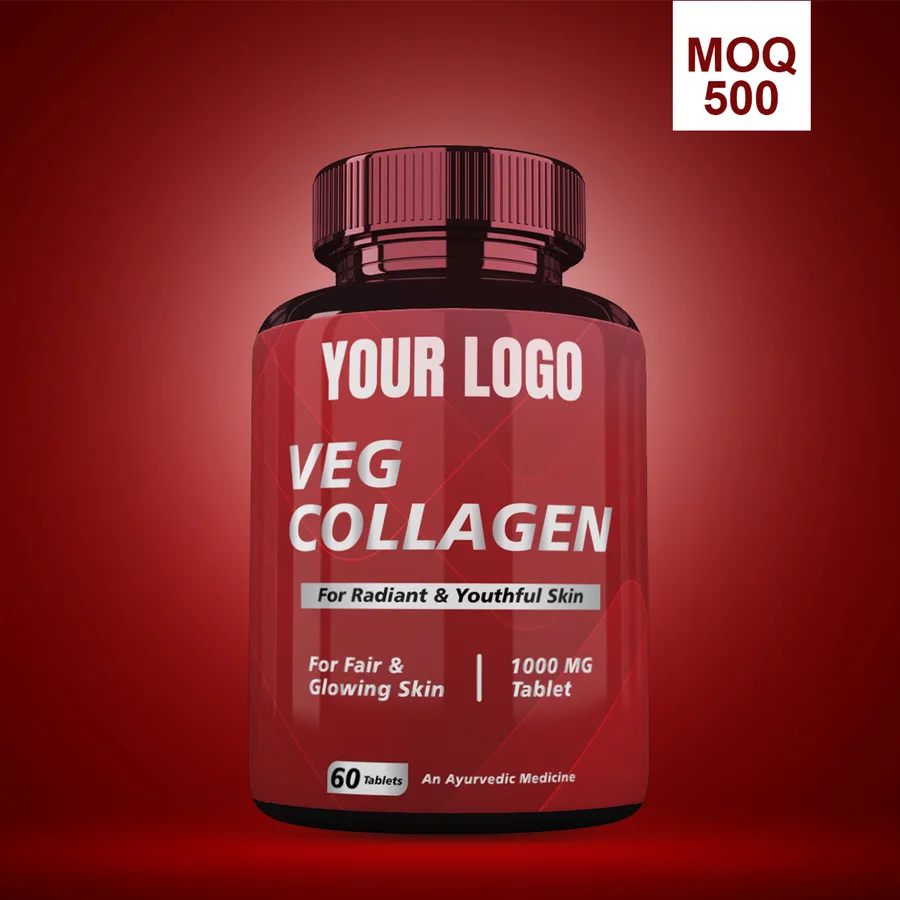
We sell a product called Veg Collagen Builder. The word “builder” in that name is doing something deliberate, and this article is about why it is there.
Collagen is a structural protein found in animals. Plants do not make collagen. They have no collagen genes.
So a plant-derived powder cannot contain collagen. Not a little. None.
Which means every “vegetarian collagen” and “vegan collagen” tub on an Indian shelf contains something other than collagen, and the honest word for that something is a builder: the raw materials and cofactors your body uses to make its own.
Whether that works is a separate question, and the answer is “partly, and much less than the name implies.”
General information, not medical advice. And if you have a kidney stone history, there is a point about collagen and oxalate at the end that applies to the animal-derived kind.
Why plants cannot have collagen
Collagen is the most abundant protein in the animal body, roughly a third of total protein. It is the structural scaffold of skin, tendon, ligament, cartilage, bone matrix and blood vessel wall.
Its structure is unusual and specific: three polypeptide chains wound into a triple helix, built on a repeating glycine–proline–hydroxyproline motif.
And hydroxyproline is the giveaway. It is a modified amino acid, made by hydroxylating proline after the protein chain is assembled, by enzymes that require vitamin C and iron.
Plants have structural materials too, cellulose, lignin, pectin. None of them is collagen, and none of them is protein in that sense.
So there is no botanical source. Not seaweed, not bamboo, not mushroom, not any fruit. A “plant-based collagen” claim is not an exaggeration; it is a category error.
What is actually in a “veg collagen” product
Open the ingredient list and you will find some combination of these. Each one has a real rationale, and each one has a limit.
Vitamin C, the strongest ingredient in the tub
And this is genuinely well founded.
Vitamin C is an essential cofactor for prolyl hydroxylase and lysyl hydroxylase, the enzymes that create hydroxyproline and hydroxylysine. Without it, collagen cannot be properly formed or cross-linked.
This is not a supplement-industry claim. It is why scurvy exists. Scurvy is, mechanistically, a collagen synthesis failure: bleeding gums, poor wound healing, skin fragility, loose teeth.
So vitamin C is genuinely required for collagen production.
And here is the limit: most people are not vitamin C deficient. Vitamin C is abundant in Indian food, amla, guava, citrus, capsicum, tomato, green chilli, and the requirement is modest.
So supplying more vitamin C to someone who already has enough does not increase collagen synthesis. The enzyme is not waiting for it.
Necessary is not the same as limiting. That distinction is the single most important idea in this article, and it applies to every ingredient below.
Glycine, proline, lysine
These are the amino acids collagen is built from, and the logic is intuitive: give the body the bricks.
The limit: on an adequate protein intake, you are not short of these. Glycine and proline are non-essential, your body synthesises them. Lysine is essential, and it is present in dal, dairy and soy.
Collagen synthesis in a well-fed person is not limited by the availability of glycine and proline. It is regulated by signalling, mechanical load on tendon, injury, hormonal state, age.
So the bricks are not the bottleneck. A builder product supplying more of them is supplying something you already have.
Where it might genuinely matter: someone with low total protein intake, which in India is not rare, and in that case the honest answer is “eat more protein”, not “buy a collagen builder.”
Silica, bamboo extract or horsetail
The rationale: silicon is involved in connective tissue formation, and there is some research interest in it.
The limit: human evidence that silica supplementation improves skin, hair or nails is weak. And horsetail contains thiaminase, an enzyme that degrades vitamin B1, so prolonged use carries a thiamine concern, which almost nobody mentions.
Zinc and copper
Both are genuine cofactors. Copper is required by lysyl oxidase, which cross-links collagen fibres. Zinc is involved in wound healing and matrix enzymes.
The limit: the same one, cofactors help if you are deficient. And zinc and copper compete for absorption, so a high zinc dose can cause copper deficiency, which is the opposite of what a collagen formulation wants. We have written about that.
Vitamin E, biotin, hyaluronic acid, herbal extracts
Variously plausible, variously weak. Biotin’s hair claim is “maintenance of normal hair”, not growth, and it falsifies thyroid and troponin blood tests at supplement doses, which has its own article.
So does a builder work?
Honest answer: it works to the extent that you were short of something in it.
If you have a genuinely low protein intake, or low vitamin C, or low zinc, correcting that supports collagen synthesis, and that is a real effect.
If you are well fed, the evidence that adding precursors and cofactors increases collagen production or improves skin is weak.
And comparing it against actual collagen peptides: hydrolysed collagen has a modest but real body of randomised trials showing small improvements in skin elasticity and hydration, and some benefit in joint pain. Many of those trials are industry-funded and the effects are small, but the evidence exists.
A collagen builder has no comparable body of trials. There is no set of RCTs showing that a vitamin-C-and-amino-acid blend improves skin the way collagen peptides modestly do.
So the honest ranking:
Collagen peptides: modest evidence, animal-derived, needs 2.5–10 g a day.
Collagen builder: weak evidence, plant-derived, and genuinely the only option for a vegetarian or vegan who wants something in this category.
And that last clause is why we make one. A Jain or vegan customer asking for collagen cannot have collagen. A builder is the honest alternative, provided it is named honestly.
The real vegan collagen, which is not in your tub
There is a genuine way to make vegan collagen, and it is worth knowing about because it is the exception that proves the rule.
Precision fermentation. Genetically engineered yeast or bacteria are given the human collagen gene sequence and produce actual collagen protein in a fermenter.
This is real. It exists. It is used in biotechnology, medical materials and high-end cosmetics.
And it is expensive, produced at small scale, and is almost certainly not in a tub costing a few hundred rupees in an Indian pharmacy.
So if a product says “vegan collagen” and does not specifically describe fermentation-derived collagen protein with a quantity, it is a builder with a borrowed name.
The labelling problem
This is where we think the category needs correcting, and our position costs us something.
“Vegetarian collagen” is, strictly, a false description. The product does not contain collagen.
Indian food labelling requires that a label not be misleading as to the nature of the product. A name that states an ingredient the product does not contain sits uncomfortably with that, whatever the small print says.
And in practice the small print usually does clarify it, “collagen builder”, “supports natural collagen”, “with collagen-building nutrients”. Which means the manufacturer knows.
Our position:
The word “builder” belongs in the product name, not in a footnote.
The ingredients and their quantities should be stated plainly, because then the customer can judge the formulation instead of the name.
And “supports your body’s natural collagen production” is a defensible framing, where it rests on authorised nutrient-function claims for the vitamins and minerals present.
We named ours Veg Collagen Builder for exactly this reason. Shorter names sell better. We kept the word.
What actually affects your collagen
This section argues against both products, and it is the useful part.
Collagen declines with age, that part is not preventable.
What accelerates it, and is modifiable:
Ultraviolet light. This is by far the largest controllable factor. UV directly degrades dermal collagen and activates enzymes that break it down. Photoageing is collagen loss, and it is the reason sun-exposed skin ages differently from covered skin on the same person.
Daily broad-spectrum sunscreen does more for your skin’s collagen than any oral supplement in this category. That is not a close contest, and it is cheaper.
Smoking. Strongly associated with accelerated skin ageing and impaired collagen synthesis.
High blood sugar. Glycation cross-links collagen and stiffens it, relevant in a country with this much diabetes.
Inadequate protein intake.
Vitamin C deficiency, the one nutrient link that is mechanistically certain.
And for skin specifically, the interventions with real evidence are topical: retinoids, which increase dermal collagen; and sunscreen, which stops you losing it.
So: sunscreen, do not smoke, control blood sugar, eat enough protein, and consider a retinoid. Then, if you still want it, a supplement.
What we will and will not say
Sayable: the authorised nutrient-function claims for the vitamins and minerals actually present, vitamin C’s contribution to normal collagen formation for the normal function of skin, bones, cartilage, gums, teeth and blood vessels (which is a genuine authorised claim and the reason this category exists at all); zinc’s contribution to the maintenance of normal skin; copper’s contribution to the maintenance of normal connective tissues; and so on, in the permitted wording.
Note how much work vitamin C’s authorised claim is doing. “Contributes to normal collagen formation” is permitted, and it is the honest basis for a builder product. It does not say “increases collagen”, and that distinction is the whole article.
Not sayable: contains collagen; plant-based collagen; reverses wrinkles; increases skin collagen; anti-ageing; firms skin; treats joint disease.
And three refusals:
We will not call a plant product “collagen” without “builder”.
We will not use before-and-after photographs for skin. Lighting, hydration, angle and makeup change apparent skin quality completely, and skin varies week to week on its own.
And we will not sell this as equivalent to collagen peptides. The peptides have modest trial evidence; the builder does not.
And the most honest summary:
Plants have no collagen genes, so there is no plant collagen. A “veg collagen” tub contains vitamin C, amino acids, silica and minerals, the materials and cofactors for making your own.
Vitamin C is genuinely required for collagen synthesis, which is why scurvy is a collagen disease. And being required is not the same as being the limiting factor, which it is not in a well-fed person.
Real vegan collagen exists through precision fermentation, and it is not what is in the tub.
And sunscreen protects more collagen than anything in this category adds.
When to see a doctor
Before taking a collagen or builder product, if you:
- have a kidney stone history, hydroxyproline in animal-derived collagen is metabolised partly to oxalate, so collagen peptides are worth asking about; builders are less relevant here
- have kidney disease, protein and mineral loads are set medically
- have a fish or shellfish allergy, marine collagen is a genuine allergy risk; and marine sources carry a heavy metal question, so ask for batch testing
- are pregnant or breastfeeding
- take zinc separately, watch total zinc and the copper balance
- are taking horsetail-containing products long term, thiaminase and vitamin B1
- have gout, ask, as protein source matters
Get seen rather than supplementing if you have:
- joint pain with swelling, redness or warmth, or morning stiffness lasting more than 30–60 minutes, this suggests inflammatory arthritis, where early prescription treatment prevents permanent joint damage, and delay is the real harm
- wounds that will not heal, and get blood sugar checked
- bleeding gums, easy bruising and poor healing together, this can be genuine vitamin C deficiency, which is treatable and sometimes missed
- skin that is thinning, bruising easily, with stretch marks and weight gain, this needs assessment
- hair loss, get ferritin and TSH first; we have written about that
The short version
- Collagen is an animal structural protein; plants have no collagen genes
- So there is no plant collagen, not a little, none
- It is about a third of total protein in the animal body
- Its structure is a triple helix on a glycine–proline–hydroxyproline repeat
- Hydroxyproline is made after assembly, by enzymes needing vitamin C and iron
- Plant structural materials are cellulose, lignin and pectin, not collagen
- So “plant-based collagen” is a category error, not an exaggeration
- A “veg collagen” tub contains builders: vitamin C, amino acids, silica, minerals
- Vitamin C is genuinely required for collagen synthesis
- Scurvy is mechanistically a collagen synthesis failure
- But most people are not vitamin C deficient, it is abundant in Indian food
- Necessary is not the same as limiting, the key idea in this article
- Glycine and proline are non-essential; your body makes them
- Collagen synthesis in a well-fed person is regulated by signalling, not by bricks
- If protein intake is genuinely low, the answer is more protein, not a builder
- Silica’s human evidence for skin, hair and nails is weak
- Horsetail contains thiaminase, which degrades vitamin B1, rarely mentioned
- Copper is needed by lysyl oxidase, which cross-links collagen
- High zinc causes copper deficiency, the opposite of what the formula wants
- Collagen peptides have modest but real RCT evidence for skin and joints
- Builders have no comparable body of trials
- Builders are still the honest option for a vegetarian or vegan
- Real vegan collagen exists via precision fermentation in engineered yeast
- It is expensive and is not in an affordable retail tub
- A “vegan collagen” claim without fermentation-derived protein and a quantity is a borrowed name
- “Builder” belongs in the product name, not a footnote
- UV light is by far the largest controllable cause of collagen loss
- Photoageing is collagen loss, sun-exposed skin ages differently on the same person
- Daily sunscreen does more for skin collagen than any oral product here
- Smoking and high blood sugar both accelerate collagen damage
- Glycation cross-links and stiffens collagen, relevant with this much diabetes
- Retinoids increase dermal collagen; that evidence is topical, not oral
- Vitamin C’s authorised claim is “contributes to normal collagen formation”
- Which is not “increases collagen”, and that is the whole distinction
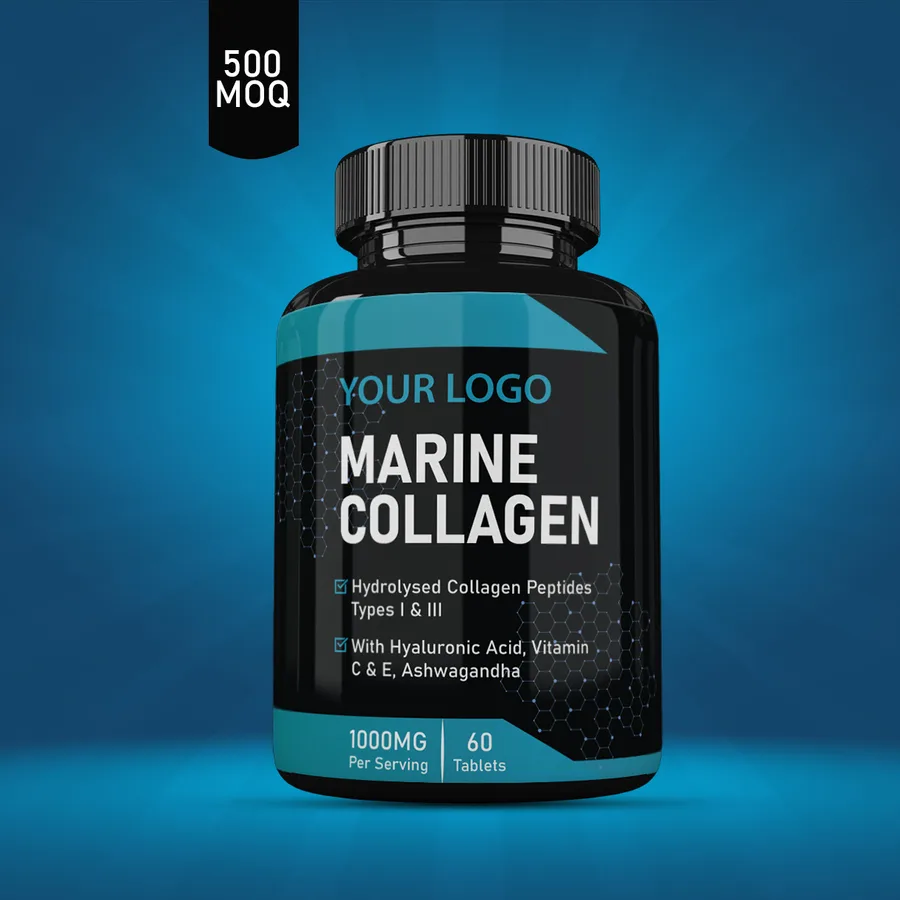
Our products: Veg Collagen Builder, Marine Collagen Capsule. Related reading: कोलेजन के फ़ायदे और सच, collagen powder vs capsule, the dose reality, marine vs vegetarian collagen, which should you buy, and label compliance.
Get our product list and minimum orders
Leave your email and we will send the formats we make, the minimum order for each and typical lead times. We use it only to reply to you.
Manufacturing in this category?
We make products in this category for other people's brands. Tell us the format and volume and we will send a specification and a per-unit cost.
Request a quotation ↗NutraHerbal manufactures food supplements, Ayurvedic proprietary medicines and cosmetics for business customers. Product information on this site describes composition, format and commercial positioning for brand owners. It is not medical advice, does not claim to diagnose, treat, cure or prevent any disease, and is not a substitute for consulting a qualified practitioner. Final label claims are the brand owner's responsibility and must be approved for the destination market.
How we write and review content: editorial policy.