Reviewed for accuracy and claims compliance: Claims compliance review
Let us get the most important thing out of the way in the first paragraph: there is no vegetarian source of collagen. Collagen is an animal protein. Plants do not make it.
So when you see “vegetarian collagen” or “plant-based collagen” on an Indian shelf, you are looking at one of two things, a product that is honest about being a collagen builder, or a product that is hoping you will not ask. Knowing which is which is most of what you need from this article.
What collagen actually is
Collagen is the structural protein that makes up a large share of skin, connective tissue, tendons and bone matrix. Type I is the dominant form in skin, which is why beauty products concentrate on it.
Supplemental collagen is hydrolysed, broken into short peptide chains. This matters because intact collagen is a large molecule that would not be absorbed usefully; the hydrolysed peptides are what the research examines.
Sources used commercially:
- Marine, from fish skin and scales. Mostly Type I, which is why it dominates beauty products.
- Bovine, from cattle hide and bone. Types I and III.
- Porcine, less common in the Indian market for obvious reasons.
All three are animal-derived. There is no fourth, plant option.
What a “vegetarian collagen” product actually contains
A well-made vegetarian product is a collagen builder, it supplies the raw materials and cofactors your body uses to make its own collagen, rather than supplying collagen itself.
That typically means:
Glycine and proline. The amino acids collagen is largely built from. Produced by fermentation, so genuinely vegetarian.
Vitamin C. Not optional window dressing, it is a required cofactor for the enzymes that hydroxylate proline and lysine during collagen synthesis. Without adequate vitamin C the process genuinely does not work properly.
Silica, often from bamboo. Traditionally associated with hair, skin and nails.
Gotu kola (centella). Classical mandukaparni, used in Ayurveda for skin and widely used in modern cosmetics as centella.
Biotin and zinc. Both with recognised roles in skin and hair.
Is that mechanism real? Yes, those are genuinely the substrates and cofactors collagen synthesis requires. Is it the same as taking collagen peptides? No, and any brand claiming equivalence is overstating. We make both products and we will not pretend otherwise.
Side by side
| Marine collagen | Vegetarian builder | |
|---|---|---|
| Is it collagen? | Yes, hydrolysed Type I peptides | No, precursors and cofactors |
| Vegetarian | No. Fish-derived | Yes |
| Research base | Reasonable body of trials on skin measures | Mechanistic; much thinner direct evidence |
| Typical dose | 2.5–10 g daily in trials | 3–6 g of amino acids plus cofactors |
| Format reality | Powder reaches research doses; capsules do not | Powder, for the same reason |
| Price | Higher | Moderate |
| Indian market reach | Limited by vegetarian preference | Much larger |
| Smell/taste | Marine note, needs masking | Neutral, easier to flavour |
The dose problem, this applies to both
This is the practical point most labels avoid.
Collagen trials typically use 2.5 to 10 grams a day. Grams. A 500 mg capsule containing 450 mg of collagen peptides delivers roughly a fifth of the lowest studied dose. You would need five to twenty capsules a day to reach the research range.
Same arithmetic applies to the vegetarian builder: meaningful glycine and proline intake is measured in grams.
So if the dose is your reason for buying, buy the powder. Capsules have a legitimate role, convenience, travel, pairing with other ingredients in a beauty routine, but they are not going to replicate a clinical trial, and we would rather say that than let you assume they will.
Which should you buy?
Buy marine if: you eat fish or are comfortable with fish-derived products, you want the version with actual research behind it, you are buying a powder, and price is not the deciding factor.
Buy the vegetarian builder if: you are vegetarian by conviction, which in India is a very large group, or you want something that pairs cleanly with the rest of a vegetarian supplement routine. You are buying a plausible mechanism rather than a trial-backed ingredient, and that is a reasonable trade for someone who will not take fish.
Buy neither if: you are expecting a dramatic visible change in a few weeks. Collagen research looks at measures over 8 to 12 weeks and the effects reported are modest. Sunscreen and sleep will do more for your skin than either product, and that is not a joke, it is the actual order of importance.
If you are launching in this category
A few notes from our side.
The vegetarian version reaches a much larger Indian market. Marine collagen rules itself out for a very large share of customers, and most brands in this category have not addressed them at all. That gap is the clearest opportunity here.
Say “collagen builder”, not “vegetarian collagen”. It is accurate, it survives scrutiny, and in our experience it does not reduce conversion, the audience is ingredient-literate enough to respect the distinction.
If you do marine, label it properly. The non-vegetarian mark goes on the front. Obscuring it in the Indian market is both a compliance problem and a reputational one, and the backlash when customers find out is severe.
Lead with powder. It is the format that can carry a credible dose, and it is where the category is going.
What a label may claim
Available: contributes to skin, hair and nail wellness; contains hydrolysed Type I collagen peptides (if it does); supplies glycine, proline and vitamin C for collagen synthesis; supports skin hydration and elasticity.
Not available: reverses ageing; removes wrinkles; “plant collagen”; claims of equivalence between a builder and collagen peptides; any specific timeline promise.
Safety notes
- Marine collagen is not suitable for anyone with a fish allergy.
- Both are generally well tolerated; digestive upset at higher intakes is the most common complaint.
- Pregnancy and breastfeeding, consult a practitioner before any new supplement.
- Collagen is a protein and not a complete one; it is not a protein substitute for dietary purposes.
This article is information, not medical advice.
The short version
There is no vegetarian collagen, what is sold as such is a builder supplying precursors and cofactors, which is a real mechanism but not the same thing. Marine collagen is actual Type I peptides with a better research base and excludes a large part of the Indian market. Research doses are in grams, so buy powder if the dose is the point. And neither will outperform daily sunscreen.
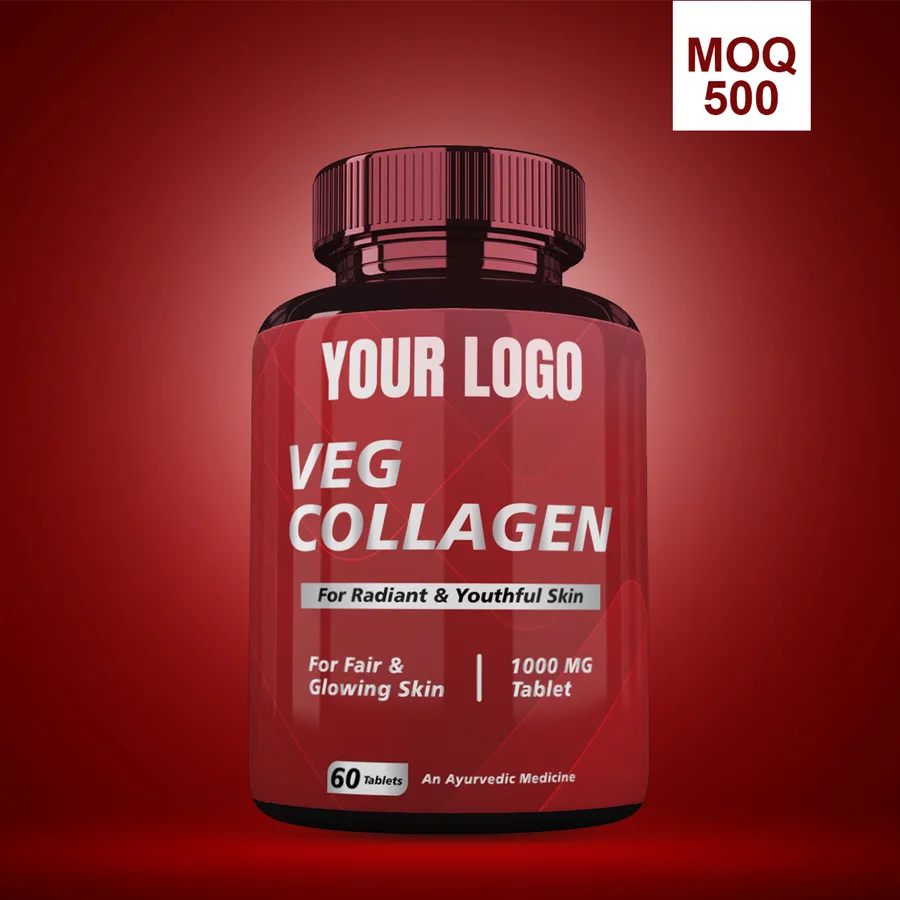
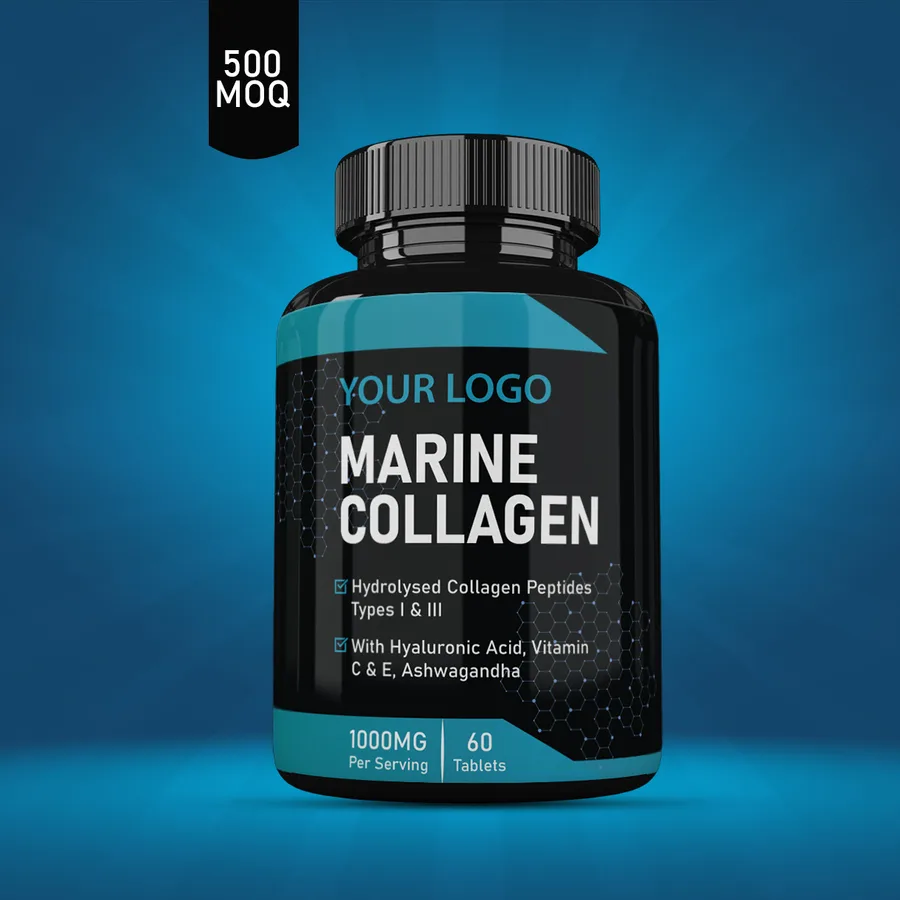
See veg collagen builder and marine collagen capsule for compositions.
Get our product list and minimum orders
Leave your email and we will send the formats we make, the minimum order for each and typical lead times. We use it only to reply to you.
Manufacturing in this category?
We make products in this category for other people's brands. Tell us the format and volume and we will send a specification and a per-unit cost.
Request a quotation ↗NutraHerbal manufactures food supplements, Ayurvedic proprietary medicines and cosmetics for business customers. Product information on this site describes composition, format and commercial positioning for brand owners. It is not medical advice, does not claim to diagnose, treat, cure or prevent any disease, and is not a substitute for consulting a qualified practitioner. Final label claims are the brand owner's responsibility and must be approved for the destination market.
How we write and review content: editorial policy.