Reviewed for accuracy and claims compliance: Claims compliance review
Shatavari is the ingredient most often put forward for menopause in India, and it deserves a more careful account than it usually gets, both of what the classical framework says and of what the modern evidence does and does not show.
We manufacture shatavari products. That is a reason to be more careful here, not less.
This is information, not medical advice. Nothing here treats menopause. Any bleeding more than a year after your last period needs prompt investigation, whatever else is going on.
The classical framework, on its own terms
Worth setting out properly, because it is usually reduced to “shatavari is good for women”, which is not what the texts say.
Ayurveda describes life in stages (avastha), each with a dominant dosha. Childhood is kapha-predominant, adult life pitta, and later life vata-predominant.
Menopause sits at that transition into the vata stage, and in the classical reading, the symptom picture reflects it.
And this is where the framework is internally coherent in a way worth noticing. The classical vata qualities are dry, light, cold, mobile, rough and erratic. Map that onto the menopausal symptom list:
- Dryness, vaginal dryness, dry skin, dry eyes, dry mouth
- Joint pain and stiffness, classically a vata presentation
- Disturbed sleep, anxiety, restlessness, mobility and erratic quality
- Thinning of hair, skin and bone, the light, rough quality
- Constipation
Hot flushes, by contrast, are read as pitta, heat, sweating, irritability, and the classical approach distinguishes between a predominantly vata presentation and a predominantly pitta one, treating them differently.
And this is the genuinely interesting part: that distinction corresponds reasonably well to what modern practice observes, that women present quite differently, some dominated by vasomotor symptoms and others by dryness, joint pain and sleep disturbance.
The classical response to a vata stage is broadly: nourishing, warm, moist, grounding and regular. Oils rather than dryness, warm cooked food rather than raw, routine rather than irregularity, and rasayana (rejuvenative) therapy.
Panchakarma, abhyanga (oil massage), and dietary regulation are part of the classical approach, and abhyanga, whatever one makes of the theory, is a daily self-massage practice that is pleasant, safe and arguably good for sleep. We would not oversell it and we would not dismiss it.
Where shatavari sits
Asparagus racemosus. In the classical texts it is classified as:
- Rasayana, rejuvenative
- Balya, strength-giving
- Stanyajanana, promoting breast milk, which is its best-known classical indication
- Shukrala, and notably it appears in both male and female contexts
- Madhura in rasa (sweet), sheeta (cooling), and snehana (unctuous, moistening)
Those last three are why it is the classical choice for this stage: sweet, cooling and moistening is the direct counter to dry, rough and hot. It is prescribed for the vata dryness and the pitta heat at once, which is a coherent reason for its prominence rather than an arbitrary one.
In the classical literature it appears in formulations like Shatavari Kalpa and Shatavari Ghrita, and in combination far more often than alone, which matters, because single-herb capsules are a modern format, not a classical one.
And its single most established classical use is lactation, not menopause. That is worth stating plainly, because the menopause positioning is substantially a modern extension of the general “women’s tonic” framing.
What modern studies show
Here we have to be careful, and we will be.
On the chemistry: shatavari contains steroidal saponins (shatavarins), along with sapogenins, flavonoids, mucilage and polysaccharides. The saponins are the usual focus.
On “phytoestrogen”: shatavari is frequently described as a phytoestrogen, and that description is weaker than it is usually presented.
Its saponins have been investigated for oestrogen-receptor-related activity in laboratory systems with mixed and modest results. It is not in the same category as soy isoflavones or red clover, whose isoflavones are structurally similar to oestradiol and much better characterised. Calling shatavari a phytoestrogen on a label is, in our view, overstating what is known.
On menopausal symptoms: there are some small human studies, including on shatavari-containing formulations, reporting improvement in symptom scores. And the limitations are substantial: small sample sizes, short duration, frequent absence of good blinding, multi-ingredient formulations that make attribution impossible, and generally industry involvement. There is not a body of evidence here that would support a confident claim.
On lactation, where the classical use is strongest, the modern evidence is also mixed, some small studies reporting increased prolactin or milk volume, others not.
On the laboratory pharmacology: antioxidant, anti-inflammatory, immunomodulatory, adaptogenic and gastroprotective effects have been reported. These are preclinical findings and the gap between a cell culture result and a benefit in a woman of fifty is large.
Our honest summary: long and consistent traditional use; a plausible pharmacological profile; and human evidence for menopause that is preliminary rather than persuasive. That is a defensible thing to sell. It is not a treatment.
Safety, which deserves more attention than it gets
Generally well tolerated, with a long history of food-adjacent use.
And the real cautions:
Asparagus family allergy, uncommon but real.
Pregnancy, classical texts use it in pregnancy, and modern practice in our view should defer to a doctor. We do not promote it for pregnancy.
Oestrogen-sensitive conditions, a history of breast, uterine or ovarian cancer, or endometriosis or fibroids. Even though we have just argued the phytoestrogen claim is overstated, the correct response to uncertainty here is caution, not confidence. Ask the treating doctor.
Diabetes medication, blood-sugar-lowering effects have been reported, so monitoring matters if you are on treatment.
Diuretics and lithium, a theoretical diuretic effect.
And the one that applies to this whole category and is more important than any of the above: heavy metals and adulteration.
Ayurvedic products have repeatedly been found contaminated with lead, mercury and arsenic, and some have been found adulterated with undeclared steroids or NSAIDs. This is a documented and recurring problem in this industry, including in exported products.
So the practical instruction to a buyer: ask for heavy metal test reports, lead, mercury, arsenic, cadmium, batch-wise. Ask for the microbiology. Ask for the licence number and verify it. A manufacturer who cannot produce these on request is telling you something.
We say this knowing we are a manufacturer, and we would rather be judged on whether we can produce those documents than on our marketing.
The other classical ingredients in this area
Ashwagandha (Withania somnifera), rasayana, with more human study behind it than most, principally on stress, sleep and anxiety. For a woman whose main menopausal problems are sleep and mood rather than flushes, this is arguably the more relevant ingredient. Caution in thyroid disease and autoimmune conditions.
Ashoka (Saraca asoca), the classical herb for uterine and menstrual complaints, and more relevant to perimenopausal bleeding than to post-menopausal symptoms. And heavy bleeding needs a diagnosis, not a herb.
Lodhra, Guduchi/Giloy, Yashtimadhu (mulethi), and mulethi deserves a specific warning: it raises blood pressure and lowers potassium with sustained use. It is not benign in long-term daily doses.
Brahmi and Shankhpushpi, for the cognitive and sleep complaints.
Triphala, for constipation, and not as an indefinite daily laxative.
And the classical formulations, Shatavari Kalpa, Ashokarishta, Dashamoolarishta, Chyawanprash, which are licensed as classical Ayurvedic medicines under a different regulatory route from food supplements. That distinction is not cosmetic, and it governs what may be printed on the pack.
The regulatory point, since it explains label wording
Two routes, and the difference matters.
A classical Ayurvedic formulation, made to a text recognised in the First Schedule of the Drugs and Cosmetics Act, is licensed as an Ayurvedic medicine and may carry the indications the text gives.
A food supplement under FSSAI’s nutraceutical route may not make medicinal claims at all, only permitted nutrient-function and traditional-use statements.
And above both sits the Drugs and Magic Remedies (Objectionable Advertisements) Act, which restricts advertising for a schedule of conditions regardless of which licence you hold.
So a shatavari capsule sold as a food supplement cannot say what a licensed Shatavari Kalpa may say, and this is the single most common compliance failure we see in this category. Companies take indications from a classical text and print them on a food-supplement label. That is not a grey area.
What we will and will not print
What is sayable on our food-supplement labels: a traditional-use statement, that shatavari has been used in Ayurveda as a rasayana and in women’s health, clearly framed as traditional use, not as a proven effect. Plus any authorised nutrient-function claims for vitamins and minerals in the formulation.
What is not sayable: treats menopause, relieves hot flushes, balances hormones, is a natural alternative to HRT, or increases breast milk. These are medicinal claims on a supplement label.
And “natural alternative to HRT” is the one we refuse most firmly, because it is the most harmful. It positions a preliminary-evidence supplement against the most effective available treatment, and a woman who delays a conversation about hormone therapy on the strength of that phrase has been actively misled.
What we also decline: before-and-after imagery, testimonial claims about symptom relief, and the word “cure” in any form.
The honest ranking
If a woman asked us what to do about menopausal symptoms, in order:
1. Resistance and weight-bearing exercise. It addresses bone, muscle, sleep, mood, joint pain and cardiovascular risk simultaneously. Nothing we make comes close to it, and it is free.
2. See a doctor and discuss hormone therapy, because it is the most effective treatment for symptoms, and because the fear surrounding it came from interpretations that have since been substantially revised. This is also the point at which thyroid, B12, vitamin D, lipids and blood pressure get checked.
3. Local treatment for vaginal dryness, which is highly effective, minimally absorbed, and under-used because nobody raises it.
4. Diet, protein, calcium, vitamin D and sleep.
5. And then, if you want it, shatavari or a classical formulation, as something with long traditional use, a plausible profile, and preliminary human evidence. Alongside the above, not instead of it.
That is the ranking we would give our own family, and it places our product fifth.
When to see a doctor
Urgently:
- Any bleeding more than a year after your last period, always investigated
- Very heavy bleeding, or bleeding after intercourse
- A breast lump or nipple discharge
- Chest pain or new breathlessness, and in women, presentation is often atypical
- Sudden severe back pain, a vertebral fracture can occur without a fall
Soon:
- Periods stopping before 40, investigation is needed
- Persistent low mood, depression risk is raised in perimenopause
- Vaginal dryness or pain with intercourse, treatable, and it does not improve on its own
- Before starting shatavari with a history of hormone-sensitive cancer, endometriosis or fibroids, or if you take diabetes medication, diuretics or lithium
- Any fracture from a minor knock
The short version
- The classical framework reads menopause as a transition into the vata stage, and the vata qualities map unexpectedly well onto dryness, joint pain, thinning and disturbed sleep.
- It distinguishes a vata presentation from a pitta one (flushes, heat) and treats them differently, a distinction modern practice would recognise.
- Shatavari is classically sweet, cooling and moistening, the direct counter to dry, rough and hot, which is a coherent reason for its use.
- Its strongest classical indication is lactation, not menopause.
- It appears classically in combinations, not as a single-herb capsule.
- The “phytoestrogen” description is overstated, it is not comparable to soy isoflavones.
- Human evidence for menopausal symptoms is preliminary: small, short, mostly multi-ingredient studies.
- Our honest summary: long traditional use, plausible profile, unpersuasive human evidence.
- Ask about hormone-sensitive conditions, diabetes medication, diuretics and lithium.
- Heavy metal contamination and steroid adulteration are documented problems in this category.
- Ask for batch-wise lead, mercury, arsenic and cadmium reports. A manufacturer who cannot produce them is telling you something.
- Ashwagandha may be more relevant where sleep and mood dominate.
- Mulethi raises blood pressure and lowers potassium with sustained use.
- Classical medicines and food supplements are licensed differently, and food supplements cannot borrow a text’s indications.
- The Drugs and Magic Remedies Act applies regardless of licence.
- “Natural alternative to HRT” is the claim we refuse most firmly, it causes real harm by delay.
- Exercise first, the doctor’s conversation second, local treatment third, the supplement is fifth, and we will say so.
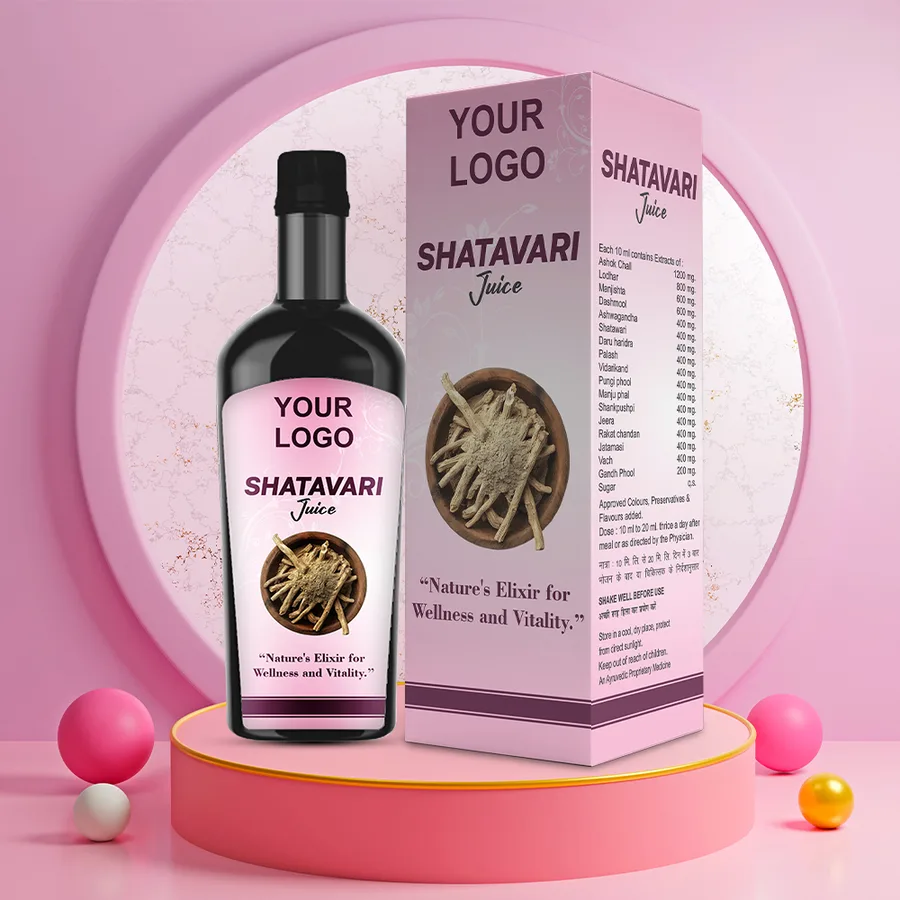
Composition detail: shatavari juice and Femino 360. Related: मेनोपॉज़ के लक्षण और उपाय, bone and heart health after menopause, and licences for Ayurvedic manufacturing.
Get our product list and minimum orders
Leave your email and we will send the formats we make, the minimum order for each and typical lead times. We use it only to reply to you.
Manufacturing in this category?
We make products in this category for other people's brands. Tell us the format and volume and we will send a specification and a per-unit cost.
Request a quotation ↗NutraHerbal manufactures food supplements, Ayurvedic proprietary medicines and cosmetics for business customers. Product information on this site describes composition, format and commercial positioning for brand owners. It is not medical advice, does not claim to diagnose, treat, cure or prevent any disease, and is not a substitute for consulting a qualified practitioner. Final label claims are the brand owner's responsibility and must be approved for the destination market.
How we write and review content: editorial policy.