Reviewed for accuracy and claims compliance: Claims and compliance review
“Panch tulsi”, five tulsi, is one of the most successful product names in the Indian herbal market. It sounds traditional, complete and self-evidently better than one tulsi.
And it conceals a real botanical fact: the five are usually not five varieties of one plant. They are usually several different species.
Some are Ocimum tenuiflorum, the plant classical texts mean by tulasi. Others are Ocimum gratissimum, Ocimum basilicum or Ocimum kilimandscharicum, different species with substantially different essential oil chemistry.
That is not necessarily a bad thing. A deliberate multi-species blend can be a reasonable formulation.
What is not reasonable is that almost no label tells you which five, so you cannot know what you are taking.
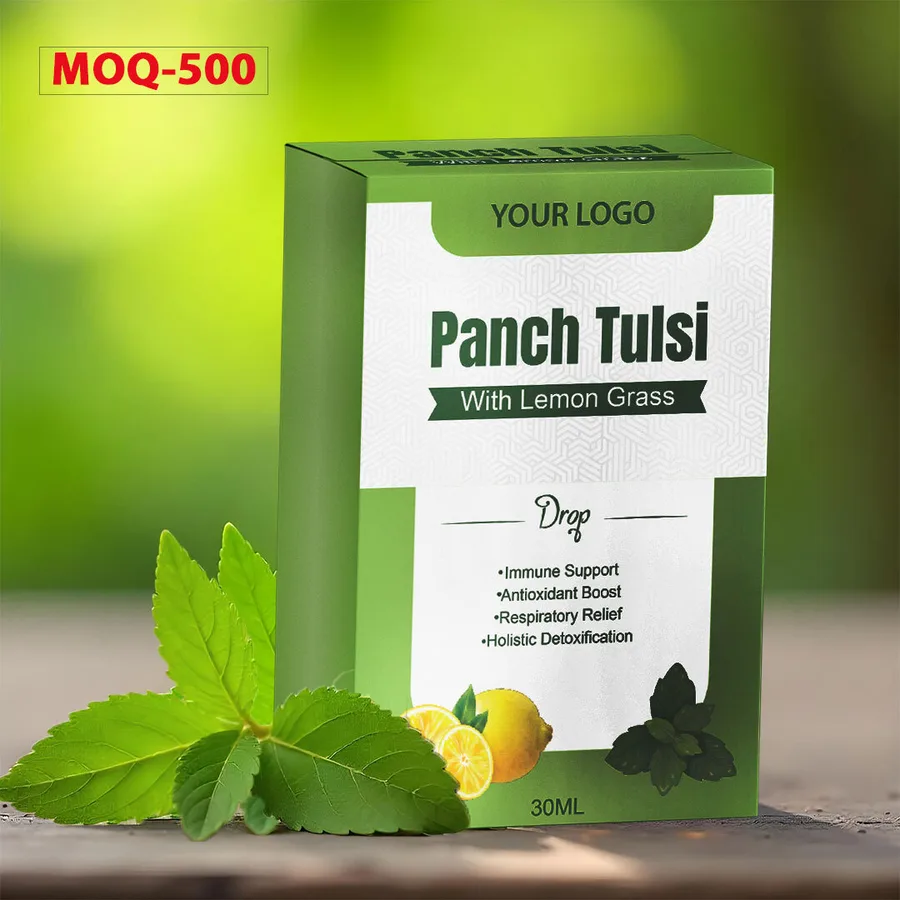
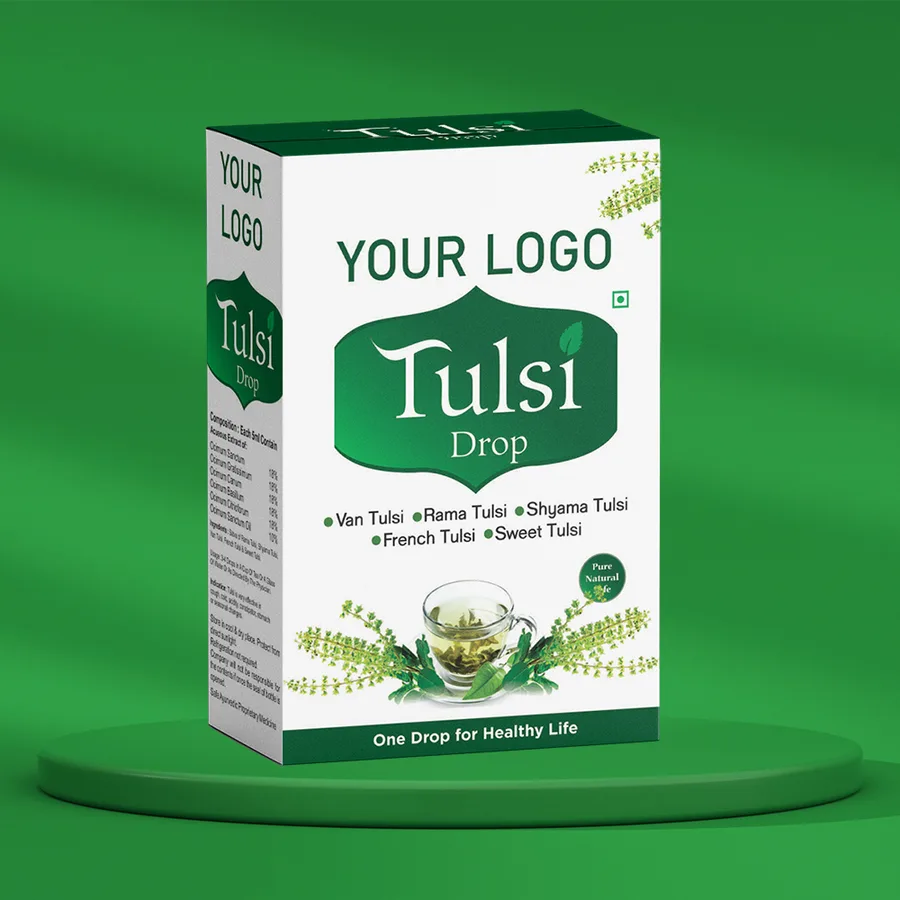
We make panch tulsi drops and juice. This article explains what is in that category and what a label should say.
General information, not medical advice. And tulsi has safety notes that are rarely mentioned, particularly for couples trying to conceive. Those have their own article.
The plant classical texts mean
Tulasi in Ayurvedic literature refers principally to Ocimum tenuiflorum (long written as Ocimum sanctum), family Lamiaceae.
Its classical description is consistent: katu-tikta rasa (pungent and bitter), ushna virya (hot potency), kapha-vata shamaka, and used in kasa-shwasa (cough and breathing), jvara (fever) and krimi (worms) contexts.
And its dominant essential oil constituent is eugenol, the same compound that gives clove its character. Eugenol is the reason tulsi smells and tastes the way it does, and it carries most of tulsi’s documented pharmacology, including the antiplatelet activity that matters for safety.
Within Ocimum tenuiflorum there are two widely grown forms:
Rama tulsi, green leaves, milder aroma. Krishna or Shyama tulsi, purple-tinged leaves, sharper aroma, traditionally regarded as the more medicinally potent of the two.
Those two genuinely are varieties of one species. So “two tulsis” would be botanically honest.
“Five” requires going outside the species.
The five, as commonly listed
Compositions vary by manufacturer, and this is the usual set:
1. Rama tulsi, Ocimum tenuiflorum, green form. Eugenol-dominant.
2. Krishna / Shyama tulsi, Ocimum tenuiflorum, purple form. Eugenol-dominant, generally higher.
3. Vana tulsi, usually Ocimum gratissimum, sometimes called wild or forest tulsi. A different species. Its oil is typically eugenol-rich too, though the profile differs, and in some chemotypes thymol predominates.
4. Kapoor tulsi, variously assigned. Often Ocimum kilimandscharicum (camphor basil), whose oil is camphor-rich, a genuinely different chemistry from eugenol, and sometimes a form of Ocimum basilicum. The naming here is the least consistent in the whole category.
5. Shwet or Babui tulsi, usually Ocimum basilicum, which is sweet basil. Its oil is typically dominated by linalool and methyl chavicol (estragole), not eugenol.
Look at what that list actually is:
Two varieties of the classical tulsi, and three other species, one of which is the sweet basil used in Italian cooking.
And their essential oils differ fundamentally: eugenol, camphor and linalool are not interchangeable compounds.
So does the blend make sense?
Being fair, because there is an argument for it.
The case for a blend:
Different species contribute different volatile compounds, which for a product intended to relieve nasal and throat symptoms is a reasonable formulation idea, camphor, for instance, genuinely produces a sensation of nasal opening, which is why it is in balms.
Traditional and regional practice does use several Ocimum species, and different regions call different plants tulsi. So a blend is not a fabrication; it reflects a real plurality of use.
And a blend hedges against the chemical variability of any single batch.
The case against:
You cannot know the dose of anything. If the label does not say which species in what proportion, the eugenol content, the constituent that carries most of tulsi’s pharmacology and its antiplatelet caution, is unknown.
The classical claim does not transfer. When a product cites tulasi’s classical designations, those refer to Ocimum tenuiflorum. A blend that is mostly Ocimum basilicum is not the plant the texts describe, and quoting the texts for it is a stretch.
And one specific point worth raising: Ocimum basilicum oil can contain methyl chavicol (estragole), a compound that has attracted regulatory attention in Europe on genotoxicity grounds at high exposures. In culinary basil this is not a concern. In a concentrated daily drop product, the quantity is a fair question, and the label does not let you ask it.
Our honest reading: a panch tulsi blend is a defensible product and an undisclosed one. The problem is not the blending. It is that “panch tulsi” is treated as an ingredient name rather than as a formula requiring declaration.
What a label should say
And this is the practical part.
Each species, named botanically. “Ocimum tenuiflorum, Ocimum gratissimum, Ocimum basilicum…”, with the common name beside it.
The proportion, or at least the order by quantity.
The part used, leaf, for all of them.
Whether it is an extract or a distillate, and the strength. Drops in particular can be an aqueous extract, an oil, or a hydro-alcoholic extract, and these are not comparable.
The quantity per serving in millilitres or drops, with the material content stated.
And the base, water, glycerine, alcohol, or oil. Alcohol content matters for some customers and for children.
What you will usually find instead: “Panch Tulsi Extract” and nothing else.
We think that is inadequate, and we have moved our own labels toward naming the species. It makes the ingredient list longer and less elegant. It also means a customer, a doctor or a client’s regulatory team can actually assess the product.
Does five work better than one?
There is no comparative trial.
Nobody has tested a five-species tulsi blend against Ocimum tenuiflorum alone, for any outcome.
So “panch tulsi is more effective” is an assumption, and a commercially convenient one.
And the honest counter-argument: the human evidence that exists for tulsi, principally the small trials on blood glucose, and some on stress markers, was generated with Ocimum tenuiflorum, usually as a defined leaf extract.
So if you want the thing the evidence was generated with, you want single-species tulsi, properly identified.
That is an uncomfortable conclusion for a company selling panch tulsi drops, and we think it is the accurate one.
Where the blend has a genuine case: as a symptomatic aromatic preparation for colds and throat discomfort, where multiple volatile compounds plausibly contribute and nobody is claiming a measured pharmacological effect.
Where the single species has the better case: anywhere a specific effect is being sought, or where the classical designations are being cited.
The quality questions
Species identity, confirmed. This is the whole point of the article. Macroscopic and microscopic identification, and ideally GC-MS of the essential oil profile, which for Ocimum is genuinely informative, eugenol, camphor, linalool and methyl chavicol have distinct signatures, so the chromatogram tells you what you actually bought.
That test is not exotic and it is the one that settles this category.
Batch-wise heavy metals, lead, arsenic, mercury, cadmium.
Pesticide residues.
Microbiology, leaves are dried in the open, and this matters for drops and juices.
And for liquids: preservative declared, alcohol content declared, and a sensible shelf life, because volatile oils degrade, and an old tulsi drop product smells flat, which is a usable consumer check.
Practical notes on the formats
Fresh leaves, the cheapest and in many ways the best. 3 to 5 leaves. And cover the vessel when making tulsi tea, because the volatile oil leaves with the steam, which is the main constituent.
Drops, concentrated and convenient, and the format where dosing errors are commonest. We have written a separate practical article on using them.
Juice, diluted, preserved, and the weakest of the formats for a leaf whose activity sits in volatile oil.
Capsules, measured, tasteless, and opaque.
What we will and will not say
Sayable: the botanical names and part used; a traditional-use statement framed as traditional use, including the classical kasa-shwasahara and kapha-vata shamaka designations described as classical designations and attributed to Ocimum tenuiflorum; the quantity; and authorised claims for any vitamins or minerals present.
And the governing fact: there is no authorised health claim for tulsi.
Not sayable: boosts immunity, treats colds or cough, prevents viral infection, helps in dengue or raises platelets, treats diabetes, treats stress, detoxifies.
And three refusals:
We will not claim that five species work better than one, because no comparison has been done.
We will not cite Ocimum tenuiflorum’s classical designations for a blend without stating which species dominate it.
And we will not make dengue or platelet claims under any circumstances, because delaying monitoring in dengue on the strength of a herb is a risk to life, and that claim circulates heavily in the tulsi and giloy categories.
And the most honest summary:
“Panch tulsi” is a formula, not an ingredient. The five are usually two varieties of Ocimum tenuiflorum plus three other species, one of which is sweet basil.
Their essential oils are chemically different, eugenol, camphor, linalool, so they are not interchangeable.
No trial has compared the blend against single-species tulsi, and the human evidence that exists was generated with Ocimum tenuiflorum.
The blend is defensible as an aromatic preparation. It is not defensible as an undeclared one.
When to see a doctor
Before taking concentrated tulsi products, if you:
- are trying to conceive, either partner; animal studies document antispermatogenic effects
- are pregnant or breastfeeding
- take an anticoagulant or antiplatelet medicine, eugenol has documented antiplatelet activity; and stop before surgery
- take diabetes medication, tulsi lowers blood glucose; monitoring, and do not reduce your own dose
- have liver disease, eugenol at high doses
- take thyroid medication
- are giving it to a child, paediatrician, and check the alcohol content of drops
Do not rely on a herb, get seen, for:
- fever beyond three days, or fever with rash, severe weakness, or bleeding from gums or nose, dengue needs testing and platelet monitoring
- breathlessness or chest tightness
- difficulty swallowing or breathing
- cough lasting more than three weeks, or coughing blood, especially with any tobacco use
- a child with high fever, lethargy, or refusing fluids
The short version
- “Panch tulsi” is a formula, not an ingredient
- The five are usually not five varieties of one plant
- Classical tulasi means Ocimum tenuiflorum
- Its dominant essential oil constituent is eugenol, the clove compound
- Eugenol carries most of tulsi’s documented pharmacology and its antiplatelet caution
- Rama and Krishna tulsi genuinely are two varieties of that one species
- So “two tulsis” would be botanically honest; five requires other species
- Vana tulsi is usually Ocimum gratissimum, a different species
- Kapoor tulsi is often Ocimum kilimandscharicum, whose oil is camphor-rich
- The naming of kapoor tulsi is the least consistent in the category
- Shwet or babui tulsi is usually Ocimum basilicum, sweet basil
- Its oil is typically linalool and methyl chavicol dominated, not eugenol
- So one of the five is the basil used in Italian cooking
- Eugenol, camphor and linalool are not interchangeable compounds
- The case for blending: different volatiles, real regional plurality, batch hedging
- Camphor genuinely produces a sensation of nasal opening
- The case against: you cannot know the dose of anything
- Without proportions, eugenol content is unknown
- And classical claims refer to Ocimum tenuiflorum, so they do not transfer to a basil-dominant blend
- Ocimum basilicum oil can contain methyl chavicol, which has drawn regulatory attention at high exposures
- Culinary basil is not a concern; a concentrated daily product is a fair question
- A label should name each species botanically, with proportions
- And state extract or distillate, strength, and the base, water, glycerine, alcohol or oil
- Alcohol content matters for some customers and for children
- What you usually get is “Panch Tulsi Extract” and nothing else
- No trial has compared five species against one, for any outcome
- So “panch tulsi works better” is an assumption, not a finding
- The human evidence for tulsi was generated with Ocimum tenuiflorum
- GC-MS of the essential oil profile is the test that settles identity here
- Eugenol, camphor, linalool and methyl chavicol have distinct signatures
- Cover the vessel when making tulsi tea, the volatile oil leaves with the steam
- Old tulsi drops smell flat, which is a usable consumer check
- There is no authorised health claim for tulsi
- And we will not make dengue or platelet claims under any circumstances
Ingredient detail: tulsi. Our formulations: Panch Tulsi Drops, Panch Tulsi Juice, Tulsi Capsule. Related reading: तुलसी के फ़ायदे और रोज़ का इस्तेमाल, tulsi safety notes people rarely mention, giloy vs tulsi for immunity, and label compliance.
Get our product list and minimum orders
Leave your email and we will send the formats we make, the minimum order for each and typical lead times. We use it only to reply to you.
Manufacturing in this category?
We make products in this category for other people's brands. Tell us the format and volume and we will send a specification and a per-unit cost.
Request a quotation ↗NutraHerbal manufactures food supplements, Ayurvedic proprietary medicines and cosmetics for business customers. Product information on this site describes composition, format and commercial positioning for brand owners. It is not medical advice, does not claim to diagnose, treat, cure or prevent any disease, and is not a substitute for consulting a qualified practitioner. Final label claims are the brand owner's responsibility and must be approved for the destination market.
How we write and review content: editorial policy.