Reviewed for accuracy and claims compliance: Claims compliance review
We manufacture a product in this category. This is the most important article on our site about it, and it says that the product does not do what the category claims.
That needs explaining, so here it is.
This is information, not medical advice. Stopping alcohol abruptly after sustained heavy use can be dangerous, see the section below. If you or someone you know needs help, the resources section is at the end.
What addiction actually is
The reason no supplement treats it starts here.
Addiction is a chronic, relapsing condition involving changes in brain circuitry, specifically in reward, motivation, memory and impulse control. It is recognised as a medical condition by every major health body, and it is not a failure of character.
Which has two consequences that matter for this article:
First, it has a physical dependence component and a behavioural one, and they need different treatment. Managing withdrawal is a medical problem. Staying stopped is a behavioural and social one. A product that addresses neither is not a treatment, and a product that claims to address both is lying.
Second, relapse is part of the condition’s natural course, not evidence that someone did not try. Treatment outcomes in addiction are comparable to those in other chronic relapsing conditions like diabetes and hypertension, where we do not treat a relapse as a moral failure.
What the products in this category claim
Walk through the market and you will find:
- “Quit alcohol in 30 days”
- “Mix it in their food, they won’t know”
- “Removes the craving completely”
- “100% natural, no side effects”
- “Cures the addiction permanently”
The second one deserves its own paragraph, because it is sold openly in India and it is the worst thing in this category.
Giving someone a product without their knowledge
This is marketed as a feature. It is presented to a desperate family, a wife, a mother, as a way to help someone who will not accept help.
It is wrong for three reasons, and the third is the dangerous one.
It does not work. No herbal preparation removes dependence, with or without the person’s knowledge.
It is a violation of the person. Administering a substance to an adult without their consent is not care, whatever the motivation. And when they find out, and they do, it damages the trust that recovery actually depends on.
And it is dangerous, specifically: if the product works at all, it works by making the person feel ill when they drink, which is the principle behind disulfiram, a real prescription medication.
Disulfiram is a genuine treatment and it requires informed consent, medical supervision and monitoring, because the reaction with alcohol can be severe, vomiting, a dangerous drop in blood pressure, cardiac effects. It is prescribed only to people who know they are taking it, precisely so they can choose not to drink.
A person secretly given something that produces that reaction, who then drinks because they do not know, is in genuine danger.
So the “mix it in their food” pitch is either selling something ineffective, or something actively hazardous. We decline to manufacture for it in either case.
What the herbs can honestly do
Being fair, because this is not a category where nothing is true.
Ayurveda has a tradition of using herbs in the context of substance use, ashwagandha, brahmi, jatamansi, shankhpushpi, and formulations for mental calm and sleep. That tradition is real.
And there is a genuine, narrow role, which is supportive:
Sleep and anxiety during early abstinence are real problems. People stopping alcohol or tobacco frequently cannot sleep, feel anxious and irritable, and that discomfort is a common reason for relapse in the first weeks. Ashwagandha has the better end of the herbal evidence for stress and sleep quality.
Nutritional repletion is genuinely important in alcohol dependence, thiamine (B1) in particular, and this one matters medically. Thiamine deficiency in alcohol dependence can cause Wernicke’s encephalopathy, a serious neurological emergency, and thiamine replacement is a standard part of medical management. Also B12, folate, magnesium and zinc, which are commonly depleted.
General recovery support, appetite, energy, liver health as part of medical care.
So the honest claim is: support for sleep, calm and nutrition during a process that is being managed medically and behaviourally. That is a real and modest role, and it is the only one.
What the herbs do not do: remove craving, treat dependence, prevent relapse, or replace treatment. No herbal product has evidence for any of those.
The danger that makes overclaiming worse here
This is why this category is different from, say, a joint supplement.
Alcohol withdrawal can kill people.
Someone who has been drinking heavily and regularly for a long time, who stops abruptly, can develop tremor, agitation, sweating, hallucinations, seizures, and delirium tremens, which has significant mortality even when treated.
Which means: a product that persuades someone they can stop on their own, at home, without medical help, is not merely ineffective. It can put them in a medical emergency.
The safe approach: anyone drinking heavily and daily should have medically supervised withdrawal, which may involve medication to prevent seizures and thiamine to prevent neurological damage. This is routine, it is available, and it is the step that a “natural quit” pitch skips.
This is the single most important thing in this article. We require it on our artwork, and we will say it here: do not stop heavy daily drinking abruptly without talking to a doctor.
For tobacco, withdrawal is uncomfortable rather than dangerous, but the same logic about effective treatment applies.
What actually works
There is real, effective treatment for addiction, and it is under-used in India largely because of stigma.
For alcohol
Medically supervised withdrawal where dependence is significant.
Medications, and these exist and work. Naltrexone, acamprosate and disulfiram are used in alcohol dependence, with evidence behind them. Which one suits a person is a clinical decision.
Thiamine and nutritional repletion.
Behavioural treatment, cognitive behavioural therapy, motivational interviewing, and contingency approaches. The behavioural component is not optional; medication without it has poorer outcomes.
Mutual support groups, Alcoholics Anonymous and others. Free, widely available in Indian cities, and genuinely helpful for many people.
Treating what is underneath. Depression, anxiety and trauma frequently co-occur, and treating only the drinking while leaving them untreated is a common reason for relapse.
For tobacco
Nicotine replacement therapy, patches, gum, lozenges. Effective, available, and widely misunderstood as “just swapping one addiction for another”, which misses that the harm from tobacco comes from combustion and the other constituents rather than from nicotine itself.
Prescription medications, bupropion and varenicline, both with evidence.
Behavioural support, which roughly doubles success rates when combined with medication.
Quitlines. India has a national tobacco quitline, and it is free.
And for smokeless tobacco, gutkha, khaini, zarda, which is a very large Indian problem: the same approaches apply, and the oral cancer risk makes it urgent. Any white patch, red patch, non-healing ulcer or lump in the mouth, or difficulty opening the mouth, needs examination now.
Where to get help in India
Because an article like this is useless without this section:
Government de-addiction centres operate across the country, many attached to district hospitals and medical colleges.
The national toll-free de-addiction helpline run by the Ministry of Social Justice and Empowerment provides counselling and referral.
The national tobacco quitline provides free cessation support.
Psychiatry departments at government medical colleges have addiction services, and they are considerably cheaper than private facilities.
Alcoholics Anonymous and Narcotics Anonymous have meetings in most Indian cities, free of charge.
A general physician is a legitimate first step. You do not need to start with a specialist.
And a word on private de-addiction centres: quality varies enormously in India, and some have been the subject of serious concerns about forced detention and mistreatment. Check registration, visit before admitting someone, ask what the medical supervision is, and ask whether the person can leave. A facility that will not answer those questions is not one to use.
What we will and will not do
We make a product in this category, and here is our position.
What our label says: traditional use of ashwagandha, brahmi and jatamansi in Ayurvedic formulations for mental calm; support for sleep quality; nutritional support including B-complex.
What our label does not say, and what we will not manufacture for: cures addiction, removes craving, quit in X days, works without the person’s knowledge, or replaces treatment. These are medicinal claims, several fall under the Drugs and Magic Remedies Act, and the “without their knowledge” pitch is one we refuse outright.
What we require on the artwork:
- That it does not treat addiction
- That stopping heavy alcohol use abruptly can be dangerous and needs medical advice
- Where to get help
And what this costs us: this is a category where desperate families pay well for a promise. Declining that promise loses orders to people who will make it. We have made that choice, and publishing this article is part of it.
If someone you love is addicted
Briefly, because this is who reads articles like this.
You cannot do it for them, and that is not your failure.
What helps: staying connected, saying clearly and without ultimatum that you want them to get help, offering practical support in getting there, and looking after yourself, including through groups like Al-Anon for families.
What does not help: secret products, lecturing, covering up consequences, or giving money that funds it.
And the thing to know: people do recover, often after several attempts. A relapse is a feature of the condition, not proof that it is hopeless.
The short version
- Addiction is a chronic medical condition involving brain circuitry, not a character failure, and not something a herb reaches.
- No supplement removes craving or treats dependence. No herbal product has evidence for it.
- “Mix it in their food” is the worst claim in this category, ineffective, a violation, and potentially dangerous if it mimics a disulfiram-type reaction in someone who does not know.
- Stopping heavy daily drinking abruptly can cause seizures and delirium tremens, which can be fatal. This needs medical supervision.
- Thiamine matters medically in alcohol dependence, deficiency can cause serious neurological damage.
- The honest herbal role is narrow: sleep, calm and nutrition alongside real treatment.
- Effective treatment exists, supervised withdrawal, naltrexone, acamprosate, disulfiram, NRT, bupropion, varenicline, and behavioural support is not optional.
- Treat what is underneath, depression, anxiety, trauma.
- Free help exists in India, government centres, the de-addiction helpline, the tobacco quitline, AA and NA.
- Check a private de-addiction centre carefully before admitting anyone.
- Relapse is part of the condition, not proof of failure.
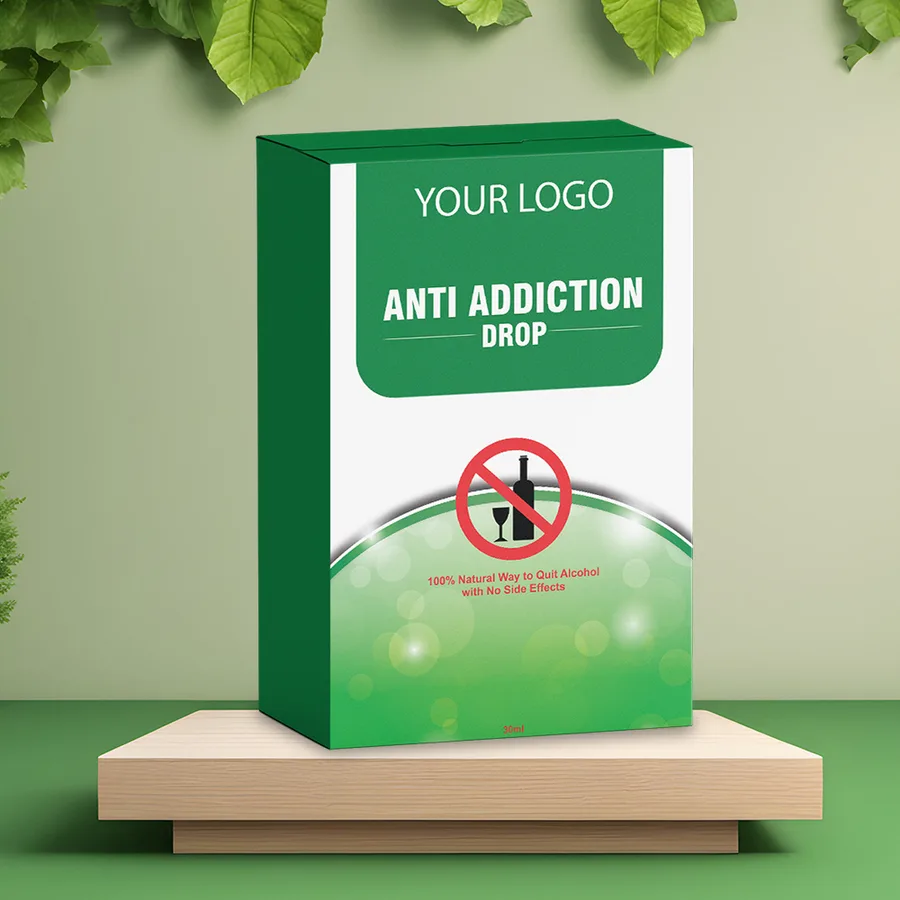
Product composition and our claims position: anti-addiction drops. Related: supporting someone who is trying to quit and the Hindi piece on alcohol and the liver: शराब और लिवर.
Get our product list and minimum orders
Leave your email and we will send the formats we make, the minimum order for each and typical lead times. We use it only to reply to you.
Manufacturing in this category?
We make products in this category for other people's brands. Tell us the format and volume and we will send a specification and a per-unit cost.
Request a quotation ↗NutraHerbal manufactures food supplements, Ayurvedic proprietary medicines and cosmetics for business customers. Product information on this site describes composition, format and commercial positioning for brand owners. It is not medical advice, does not claim to diagnose, treat, cure or prevent any disease, and is not a substitute for consulting a qualified practitioner. Final label claims are the brand owner's responsibility and must be approved for the destination market.
How we write and review content: editorial policy.