Reviewed for accuracy and claims compliance: Claims compliance review
If you only remember one number from this article, make it this: turmeric from your kitchen is roughly 2 to 5% curcuminoids. A standardised curcumin extract is 95%. That is a twenty- to fortyfold difference in the compound everybody is actually buying.
Plenty of products on the Indian shelf blur that distinction, and some depend on it. This article explains the difference, why it matters commercially and practically, and exactly which line on a label settles the question.
Turmeric, curcuminoids and curcumin are three different things
The confusion in this category starts with loose vocabulary, so it is worth being precise.
Turmeric is the whole rhizome, Curcuma longa, dried and ground. It contains starch, fibre, oils, minerals and a small fraction of coloured compounds.
Curcuminoids are that coloured fraction: a group of three related compounds, of which curcumin is the main one, alongside demethoxycurcumin and bisdemethoxycurcumin. When a label says “95% curcuminoids”, it is referring to this group.
Curcumin specifically is the single most studied of the three. Most research literature uses standardised curcuminoid extracts rather than turmeric powder.
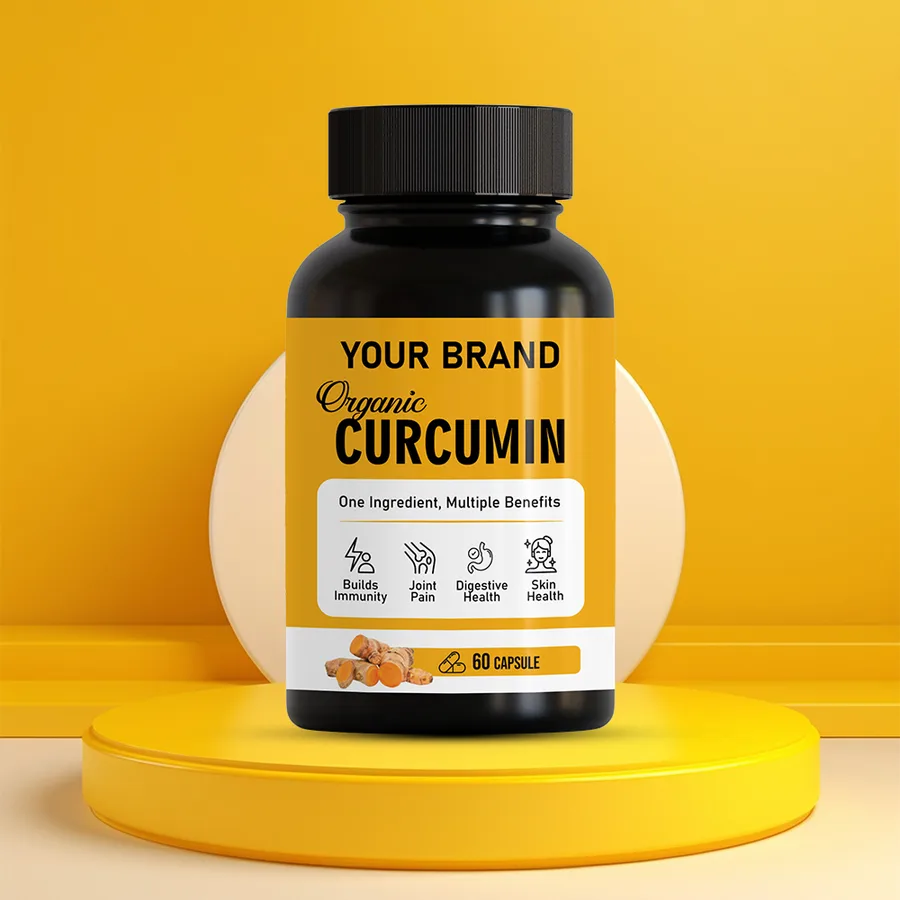
So a product described simply as “turmeric capsules” and one described as “curcumin 95%” are not two versions of the same thing. They are a food ingredient and a concentrated extract.
What the numbers mean in practice
Here is the arithmetic, laid out plainly.
| Product | Curcuminoid content | Curcuminoids in a 500 mg dose |
|---|---|---|
| Kitchen turmeric powder | ~2–5% | ~10–25 mg |
| “Turmeric extract” (unspecified) | Anywhere from 5% to 95% | Unknowable from the label |
| Standardised curcumin extract | 95% | ~475 mg |
That middle row is the problem. “Turmeric extract” with no percentage stated is a label that has told you nothing, and in our experience that omission is rarely accidental.
Why absorption is the second half of the story
Here is the part that curcumin marketing often skips: curcumin on its own absorbs poorly. It is not well soluble in water, it is metabolised quickly, and a meaningful fraction of an oral dose never reaches circulation in a useful form.
This is not a fringe criticism, it is the central practical problem with the ingredient, and it is why serious formulations do something about it. The common approaches are:
Piperine. A black pepper extract, usually at around 5 mg alongside 475 mg of curcumin. It is well established, inexpensive, and the reason you will see black pepper on a curcumin label when the connection otherwise seems odd.
Phospholipid or liposomal systems. The curcumin is complexed with phospholipids to improve its behaviour in the gut. These work better and cost considerably more.
Formulated or micellar systems. Various proprietary approaches with the same goal.
A curcumin product with no absorption strategy at all is selling you an ingredient you will largely not absorb. If a label shows a high curcuminoid percentage and nothing else, that is worth noticing.
How to read a curcumin label in thirty seconds
Four checks, in order of usefulness:
- Is a standardisation percentage printed? If it does not say 95% curcuminoids, or some stated figure, treat the product as turmeric powder until proven otherwise.
- What is the actual curcuminoid quantity per capsule? A 500 mg capsule at 95% gives roughly 475 mg. A 500 mg capsule of unspecified “turmeric extract” might give 25 mg.
- Is there an absorption component? Piperine, a phospholipid system, or something equivalent.
- Does the certificate of analysis report an assay? A manufacturer who will share a batch assay for curcuminoid content is making a checkable claim. One who will not is making an unverifiable one.
Does this mean kitchen turmeric is useless?
No, and it is worth saying so clearly, because the supplement framing can make traditional use sound worthless.
Turmeric has been used in Indian cooking and in Ayurvedic preparations for a very long time, usually in the form of the whole rhizome, often cooked with fat and black pepper, which, as it turns out, addresses both solubility and absorption in a fairly sensible way. Golden milk is not a poor imitation of a supplement; it is a traditional preparation with its own logic.
What kitchen turmeric cannot do is deliver the curcuminoid quantities used in research studies. A study examining 1,000 mg of curcuminoids daily is not describing what you get from seasoning your dal. That is the honest distinction: different preparations, different quantities, different purposes.
What a curcumin product may and may not claim
This matters whether you are buying or manufacturing. In India, a supplement may describe the traditional use of haridra and may carry general wellness positioning, joint comfort, skin wellness, daily antioxidant support. What it may not do is claim to treat, cure or prevent a disease.
You will nonetheless see curcumin marketed for arthritis, for cancer, for depression and for a long list of conditions, usually citing research that examined something quite different from the product being sold. Those claims breach Indian advertising rules, and in our own manufacturing we decline artwork that carries them.
If you are evaluating a product and the label is making disease claims, that tells you something about the rest of the label too.
If you are manufacturing in this category
A few practical notes from our side of it.
Specify the standardisation and print it. In a market where extract loads are routinely vague, a clearly printed 95% is a competitive advantage rather than a formality. Customers in this category genuinely compare these numbers on listing pages.
Budget for the absorption component. Piperine is cheap and defensible. Phospholipid systems cost more and belong in a premium tier. Omitting both saves a little and undercuts the product.
Expect to be tested. Curcuminoid assay is a straightforward laboratory test, and in this category it is the one a serious buyer or a critical reviewer will commission. Products that cannot survive it get found out.
Watch the cautions. High-dose curcumin is not advised for anyone with gallstones, and piperine can affect the metabolism of several medicines. Both notes belong on the label rather than in fine print.
Safety notes
Curcumin is well tolerated at normal dietary and supplemental doses. Three cautions are worth knowing:
- High-dose curcumin is not recommended for people with gallstones or bile duct obstruction.
- Piperine can increase the absorption and alter the metabolism of various medicines, which matters if you take any regularly.
- Anyone on anticoagulant medication should consult their doctor before taking concentrated curcumin.
This article is information, not medical advice. Consult a qualified practitioner before starting any supplement, particularly if you take prescription medication.
The short version
Turmeric powder and curcumin extract differ by roughly twenty to forty times in the compound that matters, and the only reliable way to tell which you are holding is a printed standardisation percentage backed by a batch assay. Add an absorption component or the concentration is partly wasted. And treat any product making disease claims as a product whose other numbers you should also doubt.
If you want the sourcing and quality detail, see our curcumin ingredient page. If you are putting a product together, the label compliance guide covers what must and must not appear on the pack.
Get our product list and minimum orders
Leave your email and we will send the formats we make, the minimum order for each and typical lead times. We use it only to reply to you.
Manufacturing in this category?
We make products in this category for other people's brands. Tell us the format and volume and we will send a specification and a per-unit cost.
Request a quotation ↗NutraHerbal manufactures food supplements, Ayurvedic proprietary medicines and cosmetics for business customers. Product information on this site describes composition, format and commercial positioning for brand owners. It is not medical advice, does not claim to diagnose, treat, cure or prevent any disease, and is not a substitute for consulting a qualified practitioner. Final label claims are the brand owner's responsibility and must be approved for the destination market.
How we write and review content: editorial policy.