Reviewed for accuracy and claims compliance: Claims compliance review
Curcumin is the most researched Indian botanical and the one where labels most often fail to match the research they cite.
The reason is a single pharmacological fact: curcumin is very poorly absorbed. Everything about reading these labels follows from it.
The three numbers you need
Most curcumin labels give you one number. You need three, and the gaps between them are where the category goes wrong.
Number 1: how much turmeric or extract
“Turmeric 500 mg”, straightforward, and the least informative of the three.
Number 2: the curcuminoid percentage
This is the one most often missing, and it changes everything.
Raw turmeric powder contains only a small percentage of curcuminoids, typically a few percent. A standardised extract contains 95%.
So:
- “Turmeric powder 500 mg” delivers perhaps 15–25 mg of curcuminoids
- “Turmeric extract 500 mg, standardised to 95% curcuminoids” delivers 475 mg
That is roughly a twenty-fold difference, and both labels say “500 mg”.
This is the single most common way a curcumin product misleads, not by lying, but by stating a quantity of plant material while the marketing cites research conducted on standardised extract.
What to look for: the phrase “standardised to 95% curcuminoids” or a stated percentage. If there is no percentage, assume it is low.
Number 3: the absorption component
And here is the fact that makes the whole category what it is: curcumin taken on its own is poorly absorbed, rapidly metabolised, and quickly eliminated. Plain curcumin produces very low blood levels.
Which means even 475 mg of curcuminoids, with nothing to aid absorption, delivers very little to the bloodstream.
So a complete curcumin product needs an absorption strategy. The recognised ones:
Piperine, black pepper extract, typically a small amount alongside the curcumin. The best-known and cheapest approach, with research behind the combination. This is what most Indian products use, and it is a reasonable choice.
Phospholipid complex, curcumin bound to phospholipids, which improves absorption substantially. More expensive, branded forms exist.
Water-dispersible and colloidal preparations, various proprietary technologies.
Micellar / liquid micelle forms.
Nanoparticle and cyclodextrin formulations.
Essential-oil-enhanced turmeric, turmeric with its own volatile oils retained.
What to look for: piperine, or a named branded delivery form. A label with 95% curcuminoids and no absorption component is a label that has solved half the problem.
And a caveat worth stating: these enhanced forms are not interchangeable in dose. A phospholipid form at 500 mg is not equivalent to plain curcumin at 500 mg, and comparing two products by milligrams alone does not work once delivery systems are involved. Compare each against its own research.
The piperine caution nobody prints
Piperine works by inhibiting drug-metabolising enzymes and transporters. That is the mechanism, and it is not selective for curcumin.
Which means piperine can increase the blood levels of other drugs too.
This matters for anyone on:
- Medicines with a narrow therapeutic range
- Antiepileptics, phenytoin, carbamazepine
- Some beta blockers
- Theophylline
- Several others
It is rarely a dramatic interaction and it is a real one. Anyone on regular medication taking a piperine-containing supplement should mention it to their doctor, and almost nobody does, because the label presents piperine purely as a benefit.
What a good label looks like
Each capsule contains:
Turmeric rhizome extract (Curcuma longa)     500 mg
  standardised to 95% curcuminoids           (475 mg curcuminoids)
Black pepper fruit extract (Piper nigrum)      5 mg
  standardised to 95% piperine
All three numbers present. You can check it against research and against another product.
What the evidence actually supports
Being honest, because curcumin is heavily oversold on the back of a genuinely large literature.
The preclinical literature is enormous, thousands of papers across inflammation, cancer, metabolic disease, neurological conditions and more. It is also where most of the enthusiasm comes from, and cell and animal findings translate to humans unreliably.
Where human evidence is reasonably supportive:
Osteoarthritis, this is the strongest area. Multiple trials and meta-analyses have reported improvement in knee osteoarthritis pain and function, with some comparing favourably to NSAIDs on symptoms with better gastrointestinal tolerability. The trials vary in quality and several are industry-funded, and this remains the best-supported use.
Some inflammatory markers, in various conditions.
Where it is promising and unsettled: metabolic parameters, depression as an adjunct, ulcerative colitis as an adjunct, and various others, interesting signals, insufficient evidence.
Where it is oversold: cancer treatment or prevention. There is a great deal of preclinical work and no basis for a treatment claim. This is the most harmful overclaim in the category, because somebody may substitute it for oncological care.
And a practical point on absorption that cuts both ways: the poor bioavailability that makes supplementation difficult may also mean some of the proposed systemic mechanisms do not occur at achievable blood levels. That is a genuine open question in the field rather than a settled criticism.
Dose, and the gap most products have
Trials in osteoarthritis have typically used something in the range of several hundred milligrams to over a gram of curcuminoids daily, usually split, with an absorption enhancer.
Which means: a product delivering 20 mg of curcuminoids from plain turmeric powder is not in the same territory as the research, by a wide margin.
The practical check: multiply the extract quantity by the curcuminoid percentage. That is what you are actually taking. Then compare it with what the studies used.
Most products in the Indian market do not survive that arithmetic, and the label gives you everything you need to do it.
Who should be careful
Curcumin is generally well tolerated, and there are real cautions.
Gallstones or bile duct obstruction, curcumin stimulates gallbladder contraction, which can precipitate pain. This is the most relevant caution for Indian consumers, given how common gallstones are.
Blood thinners, antiplatelet activity has been reported. Warfarin, clopidogrel, aspirin, and the newer agents. And stop before surgery, with your surgeon’s advice.
Iron deficiency, curcumin can bind iron and may reduce absorption. Relevant for anyone iron deficient, which is a large group in India. Keep it away from iron supplements and iron-rich meals.
Kidney stones, turmeric contains oxalate, and high intakes may matter for oxalate stone formers.
Acid reflux, some people find it worsens symptoms.
Diabetes medication, possible additive blood-sugar lowering; monitor.
Pregnancy, culinary amounts are fine; high-dose supplements are not advised.
Liver, and this needs stating carefully. Liver injury has been reported in association with some high-dose curcumin supplements, particularly certain enhanced-absorption formulations, and regulatory authorities in some countries have issued advice about it. It appears uncommon, the picture is still being characterised, and it is a reason for defined courses rather than indefinite high-dose use, and a reason not to take it if you already have liver disease without asking.
That last point is awkward for a category sold partly on liver health, and it is true.
Quality questions for India
Adulteration is documented and in one case serious: lead chromate has been found used to brighten turmeric in parts of the supply chain. Lead is a neurotoxin and this is not a minor adulterant.
Which makes heavy metal testing non-optional, for both culinary turmeric from an unverified source and for supplements.
Ask for:
- Batch-wise heavy metal reports with numbers, especially lead
- Curcuminoid assay, confirming the stated percentage
- Solvent residue testing, since extraction uses solvents
- Botanical identity, Curcuma longa, not a related species
- FSSAI or AYUSH licence number
Turmeric in food versus a supplement
A distinction worth being clear about, since both are legitimate.
Turmeric in cooking is a long-standing, safe, culturally embedded practice. It delivers small amounts of curcuminoids, usually with fat and black pepper present, which is a sensible traditional combination and probably not accidental.
Haldi doodh is a reasonable thing to drink, and the fat in milk helps absorption. It is not a therapeutic dose of curcumin and it does not need to be.
A curcumin supplement is a different product with a different purpose, a defined, larger dose for a specific reason, for a defined period.
Neither replaces the other, and a brand implying that a pinch of turmeric in dal is equivalent to a studied dose, or that a capsule should replace turmeric in food, is confusing two different things.
What we will and will not claim
What is sayable: turmeric’s traditional use in Ayurvedic formulations; the curcuminoid content as measured; support for joint comfort and mobility.
What is not: treats arthritis, cures inflammation, prevents or treats cancer, treats depression or any diagnosed condition. The cancer claims are the ones we refuse most firmly, they fall under the Drugs and Magic Remedies Act and the potential harm is somebody delaying treatment.
What we print: the standardisation percentage, the piperine content, and the calculated curcuminoid amount, because without that third number the label is not usable.
And what we decline: quoting osteoarthritis research on a product whose actual curcuminoid delivery is a fraction of what those trials used. That is the most common request in this category and it is the one that makes a label indefensible.
The short version
- Three numbers: extract quantity, curcuminoid percentage, and the absorption component. Most labels give you only the first.
- “Turmeric 500 mg” and “turmeric extract 500 mg at 95% curcuminoids” differ roughly twenty-fold. Both read as 500 mg.
- Curcumin is poorly absorbed. 95% curcuminoids with no absorption component solves half the problem.
- Piperine inhibits drug-metabolising enzymes, so it can raise levels of other medicines. Tell your doctor.
- Multiply extract by percentage to get what you are actually taking, then compare with the trials.
- Osteoarthritis is the best-supported use. Cancer treatment claims have no basis and are the harmful ones.
- Gallstones are the most relevant Indian caution, curcumin contracts the gallbladder.
- It can reduce iron absorption, relevant in a country with widespread iron deficiency.
- Liver injury has been reported with some high-dose enhanced formulations, a reason for defined courses, not indefinite use.
- Lead chromate adulteration of turmeric is documented. Insist on batch heavy metal testing.
- Turmeric in food and a curcumin supplement are different things. Neither replaces the other.
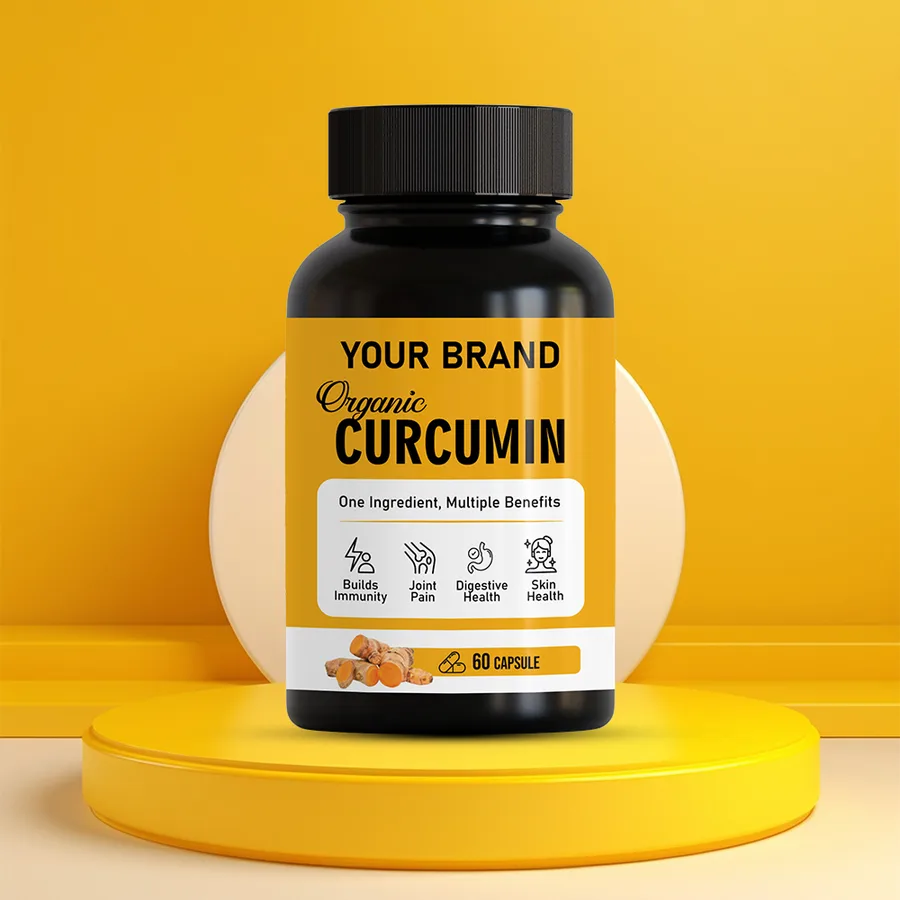
Product detail: curcumin capsule and the turmeric ingredient page. Related: how to read a certificate of analysis and proprietary blends.
Get our product list and minimum orders
Leave your email and we will send the formats we make, the minimum order for each and typical lead times. We use it only to reply to you.
Manufacturing in this category?
We make products in this category for other people's brands. Tell us the format and volume and we will send a specification and a per-unit cost.
Request a quotation ↗NutraHerbal manufactures food supplements, Ayurvedic proprietary medicines and cosmetics for business customers. Product information on this site describes composition, format and commercial positioning for brand owners. It is not medical advice, does not claim to diagnose, treat, cure or prevent any disease, and is not a substitute for consulting a qualified practitioner. Final label claims are the brand owner's responsibility and must be approved for the destination market.
How we write and review content: editorial policy.