Reviewed for accuracy and claims compliance: Claims and compliance review
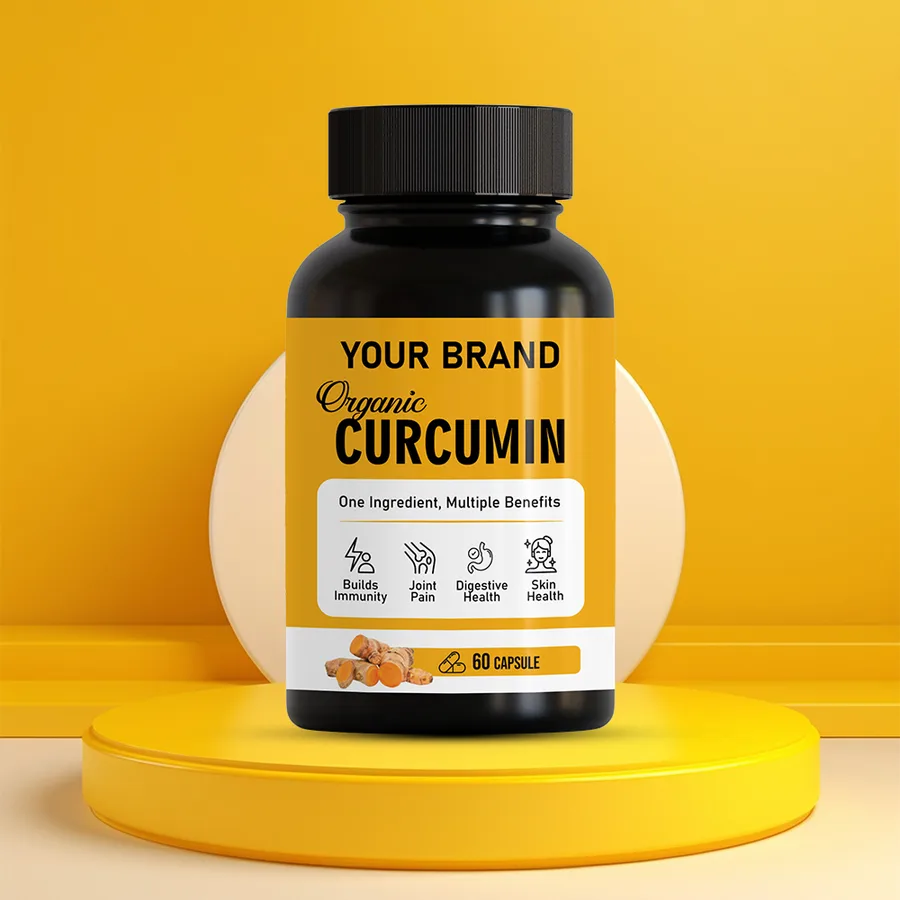
Turn over almost any curcumin capsule sold in India and you will find a small line near the bottom of the ingredient list: black pepper extract, or piperine, or a trademarked name, at 5 mg or 10 mg.
It is there for a real reason, and it works.
And the mechanism by which it works is also a drug interaction mechanism.
That second sentence is the one almost no label carries, and it is the reason this article exists. We make a curcumin capsule. We put piperine in some of our client formulations. And we think anyone taking one should understand what the 5 mg is doing.
This is general information, not medical advice. If you take any regular prescription medicine, the piperine in a curcumin capsule is a question for the person who prescribed it.
First: the problem piperine is solving
Curcumin has one dominant, extremely well-documented property: it is very poorly bioavailable.
Four things go wrong, in order:
It barely dissolves. Curcumin is practically insoluble in water at the pH of the stomach and small intestine. A compound that will not dissolve cannot be absorbed.
What dissolves is poorly absorbed. Uptake across the intestinal wall is limited.
What is absorbed is immediately conjugated. This is the big one. Curcumin is rapidly glucuronidated and sulfated, in the intestinal wall itself and then in the liver, on its first pass. The enzyme families doing this are UGT (UDP-glucuronosyltransferases) and SULT (sulfotransferases). By the time curcumin reaches systemic circulation, most of it has been converted into curcumin glucuronide and curcumin sulfate.
And what remains is cleared fast. Short half-life.
The net result, measured repeatedly: give a human a gram of plain curcumin powder and the free curcumin concentration in plasma is often at or below the limit of detection.
This is the central embarrassment of the curcumin literature. A compound that does striking things in a cell culture dish, where you can bathe cells in it directly, may never reach those concentrations in a human tissue.
So what does piperine actually do
Piperine is the pungent principle of black pepper, Piper nigrum.
It inhibits glucuronidation.
That is the core of it. Piperine inhibits UGT enzymes in the intestinal wall and liver. Inhibit the enzyme that is destroying curcumin on first pass, and more curcumin survives into the blood.
Secondarily, it inhibits CYP3A4, the single most important drug-metabolising enzyme in the human body, and it inhibits P-glycoprotein (P-gp), the efflux pump in the intestinal wall that pushes absorbed compounds back out into the gut lumen.
And it has a mild effect on intestinal permeability and transit.
The headline figure that circulates, that piperine increases curcumin bioavailability by about twentyfold, comes from a small human pharmacokinetic study using 2 g of curcumin with 20 mg of piperine. The figure is quoted far more confidently than a single small study of that size supports, and the enhancement varies a great deal with dose, formulation and the measurement method. But the direction is not in dispute. Piperine raises curcumin exposure.
Now the part the label leaves out
Read the mechanism again.
Piperine works by inhibiting UGT, CYP3A4 and P-glycoprotein.
Those are the same three systems that clear a very large fraction of prescription medicines.
Piperine does not know it was put in the capsule for curcumin. An enzyme inhibitor inhibits that enzyme for every substrate passing through it. If you are taking something else that depends on CYP3A4 or P-gp or glucuronidation for its clearance, the piperine may raise that drug’s level too.
Why CYP3A4 matters so much
CYP3A4 is involved in the metabolism of a very large share of clinically used drugs. Grapefruit juice is famous precisely because it inhibits intestinal CYP3A4, and grapefruit warnings appear on prescription leaflets for that reason.
Piperine is in the same conceptual category as the grapefruit warning. Weaker, at the doses used in supplements, and far less studied, but the same kind of effect, and nobody prints the warning.
The classes where this matters most
These are the drugs where a clearance change has real consequences, because the margin between a working dose and a harmful one is narrow, or because the consequence of too much is serious:
Immunosuppressants, tacrolimus, cyclosporine, sirolimus. CYP3A4 and P-gp substrates with narrow therapeutic windows. A transplant patient should not be taking an absorption enhancer without their transplant team knowing.
Anti-epileptics, phenytoin and carbamazepine in particular. Piperine’s effect on phenytoin levels has actually been studied, and it raises them. Seizure control is not something to perturb casually.
Anticoagulants and antiplatelets, and here there are two separate problems stacked on each other, which is why we treat this combination as the most important one.
Statins, several are CYP3A4 substrates, and higher exposure means higher muscle-toxicity risk.
Certain cardiac drugs, digoxin is a P-gp substrate with a notoriously narrow window.
Some antidepressants and antipsychotics.
Chemotherapy agents, many are CYP3A4 and P-gp substrates. This is one reason oncology teams generally ask patients to stop supplements, and it is a reasonable request rather than an arbitrary one.
Oral contraceptives and thyroid hormone, raised in the literature as plausible concerns.
And diabetes medication, because curcumin itself has glucose-lowering signals and more curcumin means more of that effect.
The anticoagulant case, spelled out
This deserves its own paragraph because it is the combination we see most often in practice.
Curcumin has documented antiplatelet activity of its own. So does the pepper-enhanced version, more so.
And many anticoagulants are cleared by CYP3A4 and P-gp, the direct oral anticoagulants in particular.
So a patient on a blood thinner who adds a piperine-enhanced curcumin capsule is doing two things at once: adding a compound with its own effect on platelets, and potentially raising the level of the drug already thinning their blood.
We think this combination should carry a warning on the pack, and we put one on ours. We would rather lose the sale.
And: stop curcumin supplements before any planned surgery or dental extraction, with your surgeon’s timing. This is standard advice for several botanicals and it is not theoretical.
The honest size of the effect
Here is where we have to be fair in the other direction too.
The piperine doses in supplements are small, typically 5 to 20 mg, which is roughly what a well-spiced Indian meal delivers anyway. The interaction studies that show clear effects often used higher doses.
Documented clinical harm from supplement-dose piperine is not common in the literature. The concern is mechanistically well-founded and under-studied, not a catalogue of case reports.
And people have eaten black pepper with turmeric for centuries, which is a genuine observation and the reason Indian cooking pairs them.
So the honest position is not piperine is dangerous. It is this: the mechanism is real, the clinical significance at supplement doses is uncertain, the consequence in the narrow-window drug classes would be serious, and the information is cheap. Telling a prescriber “I am taking a curcumin capsule with black pepper extract in it” costs nothing. That is the whole ask.
And the people most likely to be taking curcumin, older adults with joint pain, are also the people most likely to be on several prescriptions. That overlap is why this matters more than the raw numbers suggest.
The alternatives, and whether they are better
Piperine is not the only way to solve the absorption problem. Four other approaches are on the market, and the honest summary is that they trade one set of uncertainties for another.
Phospholipid complexes (phytosome)
Curcumin complexed with phosphatidylcholine. The lipid carrier improves solubility and uptake.
Reasonably well studied, with published pharmacokinetic data, and several of the better clinical trials used this type of preparation.
No enzyme inhibition, which is the central advantage, you are improving delivery rather than suppressing clearance.
Trade-off: larger capsules, more expensive, and much of the research is from the manufacturers of the specific branded complexes.
This is the approach we prefer for clients formulating for an older demographic, precisely because of the prescription overlap. It costs more. We say so, and we explain why.
Micellar and liquid formulations
Curcumin in a surfactant micelle. Some show very high measured plasma levels.
Trade-off: the plasma figures are impressive, the long-term safety data on chronic high-dose surfactant intake is thinner, and a very high systemic exposure of a compound with antiplatelet activity is not automatically a good thing.
Nanoparticle and solid-dispersion forms
A varied group. Some genuinely improve absorption. The category is also where the loosest marketing lives, “nano” on a label tells you almost nothing without pharmacokinetic data for that specific product.
Whole turmeric with its essential oil
Turmeric extract retaining the volatile oil fraction, including turmerones, which appear to aid absorption. Closer to the traditional material, and that has a certain appeal. Less pharmacokinetic data than the phospholipid route.
And the simplest one: fat
Curcumin is fat-soluble. Taking it with a meal containing fat helps. It is free, it has no interaction mechanism, and it is what traditional preparation does when turmeric goes into hot oil or is cooked into milk. It is a smaller effect than the engineered approaches. It is also the only one with no downside at all.
What a buyer should actually check
The curcuminoid figure, not the extract figure. “500 mg turmeric extract” is not a dose. “500 mg turmeric extract standardised to 95% curcuminoids” is.
Which enhancement approach it uses, named on the label, not just “enhanced absorption”.
The piperine quantity, if present, in milligrams.
Whether the dose makes sense for that approach. An enhanced formulation needs less material, not more. A label advertising both a twentyfold absorption enhancer and a very high curcuminoid dose has not thought about it.
Batch-wise heavy metal testing. Turmeric has a documented lead chromate adulteration problem, lead chromate is added as a brightening pigment, and lead is a neurotoxin with permanent effects in children. This is not a hypothetical supply-chain worry; it is a studied one. Ask for the certificate for the batch you are buying. We do not treat this as optional, and no legitimate manufacturer should.
And whether the pack warns you about the gallbladder and the blood thinners. If it does not, the manufacturer either does not know or decided not to tell you.
What we will and will not say on a pack
Sayable: a traditional-use statement for turmeric, clearly framed as traditional use; the standardisation figure; the enhancement method; and the authorised claims for any vitamins or minerals in the formulation.
And the fact that matters most: there is no authorised health claim for curcumin. Not for inflammation, not for joints, not for immunity.
Not sayable: reduces inflammation, treats arthritis, protects the liver, helps in cancer, detoxifies, boosts immunity.
And the cancer claim we will not make under any circumstances, because the harm from someone delaying treatment on the strength of it is the worst outcome in this entire product category.
What we insist appears: the curcuminoid quantity; the gallbladder and anticoagulant warnings; a surgery note; and, when piperine is in the formula, “tell your doctor if you take any regular medicine”, in a size someone can read.
And the most honest sentence we can offer:
The pepper in your curcumin capsule is there because curcumin on its own barely gets into you. It solves that by slowing down the enzymes that clear things. Your prescriptions use those same enzymes. That is not a reason to panic, and it is a reason to mention it.
When to see a doctor
Before starting a curcumin supplement, if you:
- take any blood thinner or antiplatelet, and stop before surgery or dental extraction
- take an immunosuppressant, anti-epileptic, digoxin, a statin, or chemotherapy
- have gallstones or bile duct disease, curcumin stimulates gallbladder contraction
- have liver disease, high-dose curcumin extracts have been linked to reported liver injury
- take diabetes or blood pressure medication, monitoring
- have iron deficiency, curcumin can chelate iron
- are pregnant or breastfeeding, food amounts fine, supplements no
- take any regular prescription at all, because of the piperine
Stop and get checked: yellowing of the eyes, dark urine, persistent nausea or right-upper-abdominal pain (liver or gallbladder); unusual bruising, bleeding gums, blood in stool or urine (bleeding risk); rash.
Soon: joints that are swollen, red or warm; morning stiffness lasting more than 30–60 minutes. That pattern suggests inflammatory arthritis, where early prescription treatment changes long-term joint outcomes, and the delay is the harm, not the supplement.
The short version
- Curcumin is very poorly bioavailable, this is its best-documented property
- It barely dissolves in water
- What is absorbed is immediately glucuronidated and sulfated on first pass
- The enzymes doing that are UGT and SULT
- Plasma free curcumin after a gram of plain powder is often undetectable
- That is the central embarrassment of the curcumin literature
- Piperine works by inhibiting glucuronidation
- It also inhibits CYP3A4 and P-glycoprotein
- The famous twentyfold figure comes from one small study using 2 g curcumin with 20 mg piperine
- The direction is not in dispute; the magnitude is quoted too confidently
- Those same three systems clear a large share of prescription drugs
- An enzyme inhibitor inhibits that enzyme for every substrate
- Piperine is conceptually in the grapefruit-warning category
- Highest-stakes classes: immunosuppressants, anti-epileptics, anticoagulants, statins, digoxin, chemotherapy
- Piperine has been shown to raise phenytoin levels
- The anticoagulant case stacks two problems: curcumin’s own antiplatelet effect plus raised drug levels
- Stop curcumin before planned surgery or dental extraction
- Supplement piperine doses (5–20 mg) are small, roughly a spiced meal’s worth
- Documented clinical harm at those doses is not common; the concern is mechanistic and under-studied
- Telling your prescriber costs nothing, that is the whole ask
- Older adults with joint pain are also the group most likely to be on several prescriptions
- Phospholipid complexes improve delivery without inhibiting enzymes
- Micellar forms give high plasma levels with thinner long-term data
- “Nano” on a label means nothing without pharmacokinetic data for that product
- Fat with the meal is free, has no interaction mechanism, and is what traditional preparation does
- Check curcuminoid quantity, not extract quantity
- An enhanced formulation needs less material, not more
- Turmeric has a documented lead chromate adulteration problem, demand batch heavy-metal certificates
- There is no authorised health claim for curcumin
- We will not make a cancer claim under any circumstances
Ingredient detail: haridra / curcumin. Our formulations: Curcumin Capsule and Arthravo 360. Related reading: हल्दी के फ़ायदे और कितनी लेनी चाहिए, किसके लिए हल्दी नुक़सानदेह हो सकती है, golden milk vs a curcumin supplement, and supplement label compliance in India.
Get our product list and minimum orders
Leave your email and we will send the formats we make, the minimum order for each and typical lead times. We use it only to reply to you.
Manufacturing in this category?
We make products in this category for other people's brands. Tell us the format and volume and we will send a specification and a per-unit cost.
Request a quotation ↗NutraHerbal manufactures food supplements, Ayurvedic proprietary medicines and cosmetics for business customers. Product information on this site describes composition, format and commercial positioning for brand owners. It is not medical advice, does not claim to diagnose, treat, cure or prevent any disease, and is not a substitute for consulting a qualified practitioner. Final label claims are the brand owner's responsibility and must be approved for the destination market.
How we write and review content: editorial policy.