Reviewed for accuracy and claims compliance: Claims compliance review
Triphala is the classical Ayurvedic formulation for the eyes, more so than for digestion, which is what it is best known for in the modern market.
And this article has an unusual shape: the internal use is reasonable and we make a product for it, while the best-known traditional practice, washing the eyes with triphala water, is the one thing in this whole site we would actively advise against.
We manufacture triphala products. Saying this clearly is the point of writing it ourselves.
This is information, not medical advice. Do not put anything in your eyes without an eye specialist’s advice. Sudden vision loss, a shadow across your vision, or severe eye pain with redness is an emergency.
What triphala is
Three fruits, classically in equal parts:
Haritaki (Terminalia chebula), classically rasayana, and described as the foremost of the three. Bibhitaki (Terminalia bellirica). Amalaki (amla, Phyllanthus emblica).
And a detail worth knowing: the classical texts specify different proportions for different purposes in some traditions, and equal parts is the common modern standard.
Chemistry: tannins (chebulagic and chebulinic acid, gallic acid, ellagic acid), vitamin C from amla, and a range of polyphenols. The antioxidant activity of these is well documented in laboratory work.
The classical position on eyes
This is more specific than people expect.
Triphala is classified as chakshushya, beneficial to the eyes. And in the classical literature that designation is prominent, alongside its better-known roles as a mild laxative and rasayana.
Classical eye practices involving it:
Netra prakshalana, eye washing with a triphala decoction. Netra tarpana, a medicated ghee preparation held over the eye within a dough ring. Ashchyotana, eye drops. And internal use, as powder, decoction or ghrita (medicated ghee).
The classical rationale is that it addresses pitta in the eye region, with the cooling and chakshushya properties of amla central to it.
And in the Ayurvedic framework, triphala appears in a long list of eye conditions, including what would now be read as conjunctivitis, dry eye, early lens changes and general visual decline.
The modern work, honestly
Laboratory and animal work is reasonably substantial:
Antioxidant activity, which is well characterised.
Anti-inflammatory and antimicrobial activity in vitro, and some in-vitro work on organisms relevant to eye infections.
Studies in animal models of cataract, where triphala and its components have been reported to delay lens opacity, generally in chemically or galactose-induced models. Animal lens models are a long way from human cataract.
Some work on aldose reductase inhibition, the enzyme implicated in diabetic cataract and other diabetic complications.
And in dry eye and computer vision syndrome, there are small human studies, including some on triphala ghrita and on triphala-containing preparations, reporting symptom improvement.
The limitations, stated plainly: the human studies are small, short, frequently unblinded, often use multi-ingredient preparations, and are substantially conducted at institutions with an interest in the tradition. There is no trial that would support a treatment claim.
Honest summary: a strong and specific classical designation, a coherent antioxidant rationale, encouraging animal data on lens models, and human evidence that is preliminary.
The internal use, where we think it is reasonable
As a daily or periodic rasayana, in the classical manner, triphala is a reasonable thing to take. It is well tolerated, its ingredients are food-adjacent, and amla genuinely is a good vitamin C source.
And its laxative effect is real and worth managing:
Triphala is a mild bulk and anthraquinone-containing laxative. Haritaki and bibhitaki both contribute.
Which means: start low, expect loose stools if you overdo it, and, the point we make across our whole site, no laxative belongs in indefinite daily use, herbal included. Periodic use, or a defined course, is the classical pattern anyway.
And the cautions for internal use:
Pregnancy, avoid. Haritaki has traditional emmenagogue associations and it is on standard avoid lists. Diarrhoea, IBD, or any acute abdominal condition, avoid. Dehydration or electrolyte problems, a laxative is the wrong thing. Diabetes medication, blood-sugar-lowering effects have been reported; monitor. Anticoagulants, theoretical additive effects. And absorption of other medicines, take other drugs at least a couple of hours apart, because accelerated transit reduces absorption. This matters particularly for thyroid replacement, anti-epileptics and oral contraceptives. Children and the elderly, reduced amounts, and on advice. Iron supplements, tannins bind iron, so space them apart.
And now the part we advise against
The triphala eye wash.
This is a widely practised, widely recommended traditional remedy, and we do not recommend it. Here is the reasoning in full, because dismissing a traditional practice deserves an argument rather than an assertion.
1. Sterility
The eye surface is a site where contamination has serious consequences.
A home-made decoction, cooled, strained through cloth, stored in a kitchen container, and poured into an eye cup is not sterile. It cannot be made sterile in a domestic kitchen.
And the specific hazard: Pseudomonas aeruginosa and Acanthamoeba both occur in water and both cause sight-threatening corneal infection. Acanthamoeba keratitis is notoriously difficult to treat and can end in corneal transplant or loss of the eye. Contact lens users are warned never to rinse lenses in tap water for exactly this reason.
This risk is not theoretical and it is not small.
2. The eye cup itself
Eye cups are a known vector for transferring infection from one eye to the other, and between people. They are difficult to clean properly.
3. Tannins on the corneal surface
Triphala is tannin-rich. Tannins are astringent, they precipitate proteins. The corneal epithelium is a delicate protein structure, and repeatedly applying an astringent plant decoction to it is not obviously benign. There is no safety data establishing that it is.
4. Particulates and pH
A strained decoction still contains fine particulate. Its pH and osmolarity are uncontrolled, and the eye is sensitive to both, which is why manufactured eye drops are formulated to specific values and buffered.
5. It can delay a diagnosis
The conditions people use eye washes for, redness, irritation, watering, discharge, include bacterial and viral conjunctivitis, allergic conjunctivitis, dry eye, blepharitis, corneal ulcer, uveitis and acute glaucoma.
These have entirely different treatments, and two of them threaten sight within days.
And the specific danger: a corneal ulcer treated with a home eye wash for a week can scar the cornea permanently. In India, corneal scarring from delayed or inappropriate treatment is a significant cause of avoidable blindness.
What we would say instead
If it is being done at all, it should be with a professionally manufactured, sterile, preservative-controlled ophthalmic preparation, prescribed by an eye specialist, and classical formulations do exist as licensed Ayurvedic ophthalmic products. That is a completely different proposition from kitchen decoction.
And for the symptoms people are treating: a clean warm compress and lid hygiene for blepharitis; preservative-free artificial tears for dryness; and an eye examination for anything red, painful or persistent. Those are safe, effective and cheap.
We make a triphala juice. We will not tell you to put it in your eyes.
And the same caution extends further
Nothing goes in the eye without an ophthalmologist’s advice. That includes:
Ghee, oil, honey, breast milk, rose water, onion juice, potato juice, urine, and herbal drops of any kind.
And kajal and surma, where lead content has been documented in some traditional preparations, and lead poisoning in children has been associated with their use. This is a recorded problem, not a speculative one.
And steroid eye drops bought without prescription, these cause glaucoma and cataract, and worsen infections, including fungal and herpetic ones. In India they are easily available and this is a major, well-documented cause of avoidable blindness. If you are using one without an eye specialist’s supervision, stop and get seen.
Quality, for the internal product
Batch-wise heavy metals, lead, mercury, arsenic, cadmium. Herbal products in this market have repeatedly been found contaminated.
Pesticide residues and aflatoxin, since these are agricultural fruits.
Microbiology.
Botanical identity, the three Terminalia and Phyllanthus species are subject to substitution.
Marker compound assay, is there a stated tannin or gallic acid content, or just “triphala extract”?
And for liquids: diethylene and ethylene glycol testing on every solvent batch. Children in India have died from contaminated syrups, and this is not optional.
Ask for the certificates. We would rather be judged on ours than on the tradition.
Licensing
Triphala is a classical formulation, and made to a First Schedule text it is licensed as an Ayurvedic medicine, which may carry the indications the text gives.
Sold as a food supplement under FSSAI, it may make no medicinal claims, only authorised nutrient-function claims and traditional-use statements.
And the Drugs and Magic Remedies (Objectionable Advertisements) Act applies regardless of licence.
Taking a classical text’s eye indications and printing them on a food supplement label is the commonest violation in this category.
Claims, what we print and refuse
What is sayable: a traditional-use statement, that triphala has long traditional use in Ayurveda as a rasayana and is classically described as chakshushya, framed clearly as traditional use, plus authorised nutrient-function claims for vitamins and minerals present: vitamin A, riboflavin and zinc contribute to the maintenance of normal vision; vitamin C contributes to the protection of cells from oxidative stress and to normal immune function.
What is not sayable: improves eyesight, treats cataract, prevents cataract, treats glaucoma, treats conjunctivitis, reduces spectacle power, or treats dry eye.
And what we refuse outright: any instruction or implication to use the product in or around the eyes; “improves eyesight” and “removes spectacles” claims; and any product aimed at children’s eyesight.
And what we print: “for oral use only, do not apply to the eyes”, on our triphala products. That line exists because of this specific traditional practice, and almost nobody in this category prints it.
The honest ranking
1. An eye examination. Glaucoma and diabetic retinopathy are silent and cause irreversible loss. In diabetes, annually, whatever the vision. 2. Control blood sugar and blood pressure; stop smoking. 3. Children: outdoor time, for myopia progression. 4. Greens cooked with some fat, and eggs if you eat them, for lutein and zeaxanthin. 5. UV-protective sunglasses. 6. And triphala, orally, as a traditional rasayana, with the laxative effect managed and the cautions above respected.
It is sixth, and it is not an eye treatment.
When to see a doctor
Emergency:
- Sudden loss or blurring of vision
- A curtain or shadow, or a sudden shower of floaters and flashes
- Severe eye pain with redness, haloes and vomiting, acute glaucoma
- A white spot on the cornea, or severe light sensitivity with a red eye, possible corneal ulcer
- Sudden double vision
- Any injury or chemical splash, irrigate with clean water for 15–20 minutes and go at once
- Straight lines suddenly appearing bent
Soon:
- A red, painful or watering eye lasting more than a day or two, do not treat it with a home wash
- Diabetes with no eye examination in the last year
- Over 40 and never screened for glaucoma
- Before taking triphala in pregnancy, avoid
- Before taking it alongside thyroid medicine, anti-epileptics, oral contraceptives, anticoagulants or diabetes medication
- If you are using any steroid eye drop without an eye specialist’s supervision, stop and get seen
- If a child uses kajal or surma, ask about lead
The short version
- Triphala’s classical standing for the eyes is specific, it is designated chakshushya.
- Three fruits: haritaki, bibhitaki, amla, classically in equal parts.
- Tannin-rich, and amla is a genuinely good vitamin C source.
- Laboratory antioxidant data is substantial; animal cataract models are encouraging.
- Human evidence is small, short, often unblinded and multi-ingredient. No treatment claim is supportable.
- Internal use as a rasayana is reasonable, and it is a laxative, so manage the amount.
- No laxative belongs in indefinite daily use, herbal included.
- Avoid in pregnancy, diarrhoea, IBD and acute abdominal conditions.
- Space it from thyroid medicine, anti-epileptics, oral contraceptives and iron.
- The triphala eye wash is the one traditional practice we advise against.
- A kitchen decoction cannot be made sterile.
- Pseudomonas and Acanthamoeba in water cause sight-threatening corneal infection.
- Acanthamoeba keratitis can end in a corneal transplant.
- Eye cups transfer infection between eyes and between people.
- Tannins are astringent and precipitate proteins, the corneal epithelium is protein.
- pH, osmolarity and particulate are uncontrolled in a decoction.
- The symptoms people wash for include corneal ulcer, uveitis and acute glaucoma, days matter.
- Corneal scarring from delayed treatment is a significant cause of avoidable blindness in India.
- Nothing goes in the eye without an ophthalmologist, not ghee, oil, honey, breast milk or herbal drops.
- Lead has been documented in some kajal and surma preparations.
- Unsupervised steroid eye drops cause glaucoma and cataract and worsen infections.
- Ask for batch-wise heavy metals, pesticides, identity and, for liquids, DEG/EG certificates.
- A food supplement cannot borrow a classical text’s eye indications.
- We print “for oral use only, do not apply to the eyes.” It exists because of this practice.
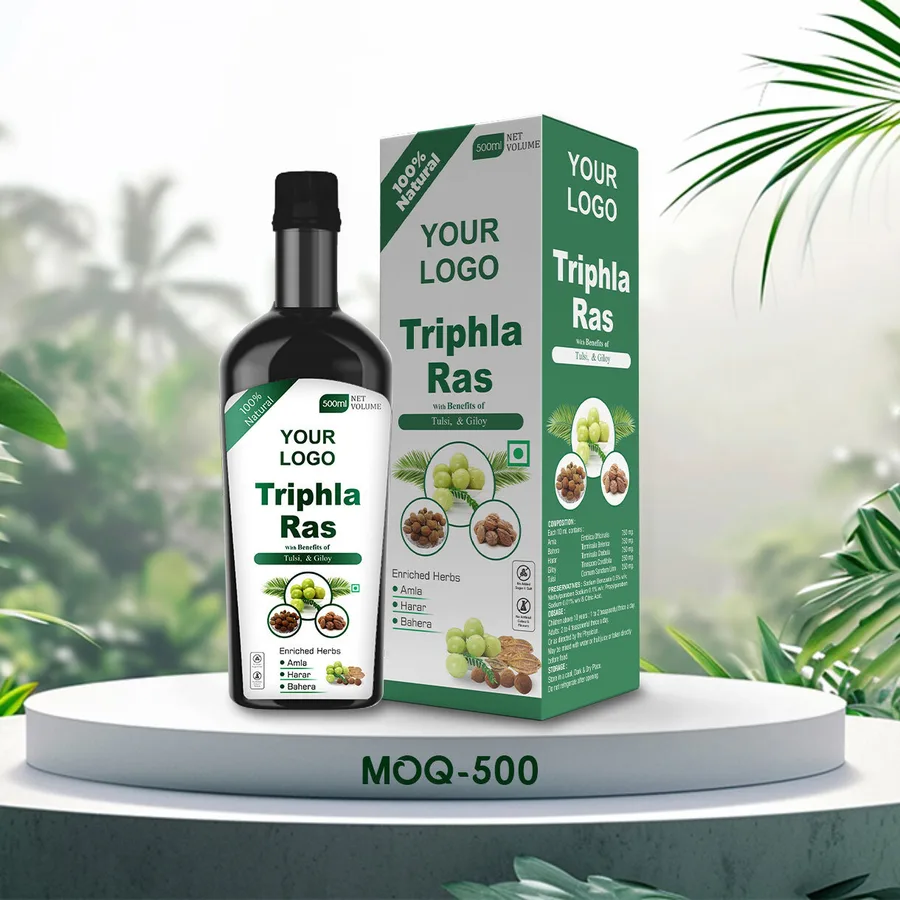
Composition detail: triphala juice and Optimo 360. Related: आँखों की रोशनी बढ़ाने के उपाय, lutein and zeaxanthin, the 10:2 standard, and licences for Ayurvedic manufacturing.
Get our product list and minimum orders
Leave your email and we will send the formats we make, the minimum order for each and typical lead times. We use it only to reply to you.
Manufacturing in this category?
We make products in this category for other people's brands. Tell us the format and volume and we will send a specification and a per-unit cost.
Request a quotation ↗NutraHerbal manufactures food supplements, Ayurvedic proprietary medicines and cosmetics for business customers. Product information on this site describes composition, format and commercial positioning for brand owners. It is not medical advice, does not claim to diagnose, treat, cure or prevent any disease, and is not a substitute for consulting a qualified practitioner. Final label claims are the brand owner's responsibility and must be approved for the destination market.
How we write and review content: editorial policy.