Reviewed for accuracy and claims compliance: Claims compliance review
If you are formulating a liver product for the Indian market, this comparison comes up early: milk thistle has international recognition and a research literature, bhumyamalaki has the classical Ayurvedic standing.
Here is the honest comparison of what each has behind it.
This is information, not medical advice. If you have a diagnosed liver condition, do not start any herbal supplement without telling your doctor.
The two herbs
Milk thistle, Silybum marianum. A Mediterranean plant, used in European herbal medicine for liver complaints. The active fraction is silymarin, a complex of flavonolignans, of which silybin is the most studied.
Bhumyamalaki, Phyllanthus niruri. Known as bhui amla, and the herb most consistently used in Ayurvedic hepatic formulations. Whole plant is used.
Evidence
Milk thistle has considerably more published research. It has been studied in alcoholic liver disease, viral hepatitis, non-alcoholic fatty liver disease and drug-induced liver injury, and has been the subject of several systematic reviews.
The honest summary of that literature: mixed. Some trials and reviews report improvements in liver enzyme measures; several report no significant clinical benefit. The Cochrane-type conclusion for alcoholic and hepatitis B/C liver disease has generally been that evidence of benefit is not convincing, while noting the trials are often of limited quality.
Silymarin does have a specific recognised use as part of treatment for Amanita mushroom poisoning, which is a genuine but very narrow indication and not what anyone is buying it for.
Bhumyamalaki has a smaller literature. Most research on the Phyllanthus genus has focused on hepatitis B, with mixed results, and much of it is of limited methodological quality. There is preclinical work suggesting hepatoprotective activity.
So: more research on milk thistle, and the additional research has not produced a clearly positive answer. Less research on bhumyamalaki, and correspondingly less certainty either way.
Neither is a demonstrated treatment for liver disease. Anyone presenting either as one is going beyond the evidence.
Standardisation
This matters commercially and it favours milk thistle.
Milk thistle is standardised to silymarin content, commonly 70–80%. That is a well-established specification, easy to verify, and easy to print.
Bhumyamalaki has no equivalent widely-used standardisation marker in commercial supply. Products are generally specified by extract ratio rather than by a measured constituent percentage, which makes quality harder to verify and harder to compare between suppliers.
For a brand owner, this is a real practical difference: you can put a checkable number on a milk thistle label in a way you usually cannot on bhumyamalaki.
Cost and sourcing
Milk thistle is imported into India, which adds cost and a supply-chain dependency.
Bhumyamalaki is grown domestically, inexpensive, and readily available. The caveat: several Phyllanthus species are used somewhat interchangeably in Indian commerce, so botanical identity testing matters more than people assume.
Market recognition in India
This cuts both ways and is worth thinking about.
Milk thistle is recognised by customers who read international supplement content, a younger, urban, research-oriented segment. It is not recognised by the traditional Ayurvedic customer at all.
Bhumyamalaki is recognised by practitioners and by customers who think in Ayurvedic terms. It has very little recognition with the international-content audience.
So they reach different people, which is the practical reason many Indian liver formulations include both.
Side by side
| Milk thistle | Bhumyamalaki | |
|---|---|---|
| Botanical | Silybum marianum | Phyllanthus niruri |
| Tradition | European herbal medicine | Ayurveda, the principal hepatic herb |
| Active marker | Silymarin, 70–80% | No widely used standardisation |
| Research volume | Considerably more | Less |
| Research conclusion | Mixed, not convincing for clinical benefit | Mixed, limited quality |
| Standardisation on label | Easy and checkable | Usually extract ratio only |
| Sourcing | Imported | Domestic, inexpensive |
| Adulteration risk | Low | Species substitution, test identity |
| Recognised by | International-content readers | Practitioners, traditional buyers |
So which should you use?
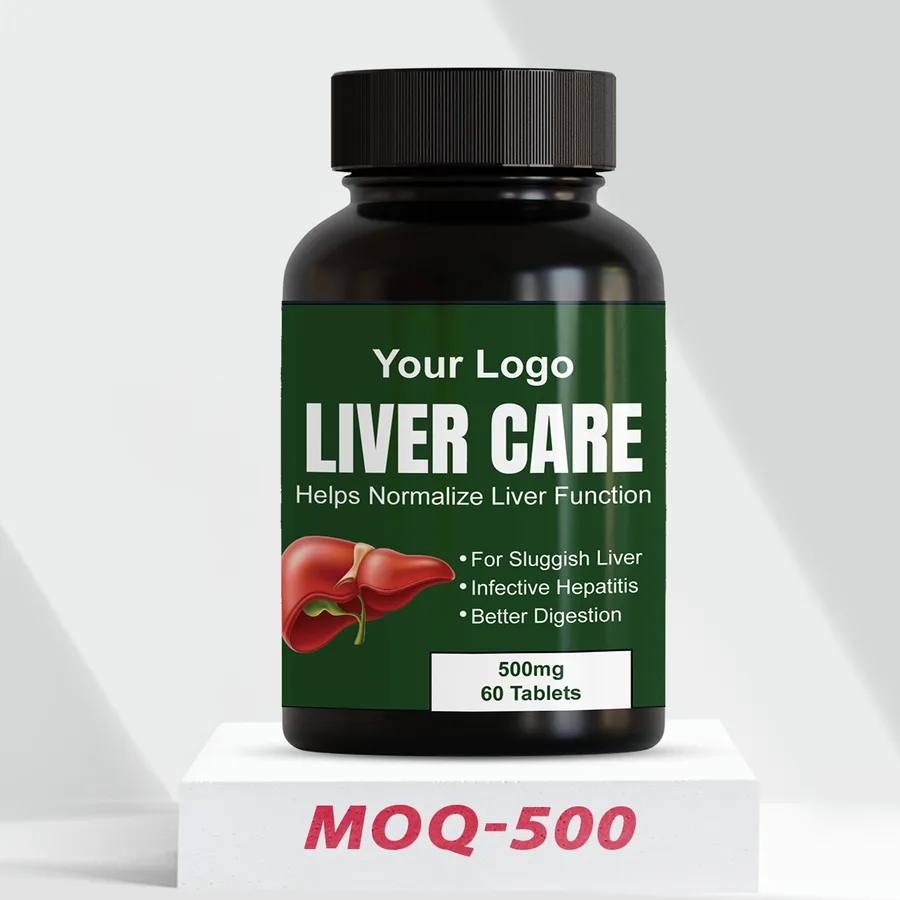
If you are formulating for India: bhumyamalaki as the base, with kutki, punarnava and kalmegh completing the classical picture. That is what our own liver tablet is built on, because the Indian liver-care customer is largely a traditional-framing customer and the classical herb names do real work on the label.
Adding milk thistle is reasonable if you want to reach the research-reading segment too, it broadens the audience and gives you a standardised number to print. It raises cost.
If you are formulating for export: milk thistle is far better recognised in Western markets, and the standardisation makes the regulatory and buyer conversation easier.
If you are buying: neither is a treatment. Choose on which framing you find credible, and check what else is in the formulation, in a multi-herb liver product, the dose of any single herb is usually modest.
What neither of them does
Being direct, because this is where the category overclaims.
Neither herb removes fat from a fatty liver. That responds to alcohol, sugar, weight and activity, nothing else has comparable evidence.
Neither repairs cirrhosis or reverses fibrosis.
Neither changes your LFT values in a way that can be claimed on a label.
Neither replaces treatment for hepatitis or any diagnosed liver condition.
In India these are all medicinal claims. We decline artwork that makes them.
The caution that matters most
If you have a liver problem, be careful about what you take for it.
Drug-induced liver injury from herbal and dietary supplements is documented in the literature, and the Indian supply chain has genuine adulteration and heavy-metal issues in some categories. Taking an unverified herbal product to support a compromised liver is a poor risk.
Practically: tell your doctor what you are taking, buy from a supplier who will show you batch testing, and prefer a defined course over indefinite use.
For brand owners
Three practical notes.
Botanical identity testing on bhumyamalaki is not optional. Species substitution within Phyllanthus is documented, and without a standardisation marker to fall back on, identity is what you have.
Milk thistle lets you print a number. In a category where most labels say “liver support” and nothing else, 80% silymarin is a differentiator.
Do not lead on detox claims. We have written separately on why the toxin framing does not survive contact with the biology, and why building copy on it sets up a product that cannot deliver.
The short version
Milk thistle has more research and that research has not produced a convincing answer; bhumyamalaki has less research and more classical standing in India. Milk thistle standardises cleanly to silymarin; bhumyamalaki usually does not, which makes identity testing important.
Use bhumyamalaki for the Indian market, milk thistle for export or for the research-reading segment, both if you want to reach everyone. And neither removes liver fat, that is diet, alcohol and movement.
Composition detail: Livaroo 360 and the bhumyamalaki ingredient page.
Get our product list and minimum orders
Leave your email and we will send the formats we make, the minimum order for each and typical lead times. We use it only to reply to you.
Manufacturing in this category?
We make products in this category for other people's brands. Tell us the format and volume and we will send a specification and a per-unit cost.
Request a quotation ↗NutraHerbal manufactures food supplements, Ayurvedic proprietary medicines and cosmetics for business customers. Product information on this site describes composition, format and commercial positioning for brand owners. It is not medical advice, does not claim to diagnose, treat, cure or prevent any disease, and is not a substitute for consulting a qualified practitioner. Final label claims are the brand owner's responsibility and must be approved for the destination market.
How we write and review content: editorial policy.