Reviewed for accuracy and claims compliance: Claims compliance review
Pick up almost any Indian liver supplement and the ingredient list will be drawn from the same six or seven herbs. That consistency is not marketing convergence, it reflects a genuine classical category.
Ayurveda has a developed framework for liver and bile-related conditions, grouped under terms including yakrit disorders and kamala, roughly corresponding to jaundice and related presentations. The herbs below are what that tradition settled on.
This article covers what each is, what the classical record says, and what modern research does and does not support. Written for formulators and for anyone trying to read a label in this category.
This is information, not medical advice. If you have a diagnosed liver condition, do not start any herbal product without telling your doctor. Herb-induced liver injury is documented, which makes this category one to approach carefully.
Bhumyamalaki, the principal one
Phyllanthus niruri, also called bhui amla. If an Indian liver formulation contains one herb, it is usually this.
Classical standing: the most consistently used herb in Ayurvedic hepatic formulations. Also known across several traditions as “stone breaker”, reflecting urinary use.
Modern research: most work on the Phyllanthus genus has focused on hepatitis B, with mixed results and trials generally of limited methodological quality. There is preclinical work suggesting hepatoprotective activity.
The honest position: the most-studied of the Ayurvedic liver herbs, and the evidence remains inconclusive rather than positive.
Formulation caution: there is no widely used standardisation marker for bhumyamalaki in commercial supply. Products are specified by extract ratio rather than by a measured constituent. Combined with the fact that several Phyllanthus species are used somewhat interchangeably in Indian commerce, this makes botanical identity testing essential rather than optional. Without a marker to fall back on, identity is all you have.
Kutki, the bitter one
Picrorhiza kurroa, also called katuki.
Classical standing: a major herb in hepatic and bile-related formulations, classified as bitter and cooling. Used in classical preparations including Arogyavardhini Vati.
Active constituents: picrosides, principally picroside I and II, and usefully, these give kutki something bhumyamalaki lacks: a standardisation marker you can measure and print.
Modern research: preclinical work on hepatoprotective activity, with some human study. The literature is smaller than milk thistle’s and the quality is variable.
The serious sourcing problem: Picrorhiza kurroa is a high-altitude Himalayan plant and is under genuine conservation pressure from over-harvesting. It is listed as threatened and is subject to trade regulation.
Two consequences for anyone formulating with it:
First, adulteration and substitution are common, Neopicrorhiza scrophulariiflora and other material is substituted. Testing for picrosides is how you know what you have.
Second, sourcing ethics are a real question. Cultivated material exists and should be preferred. A supplier who cannot tell you whether their kutki is cultivated or wild-collected is one worth asking harder questions of.
Kalmegh, the very bitter one
Andrographis paniculata, known as kalmegh, bhunimba, and “king of bitters”.
Classical standing: used in hepatic and febrile conditions.
Active constituent: andrographolide, another measurable marker.
Modern research: interestingly, the better human evidence for andrographis is not for the liver but for upper respiratory tract infection symptoms, where several trials and reviews have reported modest benefit. Liver-specific human evidence is thinner.
Cautions worth knowing:
- Reported immunostimulant activity, which is a theoretical concern for anyone on immunosuppressants or with autoimmune disease
- Avoid in pregnancy
- May affect blood pressure and blood sugar
- Allergic reactions have been reported
- The taste is genuinely extreme, which matters for formulation
Punarnava, the diuretic one
Boerhavia diffusa. The name translates roughly as “renewing”.
Classical standing: used in both hepatic and urinary formulations, and particularly associated with oedema and fluid retention.
Why it appears in liver products: the classical association with fluid retention maps onto a real clinical feature of advanced liver disease, ascites and oedema.
And this is exactly where a caution belongs. Ascites in liver disease is a serious sign requiring medical management. A herbal diuretic is not the treatment, and anyone with abdominal swelling needs a doctor rather than a supplement. We would not want punarnava’s classical association read as a reason to self-treat that.
Modern research: preclinical work on hepatoprotective and diuretic activity; limited human data.
Bhringraj, the dual-use one
Eclipta alba, better known in India for hair.
Classical standing: genuinely used in hepatic formulations as well as for hair, which surprises people who only know the hair oil.
Modern research: preclinical hepatoprotective work; little human data.
Daruharidra, haridra and amla
Daruharidra (Berberis aristata), contains berberine, which has a substantial and growing research literature, mostly on metabolic parameters including blood sugar and lipids rather than specifically on the liver. Given that fatty liver is largely a metabolic condition, that overlap is interesting, and berberine has genuine interactions with several medications worth checking.
Haridra (turmeric), curcumin has a large preclinical literature across many conditions, with the familiar bioavailability problem: curcumin is poorly absorbed without an enhancer such as piperine or a formulated delivery system. A label citing curcumin research while supplying plain turmeric powder is overstating what is in the bottle.
Amla, long classical use across formulations, high in vitamin C, and a reasonable general inclusion.
Triphala and psyllium also appear in this category, and it is worth being precise: these act on bowel regularity, not on the liver. The effect people notice is real and comes from the gut. Presenting it as liver detoxification is how a legitimate ingredient acquires an illegitimate claim.
Side by side
| Herb | Botanical | Marker | Research volume | Main caution |
|---|---|---|---|---|
| Bhumyamalaki | Phyllanthus niruri | None standard | Most, still inconclusive | Species substitution |
| Kutki | Picrorhiza kurroa | Picrosides | Moderate, preclinical | Conservation; adulteration |
| Kalmegh | Andrographis paniculata | Andrographolide | Better for respiratory | Immunostimulant; not in pregnancy |
| Punarnava | Boerhavia diffusa | None standard | Limited | Diuretic, ascites needs a doctor |
| Bhringraj | Eclipta alba | None standard | Preclinical | , |
| Daruharidra | Berberis aristata | Berberine | Growing, metabolic | Drug interactions |
How to read a liver product’s label
Practical guidance, whether you are buying or specifying:
1. Is bhumyamalaki present, and at what quantity? It is the classical base. Its absence from a liver product aimed at the Indian market is a formulation question.
2. Are quantities declared per serving? Not a “proprietary blend”. In India, quantities must be declared.
3. Are markers specified where they exist? Picrosides for kutki, andrographolide for kalmegh. A label that just says “Kutki extract 100 mg” tells you less than one saying “standardised to 4% picrosides”.
4. Is the curcumin claim honest? If it cites curcumin’s properties, check whether there is an absorption enhancer or formulated delivery. Plain turmeric powder is not the same material the research used.
5. Is there a heavy metal test report, batch-wise? Non-negotiable for herbal products, and particularly for anything with mineral ingredients.
6. Is identity testing done on the botanicals? Especially bhumyamalaki and kutki, where substitution is documented.
7. Does it make medicinal claims? “Reduces SGPT”, “cures fatty liver”, “detoxifies the liver”, “repairs liver damage”, all medicinal claims, all unsupportable, and in India all a regulatory problem.
8. Is it positioned as a replacement for treatment? Walk away.
What this category genuinely cannot do
Stated plainly, because this is where the overclaiming lives.
No herb here removes fat from a fatty liver. That responds to alcohol, sugar, weight and activity, and nothing else has comparable evidence.
None reverses cirrhosis or fibrosis.
None treats hepatitis B or C. Those have actual antiviral treatment, and hepatitis C is now curable in most cases with a defined course. Substituting a supplement for that is a serious error.
None reliably changes LFT values in a way that can be claimed.
And the caution that matters most: if you have a liver problem, be careful what you take for it. Drug-induced liver injury from herbal and dietary supplements is documented in the medical literature, and parts of the Indian supply chain have genuine adulteration and heavy-metal problems. Taking an unverified herbal product to support a compromised liver is a poor risk with the very organ you are worried about.
Practically: tell your doctor what you are taking, buy from a supplier who will show you batch testing, and prefer a defined course to indefinite use.
For formulators
Our own approach: bhumyamalaki as the base, with kutki, punarnava and kalmegh completing the classical picture, amla as a general inclusion. That is what the Indian liver-care customer recognises, and the classical herb names do real work on a label in a way imported ingredients do not.
Three practical notes:
Identity testing on bhumyamalaki is not optional. No marker means identity is your only control.
Ask about kutki sourcing. Cultivated over wild-collected, both for conservation and for consistency.
Print the markers you have. In a category where most labels say “liver support” and nothing else, a measured picroside or andrographolide percentage is a genuine differentiator and costs you only the testing.
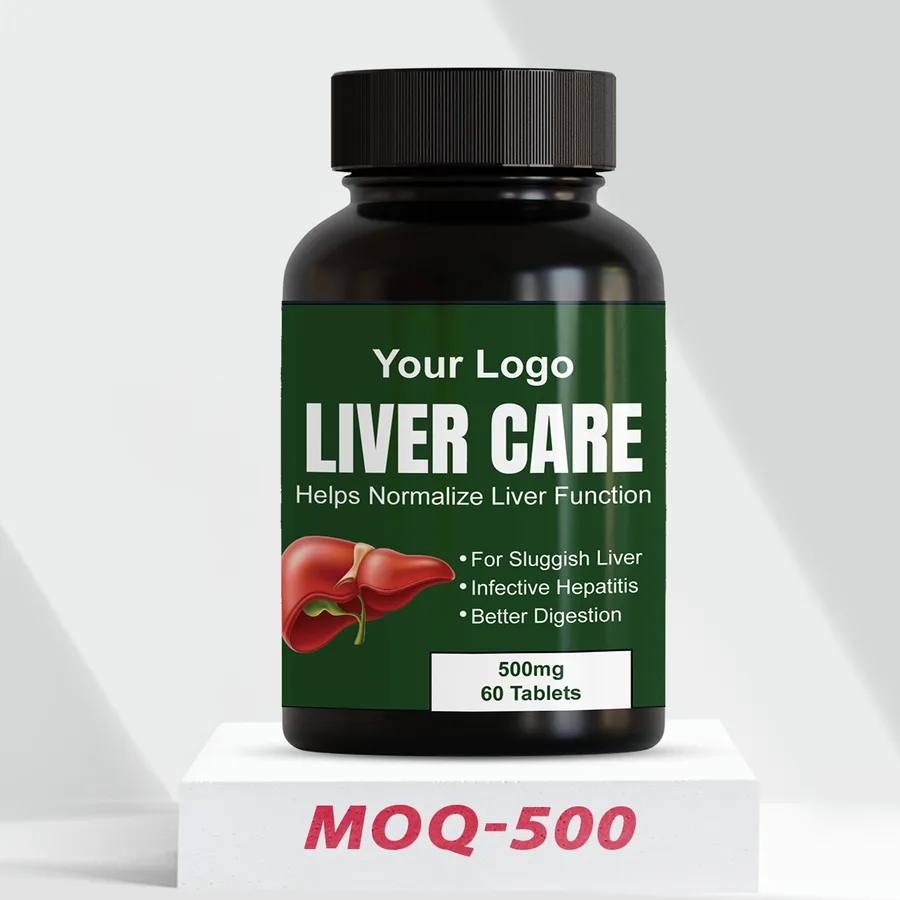
And on claims: we decline artwork claiming to detoxify the liver, reduce liver enzymes, treat fatty liver, or repair damage. We accept traditional use in Ayurvedic hepatic formulations and general liver wellness support. We also ask for a line directing anyone with a diagnosed liver condition to their doctor, which, in a category whose customers often already have a liver diagnosis, is the most useful thing the label can carry.
The short version
Bhumyamalaki is the classical base and the most-studied, with inconclusive evidence and no standardisation marker, so identity testing matters.
Kutki gives you a measurable marker (picrosides) and carries real conservation and adulteration concerns, ask whether it is cultivated.
Kalmegh’s better human evidence is actually for respiratory symptoms, not the liver, and it is immunostimulant and inappropriate in pregnancy.
Punarnava is classically associated with fluid retention, and ascites in liver disease needs a doctor, not a herbal diuretic.
Triphala and psyllium work on your bowel, not your liver.
And none of them removes liver fat, reverses cirrhosis, or treats viral hepatitis. Diet, alcohol and movement do the first; medicine does the rest.
Composition detail: Livaroo 360 and the bhumyamalaki ingredient page. Related: milk thistle vs bhumyamalaki and what “liver detox” actually means.
Get our product list and minimum orders
Leave your email and we will send the formats we make, the minimum order for each and typical lead times. We use it only to reply to you.
Manufacturing in this category?
We make products in this category for other people's brands. Tell us the format and volume and we will send a specification and a per-unit cost.
Request a quotation ↗NutraHerbal manufactures food supplements, Ayurvedic proprietary medicines and cosmetics for business customers. Product information on this site describes composition, format and commercial positioning for brand owners. It is not medical advice, does not claim to diagnose, treat, cure or prevent any disease, and is not a substitute for consulting a qualified practitioner. Final label claims are the brand owner's responsibility and must be approved for the destination market.
How we write and review content: editorial policy.