Reviewed for accuracy and claims compliance: Claims compliance review
Uric acid appears on almost every routine health package sold in India, which means a great many people discover a slightly raised number without having any symptoms at all. What usually follows is a diet sheet, a panic about dal, and sometimes a supplement.
Most of that response is misdirected. Here is what the number actually tells you.
This is information, not medical advice. A hot, swollen, intensely painful joint needs medical assessment, gout and a joint infection can look similar, and one of them is an emergency.
What uric acid is
Uric acid is the end product of purine metabolism. Purines come from two places: the food you eat, and, more significantly, the normal turnover of your own cells.
That second source is the part people miss. Roughly two-thirds of your body’s uric acid is produced internally, from your own cell breakdown, not from your dinner. Only about a third relates to diet.
This single fact reframes the whole topic, and it explains why diet alone rarely normalises a high number.
And the other half of the equation is excretion. About 70% of uric acid is cleared by the kidneys. So a raised level can arise from producing more, or from clearing less, and under-excretion is the more common mechanism in most people with persistently high levels.
Which is why kidney function matters more here than most diet sheets suggest.
What counts as high
Laboratory reference ranges vary, and your report will state its own. Broadly, levels above roughly 7 mg/dL in men and 6 mg/dL in women are usually flagged, with the clinically meaningful threshold for crystal formation generally cited around 6.8 mg/dL, the point at which uric acid starts to exceed its solubility in body fluids.
Men typically run higher than women before menopause, because oestrogen promotes uric acid excretion. Levels in women rise after menopause, which is why gout in women is largely a post-menopausal condition.
The most important thing to understand
A raised uric acid level without symptoms is called asymptomatic hyperuricaemia, and most people who have it never develop gout.
This is well established and it is the opposite of how the finding is usually treated. The majority of people with a raised number will never have a gout attack.
And current guidelines from major rheumatology bodies generally do not recommend drug treatment for asymptomatic hyperuricaemia, meaning a raised number alone, with no attacks, no kidney stones and no other complication, is usually monitored rather than medicated.
What that means practically: if your number is 7.4 and you have never had a swollen joint, you have a risk marker, not a disease. That is worth attention, and it is not worth the panic the internet will supply.
What a high level does predict
Being fair to the number, because it is not meaningless.
Gout risk. Higher levels mean higher risk, and the relationship is strong. Above roughly 9 mg/dL the risk becomes substantial.
Kidney stones. Uric acid stones, and raised uric acid is also associated with calcium stones.
And a cluster of associations that matter more than the gout: raised uric acid travels with hypertension, insulin resistance, type 2 diabetes, obesity, fatty liver and metabolic syndrome.
This is the genuinely useful insight here. For most people, a raised uric acid number is best read not as “I must stop eating dal” but as “my metabolic health needs attention.” It frequently appears alongside a rising waistline, a creeping fasting sugar and a blood pressure that has started to drift.
Whether uric acid causes those conditions or simply accompanies them is still debated, the association is clear, the causation less so. But as a prompt to check the rest of the metabolic picture, it is valuable.
So the sensible response to a raised number is to also check: blood pressure, fasting glucose and HbA1c, lipid profile, kidney function (creatinine and eGFR), and liver enzymes with an ultrasound if fatty liver is suspected.
That panel will usually tell you something more actionable than the uric acid reading itself.
Why the number changes between tests
Worth knowing, because people chase small movements.
Uric acid fluctuates. It is affected by hydration, recent alcohol, recent heavy exertion, fasting, weight change, infection, and several medications. A single reading is a snapshot, not a verdict, and small differences between two tests often mean nothing.
One counterintuitive point: during an acute gout attack, the uric acid level can be normal or even low, because the uric acid has precipitated into the joint. So a normal level during an attack does not exclude gout, and this trips people up regularly.
What raises it
The big ones, which are not dietary:
- Kidney function decline, the dominant factor in many people
- Diuretics, particularly thiazides, a very common cause of raised uric acid in people on blood pressure treatment
- Low-dose aspirin
- Some immunosuppressants, notably cyclosporine
- Obesity, and especially abdominal obesity
- Insulin resistance
- Dehydration
- Genetics, substantially, through variation in the kidney’s urate transporters
- Hypothyroidism
- Psoriasis and other conditions with high cell turnover
- Rapid weight loss, crash dieting and prolonged fasting, these raise uric acid, which surprises people who are dieting to fix it
- Strenuous exercise, acutely
The dietary ones, in rough order of actual impact:
- Beer, the most strongly implicated single item. It contributes both alcohol and purines
- Spirits
- Fructose, particularly from sugary drinks and high-fructose corn syrup. This one deserves more attention than it gets, fructose metabolism directly generates uric acid, and sugary drinks have a clearer association with gout than most of the foods on the usual avoid list
- Organ meats, liver, kidney, brain. Genuinely high purine
- Red meat
- Certain seafood, anchovies, sardines, mussels, scallops, shrimp
And the items wrongly feared, which we have written about separately: dal, paneer, tomato, and most vegetables. The Hindi piece in this series covers that in detail, because it is the single most common misconception on this topic in India.
What lowers it
Weight loss, gradual. The most effective intervention for most people, but gradual matters, since rapid loss raises it temporarily.
Reducing beer and spirits.
Cutting sugary drinks and fructose. Underrated.
Water. Adequate hydration supports excretion and reduces stone risk.
Low-fat dairy. Interesting, because it runs against the usual Indian advice, milk and curd are associated with lower uric acid and lower gout risk in several studies. Dairy proteins appear to promote uric acid excretion.
Vitamin C, modestly.
Coffee, associated with lower levels in observational studies.
Cherries, which have a small but reasonably consistent literature in gout.
And a point for people on blood pressure medication: if you are on a thiazide diuretic and your uric acid is raised, ask your doctor whether an alternative is appropriate. Losartan, for example, lowers uric acid rather than raising it. This is a conversation worth having, and it often achieves more than any diet change.
When it needs treating
Treatment is generally for:
- Recurrent gout attacks
- Tophi, visible urate deposits under the skin
- Gout with joint damage on imaging
- Uric acid kidney stones
- Certain high-risk situations, such as before some cancer treatments
The drug most used is allopurinol, which reduces production, with febuxostat as an alternative. These are long-term treatments, started at a low dose and titrated to a target level, typically below 6 mg/dL, and lower where tophi are present.
Two things people get wrong about this:
First, urate-lowering treatment is not started or stopped around attacks casually. Starting it during an acute attack can prolong the attack, and stopping it because you feel fine is how attacks return. It is taken continuously, like blood pressure medication.
Second, acute attacks and long-term control are treated differently. The attack is treated with anti-inflammatory medication; the level is controlled separately and continuously. Confusing the two leads people to take a painkiller and consider the problem solved.
One important safety note: allopurinol can rarely cause a severe hypersensitivity reaction, and the risk is linked to a genetic marker that is more common in some Asian populations. Any rash after starting it should be reported to your doctor immediately.
When to see a doctor
Urgently:
- A hot, red, severely painful, swollen joint, especially with fever. Septic arthritis can look exactly like gout and is a surgical emergency. This distinction is made by aspirating the joint, not by guessing
- Severe flank pain with blood in urine
- A joint so painful that even a bedsheet touching it is unbearable, this is classic of gout and still needs confirming
Soon:
- A first episode of joint swelling, so that it can be properly diagnosed
- Recurrent attacks
- Raised uric acid with high blood pressure, raised sugar or fatty liver, the metabolic cluster
- Visible lumps around joints, fingers or the ear
- Reduced kidney function
- Raised uric acid while on a diuretic
- Kidney stones
The diagnosis of gout is ideally made by finding urate crystals in joint fluid, not by a blood test alone. A raised level plus a painful joint is suggestive; it is not proof, and other conditions, pseudogout, infection, reactive arthritis, present similarly.
What a product can and cannot claim
We manufacture in this category, so the boundary is worth stating plainly.
What is sayable: traditional use of gokshura, punarnava and varun in Ayurvedic urinary and joint formulations; support for healthy fluid intake; general joint and urinary wellness.
What is not: lowers uric acid, treats or prevents gout, dissolves crystals, or replaces prescribed medication. These are medicinal claims, and we decline artwork that makes them.
And the honest position: the interventions with real evidence here, gradual weight loss, less beer, fewer sugary drinks, adequate water, and reviewing a diuretic with your doctor, involve no product at all. Where someone has recurrent gout, allopurinol works and a supplement does not, and a brand implying otherwise is selling someone a route to joint damage.
Gout is one of the few forms of arthritis that is genuinely well controlled by available treatment. Letting it go untreated because a herbal product seemed gentler is a poor trade.
The short version
- Two-thirds of your uric acid comes from your own cell turnover, not from food. Diet alone rarely normalises a high number.
- Under-excretion by the kidneys is the more common mechanism than overproduction.
- Most people with a raised level never get gout, and guidelines generally do not recommend drug treatment for a raised number alone.
- Read it as a metabolic signal. Check blood pressure, sugar, lipids, kidney and liver, that panel is usually more useful.
- A normal level during an acute attack does not exclude gout.
- Sugary drinks and beer matter more than dal. Low-fat dairy is associated with lower levels.
- Crash dieting raises it. Lose weight gradually.
- On a thiazide diuretic? Ask about alternatives, this often achieves more than any diet change.
- A hot, swollen, painful joint with fever needs same-day assessment, infection can look identical to gout.
- Recurrent gout is treated with allopurinol to a target level, taken continuously. No supplement substitutes for it.
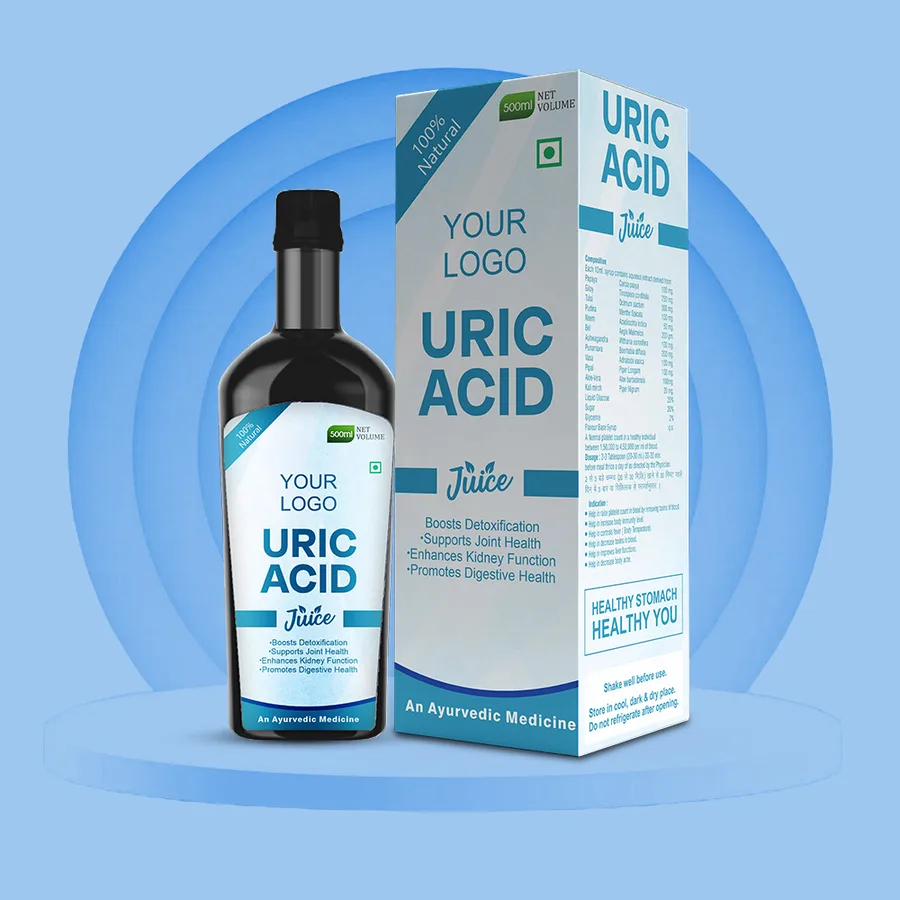
Product detail: uric acid juice and Arthravo 360. Hindi pieces: यूरिक एसिड बढ़ने के लक्षण and दाल, पनीर और यूरिक एसिड, सच क्या है.
Get our product list and minimum orders
Leave your email and we will send the formats we make, the minimum order for each and typical lead times. We use it only to reply to you.
Manufacturing in this category?
We make products in this category for other people's brands. Tell us the format and volume and we will send a specification and a per-unit cost.
Request a quotation ↗NutraHerbal manufactures food supplements, Ayurvedic proprietary medicines and cosmetics for business customers. Product information on this site describes composition, format and commercial positioning for brand owners. It is not medical advice, does not claim to diagnose, treat, cure or prevent any disease, and is not a substitute for consulting a qualified practitioner. Final label claims are the brand owner's responsibility and must be approved for the destination market.
How we write and review content: editorial policy.