Reviewed for accuracy and claims compliance: Claims compliance review
We have written separately about why summer is stone season in north India. This article is the arithmetic, written for the people it affects most, who are the people who sweat at work.
Because stone formation is, more than anything else, a concentration problem. And concentration is a volume problem. And volume is something you can count.
This is information, not medical advice. Severe one-sided loin pain, fever with loin pain, or inability to pass urine needs emergency care.
The mechanism, in one paragraph
Urine carries dissolved salts, mainly calcium, oxalate, phosphate and uric acid. At a given concentration, those salts stay dissolved. Above it, they crystallise.
Sweating removes water without removing those salts. The kidney, conserving water, produces less urine, so the same amount of salt is dissolved in less water. Concentration rises, supersaturation is reached, crystals form, and crystals aggregate into stones.
Two other summer factors push the same way: more concentrated urine tends to be more acidic, which favours uric acid stones; and more vitamin D synthesis in summer raises calcium absorption somewhat, which raises urinary calcium.
But the dominant variable is volume.
The arithmetic
This is the part worth working out for yourself.
The target that stone guidelines use is a urine output of about 2 to 2.5 litres a day. That is urine out, not fluid in, and the difference is the whole point.
Because what you drink does not all become urine. Some is lost in sweat, some in breath, some in stool.
In a temperate day with little sweating, the gap between intake and urine output is modest. On a hot day doing physical work, the gap is large.
Sweat rates during heavy work in heat can reach something like a litre or more per hour, and sustained over a working day, the total loss is substantial.
So the arithmetic is simply: fluid in must cover sweat loss plus the urine target.
Which means an outdoor worker in May needs considerably more fluid than the same person in December to produce the same urine volume, and if intake does not change with the season, urine volume falls and concentration rises.
That is why the stone season is the hot season, and why the people who form stones are disproportionately the people who work in heat.
How to check it without a lab
Two practical methods.
1. Urine colour. Pale, almost clear, through the day. Dark yellow means concentrated. This is crude and it is useful, and it is free.
(And note: B-vitamin supplements turn urine bright yellow, which is not concentration. Beetroot and some medicines change colour too.)
2. Measure it once. Collect your urine for 24 hours into a measuring jug, on a normal working day. If it is well under two litres, you have your answer.
Most people have never done this, and for a recurrent stone former it is a more useful number than any amount of general advice.
Who is at highest risk
This list is the point of the article.
Outdoor and hot-environment workers: construction labour, farmers, road and railway workers, rickshaw and delivery riders, traffic police, security guards, street vendors, and, often forgotten, anyone working beside heat indoors: cooks and kitchen staff, bakers, foundry, glass and brick-kiln workers, laundry and boiler workers.
Kitchen and furnace workers are a genuinely high-risk group and nobody counts them, because there is no sun involved.
Drivers and anyone who avoids drinking because toilets are not available. This is a real, practical, and under-discussed cause, long-distance drivers, bus conductors, women in workplaces without clean toilets. The behaviour is rational and the consequence is stones and urinary infection.
People who have had a stone before, recurrence is common, and that is the single strongest predictor.
Endurance athletes.
And medical risk factors: a family history; gout or high uric acid; inflammatory bowel disease, coeliac disease or bariatric surgery (fat malabsorption raises oxalate absorption); primary hyperparathyroidism; renal tubular acidosis; recurrent urinary infections; a single kidney; and medicines, topiramate, acetazolamide, some diuretics, and high-dose vitamin C or calcium supplements taken away from food.
What to do, in order of effect
1. Fluid, adjusted to the season and the work
This is the intervention with the best evidence in stone prevention, and it is also the simplest.
Drink to colour, through the day, not a large volume in the evening to make up for a dry shift, which does not achieve the same thing.
And a specific: drink before bed and if you wake at night. Overnight urine is the most concentrated of the day, which is when crystals have the best chance.
And where sweating is heavy for hours, plain water alone is not enough, you need salt as well, or blood sodium can fall. Chaas, nimbu paani with salt, ORS where there is real loss.
2. Citrate, and this is the under-used one
Citrate binds calcium in urine and inhibits crystal formation. It is one of the body’s own defences against stones, and low urinary citrate is a recognised risk factor.
Where to get it: lemon, lime, orange, sweet lime (mosambi). Nimbu paani is genuinely useful here, and the mechanism is specific rather than vague.
And prescribed potassium citrate exists for recurrent formers, ask, because it is effective and frequently not offered.
And a caution: citrate helps calcium and uric acid stones. In the specific case of struvite (infection) stones the situation differs, which is one reason stone type matters.
3. Salt, down
High sodium intake increases urinary calcium excretion. This is a direct, well-established effect, and it is one of the two dietary changes with the clearest benefit.
And in India the salt is mostly in pickles, papad, namkeen, packaged snacks, and restaurant food.
And the tension worth naming honestly: if you sweat heavily at work, you need some salt. The resolution is to take salt with fluid during heavy sweating and to keep habitual dietary salt modest otherwise, not to add salt indiscriminately all day.
4. Calcium, in food, not avoided
This is the most common and most harmful mistake in stone advice.
Restricting dietary calcium increases stone risk. Because calcium in the gut binds oxalate from food and carries it out in stool. Remove the calcium and more oxalate is absorbed and ends up in urine.
So: normal dietary calcium, taken with meals. Milk, curd, paneer, til, ragi, greens.
And: calcium supplements taken away from food can raise risk, if you take one, take it with a meal.
5. Animal protein, moderate
High animal protein raises uric acid and urinary calcium and lowers citrate. Moderate it; this matters more for uric acid stones.
6. Oxalate, targeted, not blanket
Only relevant for calcium oxalate stones, and only worth restricting the highest sources, spinach, beetroot, nuts, chocolate, tea in quantity, rhubarb.
And the key practical point: eat oxalate-containing foods with a calcium source. Palak with curd or paneer is better than palak alone, because the calcium binds the oxalate in the gut.
Blanket oxalate avoidance is usually unnecessary and makes diets worse.
7. Weight, and sugary drinks
Obesity and sugar-sweetened beverages are both associated with increased risk. And fructose specifically raises uric acid.
The test almost nobody is offered
For anyone who has had more than one stone, this is the thing to ask for.
| Test | Why |
|---|---|
| Stone analysis | If you pass or have a stone removed, have it analysed. The type determines the prevention entirely, calcium oxalate, uric acid, struvite, cystine. This is the single most useful test and it is routinely skipped |
| 24-hour urine | Volume, calcium, oxalate, citrate, uric acid, sodium, creatinine. This tells you what your actual problem is rather than guessing |
| Serum calcium, PTH | Primary hyperparathyroidism is a curable cause of recurrent stones and is missed for years |
| Serum uric acid | |
| Kidney function and electrolytes | |
| Urine pH and culture | Acidity, and infection stones |
| Ultrasound or CT | Imaging |
And the point of all that: prevention for a uric acid stone is different from prevention for a calcium oxalate stone, which is different again from an infection stone. General stone advice is a compromise that fits nobody exactly.
What a supplement cannot do
We make a product in this category, so this needs saying plainly.
No oral product dissolves a calcium oxalate stone. It is the commonest stone type, and it is not dissolvable by anything you can drink.
Uric acid stones are the exception, they can be dissolved by alkalinising the urine, and that is done with prescribed medication under monitoring, not with a herbal syrup.
And stones above a certain size do not pass on their own, whatever you drink. They are removed, by shock wave lithotripsy, ureteroscopy, or keyhole surgery, and these are routine, effective procedures.
What delay costs: an obstructing stone can damage the kidney, and an obstructed, infected kidney is a surgical emergency with a real mortality. Months of a “stone-dissolving” syrup while a stone obstructs is the actual harm in this category.
What the traditional ingredients honestly are: pashanbhed, varun, gokshura and punarnava have long traditional use in this area, the name pashanbhed literally refers to breaking stone, and the modern human evidence is small and preliminary. Several have diuretic effects, which plausibly supports flushing small fragments and passing gravel.
That is a reasonable thing to sell as traditional support alongside fluid intake. It is not a stone dissolver, and we will not label it as one.
Claims, our boundary
What is sayable: sodium, potassium and chloride contribute to normal electrolyte and water balance; magnesium contributes to normal muscle function and electrolyte balance; vitamin C contributes to the protection of cells from oxidative stress, and note the irony that high-dose vitamin C raises urinary oxalate, so we keep it modest in this formulation deliberately; and traditional-use statements for pashanbhed, varun, gokshura and punarnava.
What is not sayable: dissolves stones, removes stones, treats kidney stones, prevents stones, or treats urinary infection. These are medicinal claims and we decline that artwork, and in this category it is the most common claim made.
And what we require on the pack: a statement that stones need medical assessment and that severe pain or fever requires urgent care. And a caution for kidney disease, because potassium-containing and diuretic preparations are not neutral there.
The honest ranking
1. Fluid, adjusted for sweat and season, drunk through the day and before bed. 2. Citrate, lemon and lime, and prescribed potassium citrate where indicated. 3. Less salt; normal dietary calcium with meals; moderate animal protein. 4. Get the stone analysed and get a 24-hour urine, if you have had more than one. 5. And then, if you want, a traditional preparation alongside, as support for fluid intake, not as treatment.
Our product is fifth. The first one is free and does most of the work.
When to see a doctor
Emergency:
- Severe one-sided loin or flank pain, often radiating to the groin, with nausea and vomiting
- Fever or chills with loin pain, an obstructed infected kidney is an emergency
- Unable to pass urine at all
- Visible blood in the urine with pain
- Only one kidney, and stone symptoms
- Pregnancy with stone symptoms
- Dark brown urine after heavy exertion in heat, possible muscle breakdown, and a kidney risk
Soon:
- Any stone passed or removed, ask for it to be analysed
- More than one stone ever, ask for a 24-hour urine and serum calcium with PTH
- Recurrent urinary infections
- Gout or raised uric acid
- Inflammatory bowel disease, coeliac disease, or bariatric surgery
- On topiramate, acetazolamide or a diuretic
- Taking high-dose vitamin C or calcium supplements
- If you avoid drinking at work because of toilet access, this is worth raising, and it is a workplace issue as much as a medical one
The short version
- Stones are a concentration problem; concentration is a volume problem; volume you can count.
- Sweat removes water, not the salts, so the same salt dissolves in less urine.
- Concentrated urine is also more acidic, which favours uric acid stones.
- The target is 2–2.5 litres of urine out, not fluid in.
- Heavy work in heat can lose a litre or more of sweat an hour, intake must cover that plus the target.
- If intake does not change with the season, urine volume falls. That is the whole seasonal effect.
- Check with urine colour, and measure 24 hours once on a working day.
- B-vitamins turn urine bright yellow, not concentration.
- Kitchen, bakery, foundry and kiln workers are high-risk and never counted, no sun involved.
- Avoiding drinking because of toilet access is a real cause. It is a workplace issue.
- A previous stone is the strongest predictor of the next.
- Drink through the day, and before bed, overnight urine is the most concentrated.
- Heavy sweating needs salt with the fluid, or sodium can fall.
- Citrate inhibits crystal formation, lemon and lime, and prescribed potassium citrate exists.
- Less salt lowers urinary calcium, and in India salt is in pickles, papad and namkeen.
- Do not restrict dietary calcium. It binds oxalate in the gut; restricting it raises risk.
- Take any calcium supplement with food.
- Eat oxalate foods with calcium, palak with curd, not palak alone.
- Blanket oxalate avoidance is usually unnecessary.
- Have the stone analysed. The type determines everything, and this is routinely skipped.
- Ask for a 24-hour urine, and serum calcium with PTH, hyperparathyroidism is curable and missed.
- No oral product dissolves a calcium oxalate stone.
- Uric acid stones can be dissolved, by prescribed alkalinisation, not a syrup.
- An obstructed infected kidney is a surgical emergency. Delay is the real harm here.
- High-dose vitamin C raises urinary oxalate, which is why we keep it modest in this formulation.
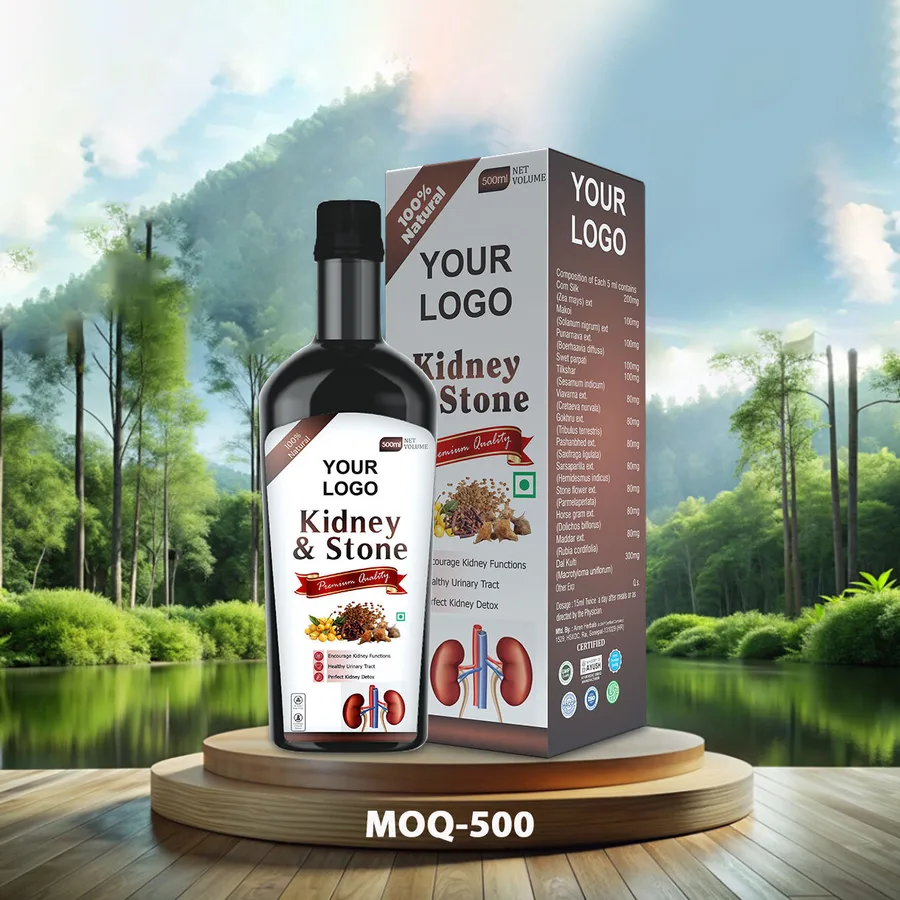
Composition detail: kidney stone juice. Related: why summer is stone season in north India, how much water is actually enough, and what no supplement can do about an existing stone.
Get our product list and minimum orders
Leave your email and we will send the formats we make, the minimum order for each and typical lead times. We use it only to reply to you.
Manufacturing in this category?
We make products in this category for other people's brands. Tell us the format and volume and we will send a specification and a per-unit cost.
Request a quotation ↗NutraHerbal manufactures food supplements, Ayurvedic proprietary medicines and cosmetics for business customers. Product information on this site describes composition, format and commercial positioning for brand owners. It is not medical advice, does not claim to diagnose, treat, cure or prevent any disease, and is not a substitute for consulting a qualified practitioner. Final label claims are the brand owner's responsibility and must be approved for the destination market.
How we write and review content: editorial policy.